
How to Buy Pumps from China Safely
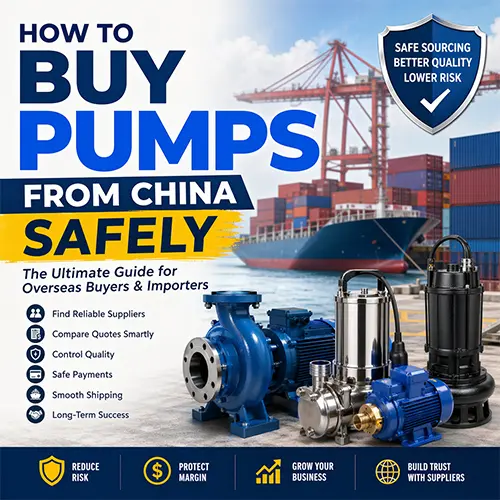
Buying pumps from China can be a very good business decision, but it is only safe when the buyer controls the process instead of reacting to supplier promises. Many overseas buyers do not lose money because China is “risky” in itself. They lose money because they move too fast, compare only price, approve unclear specifications, or place an order before they truly understand what they are buying.
That is why this article is not written as a general overview. It is written as a practical buyer guide. The goal is to help an overseas importer, distributor, contractor, project buyer, or private-label brand understand what to do first, what to confirm before payment, how to compare suppliers, how to place a safer first order, and how to reduce the most common risks before the shipment leaves China.
You do not need to be a pump engineer to buy pumps safely. But you do need a clear process. If you follow that process, you can reduce mistakes, protect margin, and build a supplier relationship that actually supports long-term business instead of creating one stressful order after another.
Why Many Overseas Buyers Choose China for Pump Sourcing
China attracts pump buyers because it combines broad manufacturing capacity, competitive cost, flexible OEM options, and a large supply chain base. The opportunity is real, but the value only becomes real when the supplier and the order are controlled properly.
For many overseas buyers, China is not attractive only because prices are lower. In many categories, China is attractive because the buyer can find multiple pump types, multiple quality levels, and multiple business models in one sourcing market. A buyer can source standard clean-water pumps, sewage pumps, multistage pumps, agricultural pumps, booster pumps, diesel-driven systems, and private-label products from the same country. That scale gives the buyer more commercial flexibility than many smaller manufacturing markets can offer.
China also often supports a full supply-chain environment around the pump itself. That includes motors, castings, seals, copper winding, packaging suppliers, control panels, export cartons, and freight networks. This matters because a pump order is not only a metal product. It is a combination of product, components, documentation, packaging, branding, and logistics. When a supply chain is mature, pricing can be more competitive and response time can be better.
Another reason overseas buyers choose China is OEM capability.
| Common Buyer Goal | Why China Is Considered |
| Lower sourcing cost | Large manufacturing base |
| More pump choices | Wide product categories |
| Private label brand | OEM support common |
| Faster scaling | Strong supply chain |
| Multiple supplier comparison | Competitive market |
OEM means Original Equipment Manufacturing, which in practical buyer language means the factory makes the product, but the product is sold under the buyer’s brand. This is important for distributors and importers who want higher resale margins, more brand control, and stronger customer loyalty. A buyer who only resells factory-branded pumps competes differently from a buyer who is building a branded product line under its own company name.
However, none of these advantages automatically protect the buyer. China offers opportunity, not automatic safety. The buyer still needs to choose the right supplier, confirm the right specifications, use the right payment structure, and inspect at the right stage. The advantage is there, but it must be managed.
The Real Risks Buyers Face When Buying Pumps from China
Most pump-buying problems are predictable. They usually come from wrong supplier choice, unclear specifications, unrealistic expectations, or weak payment and inspection control.
The first risk is choosing the wrong supplier. Some suppliers are genuine factories with stable production systems. Some are competent trading companies. Some are weak middlemen who sell aggressively but do not truly control production, delivery, or quality. If the buyer does not know which type of supplier they are dealing with, accountability becomes weak very quickly when anything goes wrong.
The second risk is buying the wrong pump, even when the pump itself is not defective. This happens when the buyer does not clearly explain the application. A pump may run normally in the factory test, but still fail commercially if it does not fit the buyer’s local market. The wrong voltage, wrong frequency, wrong head, wrong flow, or wrong material can make a shipment difficult or impossible to sell.
| Common Buying Risk | Real Result |
| Wrong supplier | Delay / weak support |
| Wrong specs | Unsellable goods |
| Wrong voltage | Customer complaints |
| Weak packaging | Damage in transit |
| No spare parts | After-sales problems |
| Lowest-price mindset | Hidden cost later |
Head means the pump’s ability to push water to a certain height or pressure. Flow means how much liquid the pump moves over a certain period of time. These are two of the most important technical values, and if they are wrong, the buyer may still receive a “working” product that is commercially useless.
The third risk is scope mismatch. A supplier’s quotation may look cheaper because it does not include the same motor quality, seal quality, accessories, packaging strength, spare parts, or documentation as another quotation. When buyers compare only the bottom-line price, they often think they are saving money while actually buying a weaker commercial package.
The fourth risk is production and delivery failure. A supplier may promise a short lead time to win the order, but actual production may depend on component availability, motor stock, packaging approval, holiday schedules, and factory workload. Lead time means the time from confirmed order to shipment readiness. If the buyer treats an optimistic sales promise as a guaranteed production commitment, delay risk increases.
The fifth risk is after-sales weakness. Some first-time buyers focus so heavily on product cost that they forget to ask about spare parts, technical support, warranty process, and replacement response. The first shipment may look successful, but when a customer later needs a seal, capacitor, impeller, or troubleshooting answer, the supplier relationship may suddenly feel much weaker than it looked during quotation.
None of these risks are unusual. They are normal international sourcing risks. That is why the safe way to buy pumps from China is not to “hope for a good supplier.” It is to use a process that makes weak suppliers easier to identify before the order is placed.
Step 1: Define the Real Application Before Contacting Suppliers
Before you ask for price, you need to describe the use case clearly. A buyer who explains the real working situation usually receives better recommendations and better quotations than a buyer who asks only for a “cheap pump.”
Many first-time overseas buyers feel uncomfortable because they do not know technical pump language. They think they must first understand every specification before speaking to a supplier. In reality, a buyer can still make strong progress by describing the real use situation clearly.
| Information to Prepare | Example |
| Liquid type | Clean water / sewage |
| Needed volume | 20 m³/h |
| Height or distance | 30m head |
| Power supply | 380V 50Hz |
| Quantity | 50 units |
| Market | Kenya / UAE / Peru |
Start with the liquid. Is it clean water, dirty water, sewage, slurry, salt water, hot water, or a chemical liquid? This matters because different liquids require different materials and different pump designs. A clean-water pump may be suitable for one market and completely wrong for another if solids or corrosive content are present.
Then describe how much water is needed. If you know the exact flow rate, state it. If you do not, describe the practical result you need. For example, you may need to fill a tank within 20 minutes, supply a four-story building, irrigate a farm zone, or move water from a pit to a discharge point. A serious supplier can often translate that usage description into a recommended range.
Next describe how far or how high the water must travel. This helps estimate head. If the pump must push water to a rooftop tank, along a long pipeline, or from a deep well, the supplier needs that information. If the buyer provides only pipe size or horsepower expectations, the recommendation may still be weak.
Then confirm the available electrical power. This is one of the most common causes of commercial mistakes. If the market uses 220V / 60Hz and the supplier quotes 220V / 50Hz, the product may become difficult to sell or install. Voltage and frequency must be confirmed in writing.
Finally, state the quantity you are considering and whether the order is for a trial batch, a launch batch, or a bulk repeat order. This affects both quotation logic and supplier seriousness. A supplier may support a small test order differently from a repeat distributor order.
A buyer who does not know the exact model should not hide that fact. Instead, the buyer should say, in plain language, what the pump must do. That is far better than pretending to understand a model that later proves wrong.
Step 2: Contact Multiple Suppliers with One Clear Inquiry
A buyer gets better quotations by sending one structured message to several suppliers instead of writing different vague messages to different companies.
One of the simplest ways to improve buying quality is to improve inquiry quality. Many buyers write only “Please send best price” or “Need pump catalogue.” That invites weak quotations because the supplier does not know whether the buyer is serious, what the application is, or what should actually be quoted.
A much better approach is to prepare one clear inquiry template and send it to around five suppliers.
| Ask Every Supplier For | Why It Matters |
| Quotation | Price benchmark |
| Lead time | Delivery planning |
| Warranty | Risk control |
| Test report | Quality evidence |
| Packaging details | Freight & damage risk |
| Photos | Product confirmation |
Five is usually enough to see the market without creating unnecessary confusion. If you send the same application information to all suppliers, you give yourself a fairer basis for comparison later.
A strong inquiry should include the liquid type, the application, the estimated flow or usage target, the height or distance involved, the voltage or power source, the quantity you are considering, the destination market, and whether OEM branding is needed. Then ask for six things: quotation, lead time, warranty, test report, packaging details, and product photos. That single list already filters weak suppliers because it requires them to respond with real substance.
The purpose of contacting several suppliers is not only to chase the lowest price. It is to understand the range of market behavior. You are observing how clearly they answer, how technically appropriate the recommendation is, how quickly they respond, and whether they speak in real details or only in sales language.
This is also the stage where a buyer begins to notice something important: strong suppliers usually ask questions back. Weak suppliers often quote too quickly. If a supplier never asks what liquid you are pumping, never asks the destination market, and never clarifies voltage or use conditions, that may sound “fast,” but it is not always a good sign. Sometimes it simply means they are guessing.
Step 3: Shortlist the Best Suppliers Instead of Keeping Everyone
The safest buyers do not keep too many options alive for too long. They remove weak suppliers early and focus on the most credible three.
After the first round of replies, the buyer should not continue equally with all five suppliers. The goal is to remove confusion.
| Supplier Warning Sign | Buyer Meaning |
| Ignores requirements | Poor fit |
| Extremely low price only | Hidden risk |
| Slow replies | Weak service |
| No evidence files | Low transparency |
| No technical answers | Weak product knowledge |
If a supplier ignores your application details, quotes obviously mismatched products, avoids technical clarification, or replies very slowly before payment, that supplier should usually be removed from the shortlist.
A supplier should also be downgraded if the response contains only catalog pages and a price list but no effort to match the actual need. A strong supplier does not need to be perfect, but they should show some sign that they understood the application and are willing to recommend appropriately.
This shortlisting stage is important because many buyers waste time trying to compare weak and strong suppliers together. That creates decision fatigue. The better path is to reduce the field to the best three. Three good suppliers are usually enough for price benchmarking, communication comparison, and technical review.
This is also the right stage to ask for further evidence. Request recent factory videos, workshop photos, test-area images, sample reports, and export market information. You are not asking these things because beautiful photos guarantee quality. You are asking because structured suppliers usually have no problem sharing concrete evidence. Weak suppliers often become vague here.
The shortlist should not be built on personality or friendliness alone. It should be built on relevance, clarity, speed, and evidence.
Step 4: Compare Quotations on Total Value, Not Unit Price Alone
The cheapest quote is often only the cheapest headline number. A buyer must compare what is actually included before deciding which quotation is really better.
| Comparison Item | Supplier A | Supplier B | Supplier C |
| Unit Price | |||
| Motor Quality | |||
| Seal Quality | |||
| Packaging | |||
| Warranty | |||
| Lead Time | |||
| OEM Support |
This is one of the most important buyer disciplines in international sourcing. Two suppliers may quote the same pump category but not the same commercial product. One may include a stronger motor, better seal, better export carton, longer warranty, and spare kit. Another may offer a lower unit price while quietly reducing those areas.
Motor quality matters because the motor is not just an accessory. It affects durability, efficiency, heat resistance, and service life. Seal quality matters because the mechanical seal is the part that prevents leakage around the rotating shaft. If it is weak, the pump may begin leaking much earlier in customer use.
Packaging also matters more than many first-time buyers expect. A pump is heavy. If the carton is weak, pallet handling is poor, or internal protection is limited, arrival damage becomes more likely. That is not just a logistics issue. It becomes a margin issue, a customer-satisfaction issue, and a claim issue.
Warranty must also be compared carefully. A twelve-month warranty is not equal to another twelve-month warranty if one starts from shipment date and the other starts from installation, or if one covers parts only and the other provides replacement support. A weakly defined warranty can look generous and still be difficult to use.
The practical way to compare quotations is to create a simple side-by-side table with columns for price, motor quality, seal quality, accessories, packaging, warranty, and lead time. Once those are visible together, the “cheap” quote may no longer look so cheap.
Step 5: Ask Direct Responsibility Questions Before Paying a Deposit
Before any payment is made, the buyer should ask direct questions that test accountability, not only sales friendliness.
| Ask Before Deposit | Why Ask |
| Exact lead time now? | Prevent fake promises |
| In stock or made to order? | Production clarity |
| Standard tests done? | Quality proof |
| Spare parts available? | After-sales readiness |
| Damage claim process? | Risk control |
| Final photos before balance? | Shipment proof |
Before deposit payment, ask what the exact current lead time is, whether the product is in stock or made to order, what standard test is performed before shipment, what spare parts are available, what the claim process is if goods arrive damaged, and what happens if quality problems appear after arrival. Also ask whether packaging photos and final product photos can be provided before the balance is paid.
These questions matter because they move the relationship from sales language into operating language. A supplier who becomes uncomfortable with basic responsibility questions may not be the right long-term partner. A supplier who answers clearly and in writing is much easier to trust.
Always save these answers in email or written chat. Never rely on memory. When disputes happen in international trade, written confirmation matters far more than good verbal tone.
Step 6: Use Payment Terms That Control Risk
Safe payment terms reduce risk, but the best payment structure is one that protects both sides enough to keep the order moving.
| Payment Method | Buyer Safety | Common Use |
| 100% Upfront | Low | Avoid for new supplier |
| 30/70 | Medium-Good | Common first orders |
| 50/50 | Medium | Smaller orders |
| LC | High | Larger deals |
For many first orders, a common payment structure is 30% deposit and 70% balance before shipment. The deposit starts production. The balance releases the goods.
The buyer should avoid full payment in advance to an unverified supplier. All payment terms should be clearly written in the Proforma Invoice.
Step 7: Place a Controlled First Order
A first order should test the supplier and the market.
| Buyer Situation | Better First Order Logic |
| New importer | Small test batch |
| New supplier | Controlled volume |
| Proven distributor | Larger repeat batch |
| Seasonal demand | Time-sensitive quantity |
If you believe you can sell 100 units in two months, it may be safer to start with 30 to 50 units and reorder quickly if demand is real.
This approach costs more per unit, but often protects cash flow, warehouse space, and decision flexibility.
Step 8: Inspect Before Shipment
The earlier a problem is found, the cheaper it is to solve.
| Inspect Item | Check For |
| Product photos | Labels / finish / quantity |
| Cartons | Strength / print |
| Pallets | Stability |
| Test video | Running condition |
| Reports | Quantity / QC evidence |
Once the goods arrive in the destination country, almost every type of problem becomes slower, more expensive, and more frustrating to resolve.
At a minimum, the buyer should request final product photos, packaging photos, and some form of running test evidence.
Step 9: Plan Freight Based on Margin
Freight is part of the buying decision because it directly changes landed cost.
| Shipping Method | Best For | Cost | Speed |
| Sea | Bulk orders | Low | Slow |
| Air | Urgent replenishment | High | Fast |
| Courier | Samples / parts | Highest | Fastest |
Landed cost means the real cost after product price plus freight and related import cost.
A supplier who is slightly higher in product cost but better in packaging efficiency may actually create better landed economics.
Step 10: Prepare After-Sales Support
A buyer who only thinks about arrival is not yet ready to sell.
| Ask Supplier For | Why Needed |
| Spare parts list | Service planning |
| Exploded diagram | Repairs |
| Manual | Customer use |
| Wiring diagram | Installation |
| Troubleshooting guide | Faster support |
Before the shipment leaves, ask the supplier for a spare-parts list, exploded parts diagram, installation manual, wiring diagram if relevant, and a basic troubleshooting guide.
Customer trust depends not only on product quality, but also on the speed and clarity of support.
FAQ: Real Questions First-Time Overseas Buyers Actually Ask
A useful FAQ section should answer the questions buyers are genuinely worried about, not only the questions that look good in search results.
What if I pay the deposit and the supplier disappears?
This is one of the most common first-time buyer fears. The best protection is not one single trick. It is a system. Verify the supplier before payment. Use written company details, product evidence, video calls, structured Proforma Invoice terms, and staged payment instead of full prepayment. If the supplier avoids verification before deposit, that itself is a warning sign.
I do not understand pump specifications. What should I do?
Describe the real application in plain language. Explain what liquid is being pumped, how far or high the water must travel, what power is available, and how many units you need. A good supplier should help translate the use case into a pump recommendation. Do not pretend to know the model if you do not.
Is Alibaba Gold Supplier automatically safe?
No. It is one signal, not a guarantee. A platform badge can be helpful, but it does not replace supplier verification, written terms, inspection, or commercial discipline.
What if one quotation is much cheaper than the others?
Do not reject it immediately and do not trust it immediately. Ask what is different. Compare motor quality, seal quality, accessories, packaging, warranty, and lead time realism. The low price may be real efficiency—or it may be reduced scope.
How many suppliers should I compare?
A practical method is to contact around five suppliers and shortlist the best three. Fewer than that gives weak benchmarking. More than that often creates confusion without adding much value.
What if the shipment arrives damaged?
Before ordering, confirm in writing who handles damage claims, what evidence is needed, and what replacement method applies. After arrival, take photos immediately of pallets, cartons, labels, and damaged units before unpacking everything. Documentation matters.
Can I get my own logo on the pumps?
Yes, many Chinese suppliers support OEM branding. But the buyer should confirm exactly what “OEM” includes. Sometimes it means only a logo plate. Sometimes it includes cartons, manuals, labels, and packaging marks. Clarify this early.
What if I do not know whether to buy from a factory or a trader?
Judge capability rather than title alone. A strong factory may be best for direct control and OEM depth. A strong trader may be useful for mixed sourcing and faster coordination. The key is who can actually deliver and support the order well.
Final Conclusion: Buy with a System, Not with Hope
Buying pumps from China safely is not about luck. It is about using a process that makes weak decisions less likely.
A professional buyer does not begin with “who is cheapest?” A professional buyer begins with “what exactly do I need, which suppliers are credible, what is included in this quotation, what payment structure protects me, how much should I order first, and how do I verify before shipment?”
If you follow that logic, the buying process becomes much safer. You do not need to remove all risk. You need to control enough of it that your margin, timeline, and reputation are protected.
The buyer who buys from China emotionally usually blames the country later.
The buyer who buys from China systematically usually builds repeat business.
Before your next order, make sure you can honestly say yes to these points: the application is clear, the suppliers were compared properly, the quotation scope is normalized, the payment terms are safe, the first-order quantity is controlled, inspection is planned, freight is understood, and after-sales support has been considered.
If those things are in place, you are no longer guessing. You are buying professionally.
Get A Quote

Get A Quote
0 Comments