
Global Pump Supplier Comparison Guide: How B2B Buyers Choose the Right Supplier Worldwide
Introduction
Choosing a global pump supplier is not simply about finding a factory that can ship products. For B2B buyers, this decision affects project schedules, system reliability, maintenance costs, warranty risk, spare parts continuity, and your reputation with end customers.
Many importers and procurement teams make the same mistake: they compare only unit price. That may look efficient during quotation review, but low initial pricing can hide expensive problems later—unstable quality, weak documentation, delayed delivery, poor efficiency, seal leakage, missing spare parts, or slow after-sales support.
A stronger buying strategy is to compare suppliers through total business value:
- Can they supply the right pump for your application?
- Can they maintain quality across repeat orders?
- Can they deliver on time?
- Can they support technical questions quickly?
- Can they help reduce long-term operating cost?
- Can they grow with your business?
This guide is written for distributors, EPC contractors, industrial plants, wholesalers, retailers, and private-label buyers who need a professional supplier selection framework. It focuses on practical decisions, not sales claims.
Why Choosing the Right Pump Supplier Matters More Than Lowest Price
A pump is not just a product. It is a working asset inside a larger system involving motors, pipes, valves, controls, fluid conditions, and maintenance schedules. If the supplier is weak, the pump may become the most expensive “cheap purchase” in the project.
What Happens When Buyers Choose Only by Price
Many low-price sourcing decisions create predictable problems:
- Pump curve does not match actual duty point
- Higher electricity consumption
- Bearing failure after short operation
- Seal leakage
- Cavitation caused by poor sizing
- Late delivery delaying project completion
- Spare parts unavailable later
- Inconsistent quality between orders
These problems often cost far more than the original price difference.
What Professional Buyers Compare Instead
| Decision Factor | Why It Matters |
| Technical Fit | Correct pump for real operating conditions |
| Quality Consistency | Stable repeat orders and fewer claims |
| Lead Time Reliability | Protects project schedule |
| Communication Speed | Faster problem solving |
| Spare Parts Support | Lower downtime risk |
| Documentation Quality | Easier approvals and installation |
| Lifecycle Cost | Better long-term value |
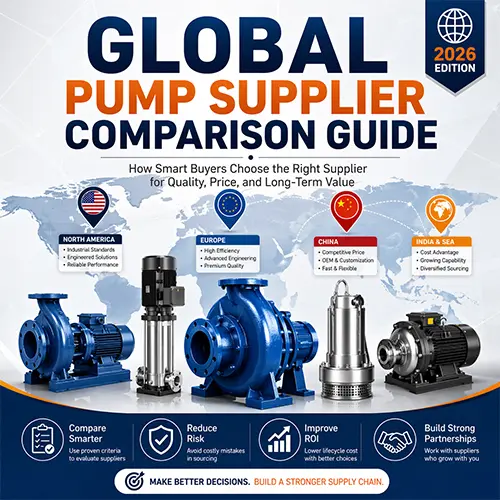
Global Pump Supplier Regions Compared
Different regions offer different advantages. There is no universal best source. The right supplier depends on your market position, project type, and customer expectations.
Europe Pump Suppliers
European suppliers are often associated with strong hydraulic engineering, premium efficiency, high-end materials, and detailed compliance systems.
Best for buyers who need:
- Energy-efficient systems
- Strict technical specifications
- Municipal or industrial premium projects
- Long service life focus
Possible trade-offs:
- Higher purchase cost
- Longer lead time
- Less flexibility for small custom orders
North America Pump Suppliers
North American manufacturers are strong in industrial systems, standards-based applications, and engineered packages.
Best for:
- Heavy industry
- Oil & gas related sectors
- Municipal infrastructure
- Buyers needing ANSI/API style confidence
Possible trade-offs:
- Higher pricing
- Longer procurement cycles in some cases
China Pump Suppliers
China is one of the world’s largest pump manufacturing centers, ranging from budget factories to advanced exporters with modern machining and testing systems.
Best for:
- OEM/private label business
- Competitive pricing
- Fast scaling orders
- Product customization
- Buyers needing margin control
Possible trade-offs:
- Quality level varies widely between suppliers
- Buyer screening is essential
India & Southeast Asia Suppliers
This region is growing as an alternative sourcing base with improving export capability.
Best for:
- Diversifying sourcing strategy
- Mid-range budget projects
- Regional distribution buyers
Possible trade-offs:
- Technical capability differs by supplier
- Documentation systems may vary
| Region | Main Strength | Best For | Buyer Risk |
| Europe | Engineering quality | Premium projects | Price |
| North America | Industrial systems | Spec-driven projects | Cost |
| China | Cost + flexibility | OEM / volume | Qualification needed |
| India / SEA | Diversification | Budget sourcing | Capability variance |
How to Compare Pump Suppliers Step by Step
A structured process protects buyers from emotional or rushed decisions.
Step 1: Define Your Real Pump Application
Before requesting quotations, prepare accurate operating data.
You should know:
- Flow rate
- Required head pressure
- Liquid type
- Temperature
- Solids content
- Corrosion risk
- Voltage / frequency
- Installation altitude
- Duty cycle (continuous or intermittent)
Without this information, quotations are often guesses.
Step 2: Shortlist Suppliers by Product Strength
Do not assume every supplier is strong in every category.
Examples:
- End suction pumps for general water transfer
- Multistage pumps for higher pressure
- Slurry pumps for abrasive media
- Split case pumps for high flow
- Submersible sewage pumps for wastewater
- Inline pumps for HVAC systems
Choose specialists where possible.
Step 3: Check Manufacturing Capability
Request proof of real production strength.
Look for:
- CNC machining lines
- Dynamic balancing process
- Pump performance test benches
- Assembly quality systems
- Material traceability
- Export packaging standards
- Quality inspection records
Step 4: Compare Commercial Terms Carefully
| Item | What Buyers Should Check |
| Lead Time | Is it realistic or only attractive on paper? |
| MOQ | Fits your stocking model? |
| Warranty | Clear and enforceable? |
| Payment Terms | Safe for first order? |
| Packaging | Suitable for sea freight? |
| Spare Parts | Available after sale? |
Step 5: Run a Trial Order First
For new suppliers, a pilot order reduces risk.
Use the first order to test:
- Product consistency
- Packaging quality
- Delivery discipline
- Response speed
- Documentation quality
- Market feedback
Technical Factors Buyers Often Miss
Many sourcing mistakes happen because purchasing teams compare only commercial terms.
Pump Efficiency
Two pumps with similar appearance may have very different energy consumption. If your customer runs pumps daily, efficiency directly affects electricity cost.
For long-hour operations, ask for efficiency curve data.
NPSH Margin
NPSH (Net Positive Suction Head) measures suction conditions needed to avoid cavitation. Poor suction design can create noise, vibration, impeller damage, and unstable flow.
Ask suppliers to confirm suction conditions before production.
Material Compatibility
Material should match liquid conditions, not just budget.
| Application | Common Material Direction |
| Clean water | Cast iron |
| Mild corrosion | Stainless steel 304 |
| Stronger corrosion | Stainless steel 316 |
| Abrasive slurry | High chrome alloy |
| Seawater | Duplex stainless steel |
Wrong material often causes early failure and warranty disputes.
Seal Quality
Mechanical seals greatly affect leakage performance. If the pump is installed in remote locations, stronger seal systems can save major service cost.
OEM Factory vs Brand Manufacturer vs Trading Company
Understanding supplier type helps you negotiate correctly.
OEM Factory
OEM (Original Equipment Manufacturer) factories produce under customer brands or customized requirements.
Best for:
- Building your own brand
- Better margins
- Flexible packaging
- Repeat private-label business
Risks:
- Need stronger QC management
- Engineering level varies
Global Brand Manufacturer
Known brands often provide established reputation and global service systems.
Best for:
- End users needing confidence
- Premium projects
- Corporate approved vendor lists
Risks:
- Higher price
- Less flexibility
Trading Company
Trading companies coordinate products from multiple factories.
Best for:
- Mixed category orders
- Buyers needing one contact window
- Fast sourcing convenience
Risks:
- Less factory visibility
- Technical depth may vary
| Supplier Type | Best For | Main Risk |
| OEM Factory | Margin & customization | Need controls |
| Brand Manufacturer | Reputation & support | Price |
| Trading Company | Convenience | Less transparency |
Red Flags Buyers Should Never Ignore
Small warning signs during quotation stage often become larger problems later.
Technical Red Flags
- No performance curve available
- No clear material list
- Cannot explain motor sizing
- Generic copy-paste quotations
Operational Red Flags
- Slow replies for basic questions
- Constantly changing lead times
- No factory photos or audit access
- Poor English documentation
Commercial Red Flags
- Price far below market with no explanation
- Full prepayment demanded immediately
- Vague warranty wording
- No spare parts commitment
If several red flags appear together, move cautiously.
Which Supplier Type Is Best for Your Business Model
If You Are a Distributor Building a Brand
Choose OEM factories with repeat quality control, packaging capability, and stable lead times.
If You Are an EPC Contractor
Choose suppliers with documentation discipline, realistic delivery planning, and project communication speed.
If You Are an Industrial Plant
Choose engineering-driven suppliers with strong reliability and spare parts support.
If You Compete Mainly on Price
Choose efficient manufacturers with real scale—not simply the cheapest quote.
First Order Risk-Control Checklist for Buyers
The first order is where most supplier problems appear. A structured checklist protects cash flow and reputation.
Use This Before Payment
| Check Item | Why It Matters |
| Confirm final datasheet | Avoid wrong model shipment |
| Confirm motor voltage/frequency | Prevent unusable units |
| Confirm packaging method | Reduce transport damage |
| Confirm delivery date in writing | Accountability |
| Confirm spare parts list | Future support |
| Confirm warranty terms | Claim clarity |
| Confirm inspection photos | Quality evidence |
Buyer Scorecard for Final Supplier Decision
Use weighted scoring instead of instinct. This improves internal approvals and creates objective supplier comparisons.
| Criteria | Weight | Supplier A | Supplier B | Supplier C |
| Technical Fit | 0.25 | |||
| Quality Control | 0.2 | |||
| Price | 0.15 | |||
| Lead Time | 0.15 | |||
| Communication | 0.1 | |||
| After-Sales Support | 0.15 |
Get A Quote

Get A Quote
0 Comments