
Generator Sizing for Water Pump: Motor Starting kVA, Inrush & Worksheet
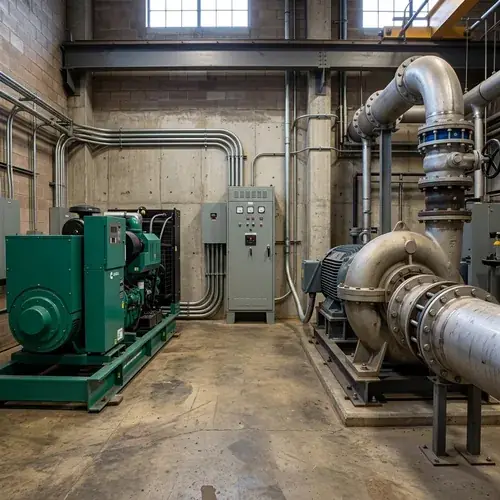
Generator sizing for water pump stations is not decided from the pump motor’s running kW. The generator is sized from motor starting kVA — the locked-rotor apparent power the alternator must deliver while the motor accelerates — plus the voltage dip your control panel can tolerate. If you skip that calculation, a 45 kW pump can stall or trip a generator that was perfectly sized for running load, exactly at the moment the backup system is needed.
The costly mistake we see repeatedly is specifying a genset against the pump duty point, for example 45 kW running, and discovering later that a direct-on-line start can demand several times that in starting kVA. The resulting voltage collapse can drop out contactors, fault VFDs, and leave a pump station down. The worksheet below forces the right comparison between required starting kVA and the alternator’s motor-starting capability curve.
Before you issue an RFQ, collect the motor nameplate data in the relevant section below, decide the starting method, then work through the worksheet. If a supplier quotes only a kVA number without the motor-starting curve, the quote is not ready for technical approval.
Quick Answer / 30-Second Buyer Decision
Size the generator from these five inputs, in this order:
- Running load — total pump motor kW plus auxiliary loads.
- Starting kVA — calculated from locked-rotor amps (LRA) or the NEMA code letter, not from running kW.
- Starting method — DOL, star-delta, soft starter, or VFD changes the starting kVA by a factor of two to six or more.
- Allowable voltage dip — usually 10–15% for industrial pump panels, confirmed with the panel supplier.
- Alternator motor-starting curve — compare the required starting kVA against the curve for that exact alternator at the allowed dip and at the motor’s locked-rotor/starting power factor, typically 0.2 to 0.4.
If the required starting kVA at the allowed dip is higher than the alternator’s published skVA capability, move up a frame size or reduce the starting surge with a soft starter or VFD. The engine kW only tells you whether the set can carry the run load; the alternator starting capability tells you whether it can actually start the pump.
Scope of This Guide
This guide covers electric-motor-driven water pump stations that need a backup or prime generator: clean water transfer, lift stations, fire pump backup, irrigation booster sets, and industrial process water systems. It focuses on three-phase induction motors because those are the standard in B2B pump stations.
It does not drift into diesel engine rebuilds, portable generator reviews, or basic centrifugal pump hydraulics. The boundary is electrical sizing: how to read the motor data, convert it to starting kVA, compare it against a generator’s motor-starting capability, and put the right requirements into an RFQ.
The #1 Costly Mistake: Sizing by Running kW Instead of Starting kVA
Most under-sized backup generator failures in pump stations come from the same root cause: the buyer or contractor sized the set from the pump’s running kilowatts and treated startup as a minor overhead. The running load is not the problem. An electric motor at standstill draws locked-rotor current, commonly 6 to 10 times full-load amps (FLA), because the rotor is not yet turning and the motor briefly behaves like a transformer with a short-circuited secondary. That spike persists while the motor accelerates, usually until it reaches roughly 75% of rated speed.
During that spike the power factor is very low compared with the nameplate running power factor, so the apparent power — kVA — is far larger than the real power, kW. A generator alternator must supply both the real power and the reactive magnetizing current. That is the physical reason inrush current genset failures happen: the engine may have enough kW, but the alternator’s voltage regulator cannot hold terminal voltage while it tries to deliver the starting kVA.
The failure mode is predictable. The terminal voltage sags below the holding voltage of motor contactors and control relays, the contactor drops out, the VFD trips on undervoltage or DC bus fault, or the motor never reaches rated speed and the protection relay trips. This is also why a pump can appear to be mechanically fine yet fail to start: the problem is upstream in the power source. If you are troubleshooting an electrical no-start after a pump mechanically checks out, review the guide on why a pump won’t prime or start before assuming it is hydraulic.
NEMA MG-1 gives you a practical design boundary: motors are expected to operate successfully at ±10% voltage variation at rated frequency. Starting torque is proportional to voltage squared, so at 90% voltage the motor develops only 0.9² = 81% of rated starting torque. Actual acceleration also depends on the pump and motor torque curves and the required starting torque, so confirm the specific allowable dip with the control panel supplier. That is why an undersized generator can drop voltage just enough to prevent a high-inertia or partially loaded pump from accelerating, without necessarily tripping instantly.
The takeaway: kW tells you whether the generator can carry the pump after it is running. kVA tells you whether it can start the pump at all. Both must clear.
How to Read a Pump Motor Nameplate for Generator Sizing
The nameplate is where you get the real numbers. Do not start with a catalog kW figure, especially for used or rebuilt motors. The six fields that matter for generator sizing are:
- Rated output in kW or HP.
- Rated voltage, phase, and frequency — usually 400V 3-phase 50Hz or 460V 3-phase 60Hz.
- Full-load amps (FLA) — the running current at rated load.
- Locked-rotor amps (LRA) or the NEMA code letter — the startup current basis.
- Power factor (PF) and/or efficiency — needed to convert kW to running kVA.
- Service factor (SF) — tells you whether the motor can run slightly above rated kW for limited conditions. Do not base continuous generator sizing on the full service factor unless the actual pump duty point requires that overload capacity; otherwise the generator may be unnecessarily oversized for normal running conditions.
If the nameplate shows LRA directly, use that. Many North American and export motors instead show a NEMA code letter. The code letter gives a locked-rotor kVA range per horsepower, which is exactly what you need for NEMA code letter generator sizing. A few code letter ranges often seen on industrial pump motors:
| NEMA code | Locked-rotor kVA per HP | What it tells you |
|---|---|---|
| F | 5.00–5.59 kVA/hp | Often seen on high-efficiency industrial pump motors |
| G | 5.60–6.29 kVA/hp | Often seen on larger 4-pole pump motors |
| H | 6.30–7.09 kVA/hp | High locked-rotor; requires extra generator margin |
The conversion for a 3-phase motor is straightforward:
Motor starting kVA = (√3 × V_line × LRA) / 1000
If you only have HP and the code letter:
Motor starting kVA = HP × code letter kVA/hp
The running kVA equivalent is:
Running kVA = (√3 × V_line × FLA) / 1000
For a deeper walk through motor kW, voltage, phase, service factor, and protection decisions, see the full pump motor selection guide. The electrical sizing here assumes the motor is correctly selected for the duty point in the first place.
One thing buyers often miss: the nameplate power factor is the running power factor, not the starting power factor. Do not multiply the starting kW by running PF to get starting kVA. Use LRA or the code letter instead. The starting power factor is low for a different physical reason — typically in the 0.2 to 0.4 range for a locked induction motor — because the motor is drawing magnetizing current while the rotor is not yet producing useful mechanical output.
How Starting Methods Affect Inrush Current and Generator Sizing for Water Pump Stations
The starting method is the largest lever you control. A 45–50 kW pump may need roughly 300 to 450 starting kVA with DOL, depending on the motor’s locked-rotor amps or NEMA code letter, but only a fraction of that with a VFD or soft starter. That can change the generator frame size significantly, sometimes by a full frame or more depending on the application. The table below gives practical planning ranges, not universal constants. Confirm the actual multiplier from the motor nameplate and the starter or VFD documentation before you quote.
| Starting method | Typical inrush current (× FLA) | Generator sizing impact | Best application |
|---|---|---|---|
| Direct-on-line (DOL) | 6–10× | Highest starting kVA; must clear full locked-rotor kVA | Small or medium pumps where inrush is already accounted for and utility supply is available |
| Star-delta | 2–4×, with reduced starting torque | Lower during star connection; small second surge when transferring to delta | Centrifugal pumps with low starting torque requirement |
| Soft starter | 2–4×, adjustable | Reduces starting kVA and controls acceleration; bypasses after ramp | Pumps needing reduced mechanical shock with a smaller genset |
| VFD | 1–2× FLA, often near or below full-load current | Lowest starting kVA; best voltage dip control | Variable-flow stations, large pumps, energy-sensitive sites |
The trade-off is not only electrical. Star-delta reduces starting torque to about one-third of DOL, which is usually acceptable for starting a centrifugal pump with the discharge valve closed, but it is not a universal fix for high-inertia loads. Soft starters reduce starting torque roughly as the square of the voltage reduction, and a poorly set soft starter can still produce a deep dip if it ramps too quickly.
VFDs are the most effective generator-shrinking tool, but they introduce harmonics. A VFD’s input rectifier draws non-linear current that can distort the generator voltage waveform and overheat the alternator or cause voltage-regulator instability if the generator is marginal. If the pump station uses a VFD on generator backup, ask the genset supplier for the harmonic profile, specify a line reactor or harmonic filter if required, and confirm that the alternator voltage regulator can handle the stated total harmonic distortion under starting and running conditions.
The decision question for the buyer: do you spend on a larger generator, or spend on a soft starter/VFD plus a smaller generator? On oversize-driven backup systems the smaller-generator-plus-drive route often wins on total cost and fuel performance, but only if you run the starting kVA numbers for both options.
Step-by-Step Generator Sizing Worksheet (With Worked Example)
The sizing logic is sequential. Run the worksheet in this order, and write one line per motor. Do not skip the alternator curve step — that is where quotes without backup documentation usually fail.
| Step | What to do | Formula or check |
|---|---|---|
| 1 | List every motor and auxiliary load that can run on the generator | Motor kW, FLA, voltage, phase, frequency |
| 2 | Record each motor’s starting data | LRA, NEMA code letter, or manufacturer’s locked-rotor kVA |
| 3 | Calculate running kVA per motor | √3 × V × FLA / 1000 |
| 4 | Calculate starting kVA per motor | √3 × V × LRA / 1000, or HP × code kVA/hp |
| 5 | Choose the starting sequence | Largest motor first, then smaller motors, one at a time |
| 6 | Add the largest starting kVA to the running load already online | Required transient kVA |
| 7 | Confirm allowable voltage dip with the pump control panel supplier | Usually 10–15%, but ask |
| 8 | Compare required transient kVA with the alternator motor-starting curve at the motor’s starting power factor | Genset skVA capability at that dip and starting PF must exceed required kVA |
| 9 | Apply site derating and prime/standby basis, then select the next standard frame | Manufacturer’s altitude/temperature table |
For a rough worksheet example, assume a small lift station with two 45 kW 400 V 3-phase 50 Hz pumps, DOL starting, each motor nameplate showing FLA 82 A and LRA 540 A, plus about 5 kW of controls, lighting, and battery charging.
The running kVA of one pump is:
√3 × 400 V × 82 A / 1000 = 56.8 kVA
A 5 kW auxiliary load at a running power factor around 0.8 is roughly 6 kVA.
The starting kVA of one DOL pump is:
√3 × 400 V × 540 A / 1000 = 374 kVA
If you start one pump while the other is already running and auxiliaries are online, the largest transient demand is:
374 kVA starting + 56.8 kVA running + 6 kVA auxiliary ≈ 437 kVA
This arithmetic sum is a first-pass sizing estimate, not a rigorous vector addition. The actual bus kVA depends on the running and starting power factors. For final selection, have the generator supplier check the combined kVA by vector addition or transient motor-starting software, then round up to the nearest standard frame, not down.
That is the number the alternator must handle at the allowed voltage dip and at the motor’s locked-rotor/starting power factor, typically 0.2 to 0.4 for an induction motor. If the pump panel supplier permits 15% dip, check the candidate alternator curve at 15% dip and at that starting power factor: its motor-starting skVA capability must sit at or above that total. If it sits below, the alternator is too small, even though the engine may be fine carrying the steady-state kW.
This is also the correct time to sequence pumps. If the station has a duty/standby or duty/duty arrangement, configure the transfer control so pumps restart one at a time, largest first. If you need help with how a lift station’s duty and standby pump configuration affects hydraulic sizing, review the wastewater lift station pump sizing guide before you lock the electrical sequence.
A serious buyer also checks the other side: the engine kW rating must be large enough for the running load, not just the alternator’s transient capability. In the example, two 45 kW shaft-output pumps plus auxiliaries will draw more than 90 kW of electrical power once motor efficiency is included. A generator sized only for transient starting kVA but under-rated on engine kW is not a valid selection: it may start the pumps but overheat or trip thermally after running for some time, because the engine cannot sustain the continuous electrical input required.
Environmental Derating and Prime vs. Standby Ratings
Two ratings look identical on a quote but are not. Standby power is for emergency use, limited to a relatively small number of hours per year and variable load. Prime power is for continuous or extended operation with variable load, and continuous power is for a constant load without restriction. A genset quoted at 200 kVA standby is not a 200 kVA prime set; the prime rating is typically lower. If your pump station must run for days after a storm, size on prime or continuous, not standby. The rating definitions are covered by ISO 8528, and the supplier should state the basis on the data sheet.
Altitude and temperature reduce what the engine can actually deliver. Reference conditions are commonly 25°C, 100 m altitude, and standard relative humidity. Above that, thinner air means less oxygen in the cylinder, lower engine output, and in some cases reduced alternator cooling. The derating is not one universal percentage: naturally aspirated engines typically fall off faster than turbocharged sets, and the alternator may derate independently because of reduced air cooling. Ask for the manufacturer’s derating table for your exact elevation and maximum summer temperature.
Site voltage and frequency also matter. A motor nameplate rated 50Hz cannot simply be run on a 60Hz generator without checking speed, pump curve, and current. If you are exporting a pump station to a different grid frequency, make that explicit in both the pump and generator RFQs because the pump performance changes with speed and the motor current changes with voltage-to-frequency ratio.
Common Mistakes in Pump Station Backup Power Design
These are the failure modes I would probe if a commissioned pump station tripped on first generator test:
- Sizing on running kW only. The classic error. Fix it by calculating starting kVA before the PO is signed.
- Oversizing the diesel set to survive a brief starting surge, then running it lightly. A diesel generator that idles or runs below about 30–50% load for long periods can suffer wet stacking — unburned fuel and carbon accumulating in exhaust valves, turbocharger, and exhaust system because combustion temperature never rises enough to burn them off. Treat that percentage as a general guideline; the engine/genset manufacturer’s minimum load recommendation is the binding number. If the set is oversized to clear inrush, plan for a load bank test schedule or load management.
- Ignoring VFD harmonics. A VFD reduces inrush but injects non-linear current. If the generator is too tight, harmonic heating and voltage-regulator instability can cause a separate class of failures.
- Not sequencing restarts. After a grid outage, multiple pumps may try to restart at the same time if the control logic has no stagger. The generator sees the sum of all starting kVA plus running loads. Add automatic restart sequencing or size for the full simultaneous start if the local code or station control cannot prevent it.
- Assuming the control panel can tolerate deep voltage dips. Motor contactors can drop out below roughly 85% nominal voltage depending on the contactor and panel design, and a VFD may fault earlier. Confirm the actual limit with the panel builder before accepting a 20% dip “safe” assumption.
- Buying a quote without the alternator motor-starting capability curve. This is the single most useful document in the whole purchase. If the supplier cannot or will not provide it, treat the sizing as unverified.
- Forgetting auxiliary loads. Controls, lighting, battery chargers, fuel pumps, cooling fans, sump pumps, and UPS panels all add running kVA. Small individually, but they consume thermal and voltage margin.
When the electrical backup generator sizing becomes expensive or complex, a direct diesel engine water pump may be a better emergency alternative for some sites, particularly where the backup need is only a single pump. See the diesel engine water pump buying guide for the hydraulic trade-off.
Supplier Verification Before You Award the PO
You do not need to trust a supplier’s claim that the set “will start the motor.” You need to see the evidence. Three signals separate a technically competent generator supplier from a price-first reseller:
- They ask for the motor’s LRA or NEMA code letter before quoting. If the supplier quotes without asking how the pump is started, the sizing is a guess.
- They send an alternator motor-starting capability curve, not just a kVA number. The curve must be evaluated at the motor’s locked-rotor/starting power factor — typically 0.2 to 0.4 — and against the instantaneous voltage dip for that exact alternator. The same engine with a different alternator can behave entirely differently.
- They ask for site altitude, maximum ambient temperature, and the control panel’s allowable voltage dip. That tells you they are applying derating and voltage limits rather than quoting a catalog frame.
Ask whether the quoted kVA is standby, prime, or continuous. Ask for the engine derating table. If the supplier cannot provide the alternator curve, the most likely outcome is finger-pointing during commissioning: “the pump starting method is wrong” or “the site is too hot.” A clear RFQ removes that excuse before it happens.
RFQ Checklist: What to Put in the Enquiry So the Genset Actually Starts the Pump
Use this table as the core of your technical RFQ. Every blank that you leave invites the supplier to assume the most favorable condition.
| Field | Your input / what to request |
|---|---|
| Pump motor data | kW/HP, voltage, phase, frequency, FLA, LRA or NEMA code letter, power factor, service factor |
| Starting method | DOL, star-delta, soft starter, or VFD; include starter/VFD make and model |
| Number and sequence | Number of pumps, largest-first sequencing, simultaneous restart possibility |
| Auxiliary load | Controls, lighting, battery chargers, fuel pumps, ventilation fans, UPS panels, sump pumps |
| Allowable voltage dip | State the panel limit, for example 10% or 15%, confirmed with the panel builder |
| Site conditions | Altitude, maximum ambient temperature, indoor/outdoor enclosure |
| Duty basis | Standby, prime, or continuous; expected annual run hours and outage duration |
| Required curves and data | Alternator motor-starting capability curve at the motor’s starting power factor (confirm 0.2–0.4 or the actual nameplate-based value), engine derating table, harmonic limit for VFD loads |
| Required documentation | Data sheet, factory test report, FAT procedure, load bank test report |
| Inspection | Pre-shipment inspection, witnessed load bank test, on-site commissioning |
One more instruction for your purchasing team: reject any quote that says only “[kVA] standby with automatic voltage regulator” and no motor-starting curve. The generator sizing question is not whether the set can produce a kVA number. It is whether the alternator can produce the required starting kVA at an acceptable voltage dip and starting power factor on the day of commissioning.
FAQ: Generator Sizing for Water Pump Stations and Motor Starting Questions
These are the questions buyers raise after the first round of electrical review, answered with the decision logic above.
How many times running current is starting current?
For a direct-on-line three-phase induction motor, locked-rotor current is commonly 6 to 10 times full-load amps, depending on motor design, NEMA code letter, voltage, and rotor construction. The actual multiplier for your motor comes from the nameplate LRA or NEMA code letter, not from a general rule. At constant voltage, the starting kVA ratio follows the current ratio directly, so a 6× locked-rotor current means roughly 6× running kVA before derating. The starting power factor is much lower, but that mainly reduces starting kW rather than changing the kVA-to-current relationship.
How do I calculate generator size for a 3-phase motor?
First, calculate running kVA from the nameplate FLA:
Running kVA = (√3 × V_line × FLA) / 1000
Then calculate starting kVA from LRA or the NEMA code letter:
Starting kVA = (√3 × V_line × LRA) / 1000
Add the largest motor’s starting kVA to the running load that is already online. Compare that total against the alternator’s motor-starting capability curve at your allowed voltage dip and at the motor’s locked-rotor/starting power factor. Then apply altitude, temperature, and prime/standby derating. The engine kW must also cover the steady-state running load.
What happens if a generator is undersized for a pump?
The generator may start and run the pump on a test bench, then fail under real conditions. The usual failure is a severe voltage dip when the pump starts: contactors drop out, VFDs fault on undervoltage, protective relays trip, or the motor stalls before reaching full speed. The engine may not stop immediately, but the pump station does not transfer, and the backup system has failed at the worst possible time.
What is the difference between kW and kVA in generator sizing?
kW is real power — the work the engine must produce. kVA is apparent power — the total electrical load the alternator must handle, including reactive current. A motor with a running power factor of 0.85 draws roughly 0.85 kW for every 1 kVA of apparent power, but during starting the power factor falls sharply. That is why a 45 kW pump can demand far more kVA during starting than its running kW suggests.
Can I use a VFD to reduce the generator size for a pump station?
Yes, in most cases a VFD reduces the starting kVA requirement to roughly 1 to 2 times full-load current as a planning estimate, because the drive accelerates the motor with controlled voltage and frequency rather than slamming full line voltage onto a stopped rotor. The actual value depends on drive setup, ramp rate, and starting torque demand. The trade-off is harmonic current from the VFD input, which can overheat a marginal generator or destabilize the voltage regulator. Request the harmonic profile and add a line reactor or filter if the genset supplier calls for it.
Official Sources and Compliance References
The technical boundaries in this article come from two public reference frameworks:
- NEMA MG-1 (Motors and Generators) — the source for NEMA code letter locked-rotor kVA/hp ranges and the ±10% voltage variation envelope for induction motors at rated frequency. Use it to determine starting kVA from the nameplate and to justify the allowable voltage dip limit.
- ISO 8528 — the standard family covering generator set ratings, performance, and test criteria. It is the reference for standby, prime, and continuous rating definitions, and for the site derating discussions in the RFQ.
For installed pump station safety systems, additional local electrical and fire protection codes apply to transfer switches, grounding, load shedding, and fire pump backup power requirements. Confirming local code compliance is a site-level obligation before procurement, not a buyer-optional detail.
Bottom Line for Buyers
The number that reliably starts a water pump is not the pump’s running kW. It is the motor starting kVA the alternator must deliver, checked against the actual motor-starting capability curve at a voltage dip and locked-rotor/starting power factor your control panel will tolerate. If you take nothing else from this guide, take these four habits into your next pump station generator purchase:
- Ask for LRA or NEMA code letter on every pump motor nameplate.
- Decide DOL, soft starter, or VFD before requesting the generator quote.
- Require the alternator motor-starting capability curve in writing, evaluated at the motor’s starting power factor.
- Always confirm whether the quoted kVA is standby or prime.
With those four items, a pump station generator RFQ moves from “will it start?” to a verifiable engineering decision.
Get A Quote

Get A Quote
0 Comments