
Self-Priming vs Submersible Pump vs End-Suction: Dewatering Selection Guide
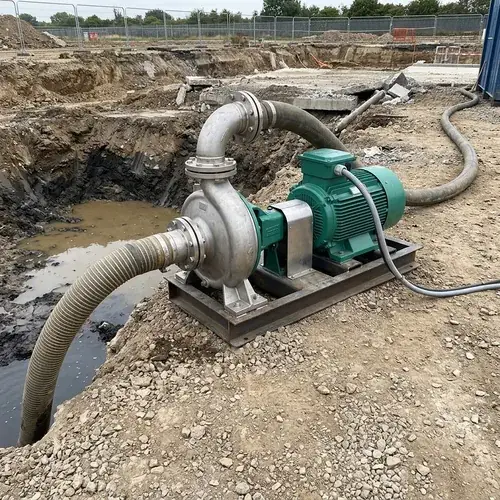
The self priming vs submersible pump decision starts with one measurement: where is the water surface relative to the pump inlet. If the pump stays above a pit and the vertical lift is roughly 25 ft or less at sea level, a self-priming unit is usually the lowest-maintenance choice. If the liquid is deeper or you must place the pump inside the wet well, go submersible. If an elevated tank or pond already feeds water downhill to the pump, an end-suction centrifugal typically gives the highest efficiency and easiest long-term service when selected near its best efficiency point.
That geometry test usually saves more project cost than a catalog comparison, because the three pump types fail in different ways. A self-priming pump asked to lift too high starves the impeller. A submersible pump solves that lift problem but turns every future repair into a retrieval job. An end-suction pump forced to pull from a long suction hose can cavitate, lose flow, and wear seals prematurely. This guide walks you through the suction-lift limits, solids handling, maintenance access, energy trade-offs, supplier checks, and the RFQ data that gets you the right quote before you pay.
Before you send a quote request, sketch the liquid surface elevation and the pump centerline. That one sketch will tell you faster than any spec sheet which architecture you can eliminate.
Quick Answer: Which Pump Do You Need Based on Site Geometry?
Draw the water surface and the pump inlet on the same section view. The pump type falls out of that relationship:
- Pump above the liquid, with vertical lift below about 25 ft (8 m) — use a self-priming pump. It stays on dry ground, re-primes itself after the initial casing fill, and gives your crew easy access for seal and impeller service.
- Pump inside the liquid, or liquid depth is beyond practical suction lift — use a submersible pump. It pushes water upward instead of pulling it, so the 25-ft suction lift limit does not apply.
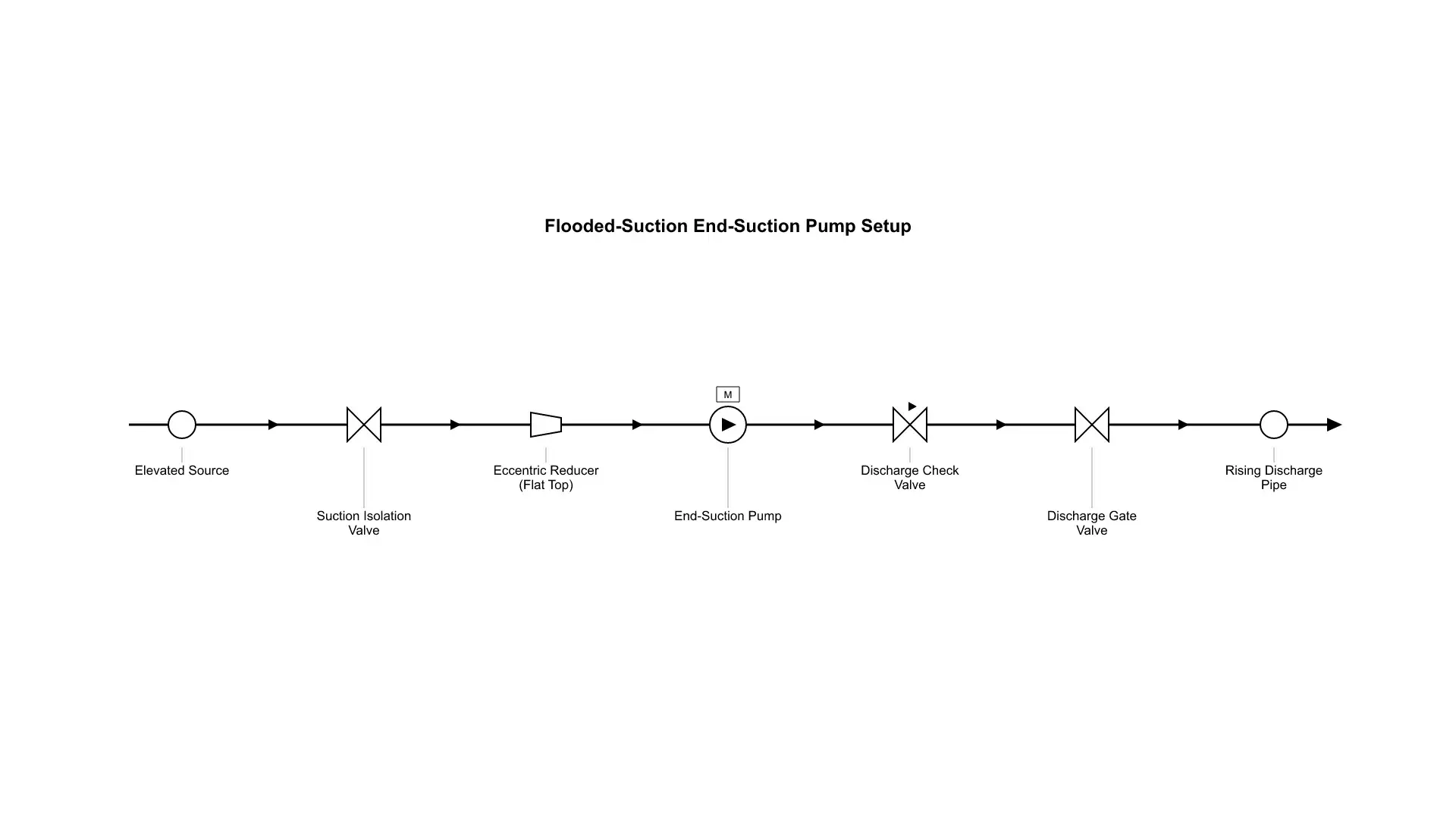
- Liquid surface already above the pump inlet centerline — use an end-suction centrifugal pump with flooded suction. This is typically the highest-efficiency option for a permanent transfer station, provided the pump is selected near its best efficiency point.
Lock in these three definitions before you read a supplier quote. Flooded suction means the source liquid surface is higher than the pump impeller centerline, so gravity keeps the pump inlet under positive pressure. Suction lift means the pump inlet is above the liquid surface, so atmospheric pressure must push water into the pump after the air is evacuated. Submerged means the pump sits in the liquid and pushes the fluid up the discharge line.
Measure actual vertical lift, not hose length. A 100-ft suction hose laid over flat ground does not create 100 ft of suction lift. The pump only sees the vertical difference between the water surface and the inlet.
Scope of This Guide
This article compares three centrifugal pump types used for site dewatering, water transfer, and drainage: self-priming, submersible, and end-suction centrifugal. The focus is B2B project selection, not residential sump work or a general physics lesson.
That means suction geometry, total dynamic head, NPSH margin, solids passage, motor power, maintenance labor, factory test documentation, and landed project risk. I won't cover positive displacement pumps, deep-well turbine pumps, chemical metering pumps, or heavy mining slurry circuits beyond a note on wear materials. Those follow different selection rules.
If your liquid is clean water, muddy construction water, light sewage, pond water, or drainage water with occasional small solids, you're in the right place. If the liquid is highly viscous, shear-sensitive, or carries very abrasive solids above a few millimeters, stop and confirm the duty with a supplier before applying these rules.
Self-Priming Pumps: Best for Above-Ground Access and Moderate Lifts
A self-priming pump is a centrifugal pump that can automatically evacuate air from its suction line after the casing has been filled once, allowing the pump to sit above the liquid source and re-prime itself on startup. For a closer look at how that priming chamber differs from a standard volute, see the differences between self-priming and standard centrifugal pumps. That first fill is physical, not optional: a self-priming pump needs the casing charged with liquid before it can create the liquid seal that pulls air out of the suction line.
The practical suction lift limit is about 25 ft (8 m) at sea level, and that number is not a guarantee for every installation. Atmospheric pressure is doing the work of forcing water into the evacuated suction line. At higher elevation, the available atmospheric pressure drops, so the usable lift drops with it. Hot water makes the problem worse because its vapor pressure rises. A pump that re-primes comfortably at sea level may lose prime or cavitate at high elevation with hot water, even if the mechanical lift is unchanged. The 25-foot suction lift limit is a design ceiling, not a safety margin. A practical design margin often puts the operating lift closer to 20–22 ft once friction loss, air leaks, and inlet strainer clogging are counted.
Self-priming pumps earn their place in construction dewatering, pond transfer, flood response, sewage bypass, and irrigation work because the pump can be moved, started, opened, and repaired without pulling anything out of the water. A skid or trailer-mounted unit can be rotated between pits on site. From a total cost of ownership perspective, that above-ground maintenance access is the main financial advantage. Replacing a mechanical seal on a self-priming pump is an ordinary job. Replacing the same seal on a submersible in a wet well usually involves lifting gear, confined space risk, and a lot more labor.
Solids handling depends on the impeller and volute design, not on the self-priming feature itself. Clean-water models handle fine silt, while trash-pump versions are commonly specified to pass spherical solids in the 1.25 to 3-inch range depending on the model. If you expect mud, leaves, or small stones, do not assume the pump will pass them. Ask the supplier for the maximum spherical solid passage and for the wetted material option; high-chrome wear parts are often worth the extra cost when sand is present. For the physics behind this ceiling and why it falls at altitude or with warm water, see the 25-foot suction lift limit guide.
The main engineering failure with self-priming pumps comes from treating the 25-ft rule as a fixed number while ignoring suction pipe air leaks. A small leak at a hose clamp or coupling will prevent the pump from reaching full lift or will cause repeated loss of prime. Use rigid or reinforced suction hose rated for vacuum, keep the suction line as short and straight as practical, and avoid high loops that trap air. If the pump cycles on and off repeatedly, a foot valve or check valve at the liquid end helps keep the suction line charged, but it also adds maintenance. In a dirty pit, a clogged strainer is far more common than an impeller failure.
Submersible Pumps: Best for Deep Dewatering and Zero Priming Issues
A submersible pump is a close-coupled pump and motor assembly sealed for continuous operation under water, with the pump inlet located near the bottom of the unit. It pushes liquid upward, so it removes suction lift and priming from the design problem entirely.
That's the deciding factor for deep construction pits, excavations, mines, sumps, lift stations, and wet wells. If the water surface is more than 25 ft below the top of the pit, a self-priming pump is the wrong tool because atmospheric pressure cannot push the water high enough. A submersible pump sitting at the bottom has no such limit: it pushes against discharge head, which the pump and motor combination is sized to handle.
The trade-off is maintenance access. The pump, motor, seals, and bearings are all down in the liquid. When something fails, you must retrieve the pump. In a proper installation, guide rails and an auto-coupling foot allow the pump to slide down and lock into the discharge connection without requiring a diver to unhook piping. A lifting chain or cable stays attached.
In poor installations, someone has to enter the wet well, disconnect a flanged or flexible connection by hand, and hoist the pump out. That's where project labor cost often gets underestimated. Before you buy a submersible, confirm the retrieval plan: lifting point, guide rail system, cable management, and whether your site can bring lifting equipment close enough to the access opening.
Solids handling varies widely. Dewatering pump selection for sandy groundwater usually favors a unit with hardened wear parts and some tolerance for fine sand. A sewage-duty submersible has a single-channel or vortex impeller designed for larger solids and stringy material. These are not the same pump, even when both are called submersible. If your duty is muddy construction water, compare it with a trash-pump variant using the dewatering pump vs trash pump criteria before you guess.
Motor power for industrial dewatering pumps commonly ranges from a few horsepower on small drain-down sets up to about 125 HP on larger jobsite skids, though larger mine/quarry dewatering sets exist; confirm the required power range with the supplier. The range matters less than stating your actual available power supply. A pump curve that meets your head and flow still has to match voltage, phase, frequency, starting method, and cable length. Cable voltage drop on a deep submersible run can be real, so the supplier needs the full electrical picture, not just the pump duty.
Dry-run protection is also part of the selection. Some dewatering submersibles can tolerate brief dry operation, some cannot. Don't accept a general statement like "it is fine." Ask for the manufacturer's minimum submergence requirement and whether the unit has thermal overload protection or an external level-control system. The motor can overheat quickly if it runs unsubmerged under load.
End-Suction Centrifugal Pumps: Best for Flooded Suction and High Efficiency
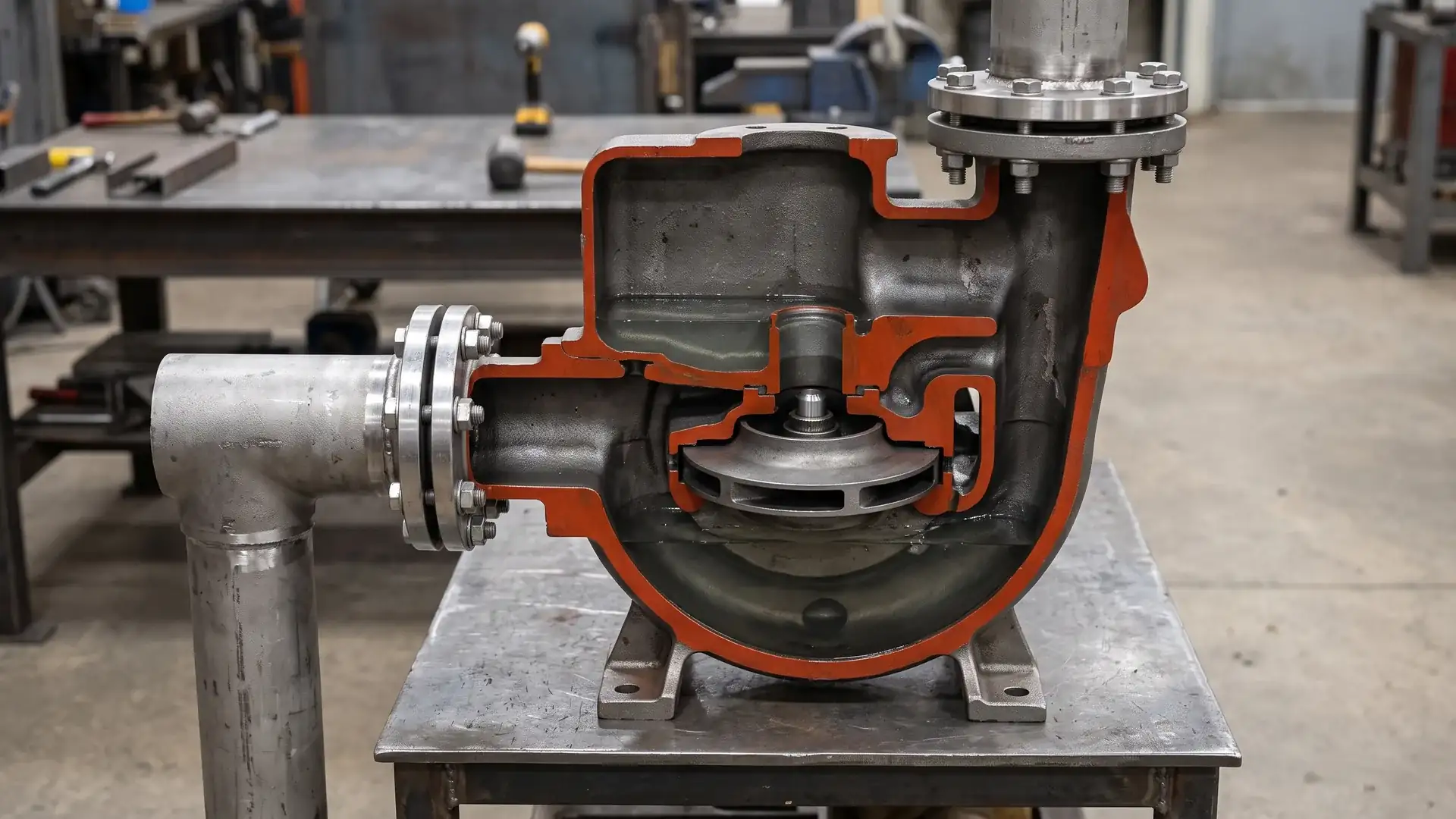
An end-suction centrifugal pump has a single axial suction inlet at the impeller eye and a radial discharge, typically mounted on a common baseplate with a motor coupled to the pump shaft. It generally delivers the highest clean-water hydraulic efficiency among these three architectures when the site gives it flooded suction and the pump is selected near its best efficiency point (BEP).
That's the key boundary: the liquid source must already sit above the pump inlet centerline. In practice this is a tank discharging to a pump, a pond with a pump room below the waterline, a clearwell, a suction tank, or an industrial water-return circuit. If the layout naturally feeds water downhill to the pump, an end-suction unit is the most efficient and easiest-to-maintain permanent transfer option. The back pull-out design lets maintenance pull the rotating assembly out the back without disconnecting the suction and discharge piping, depending on the model and coupling arrangement. That feature lowers downtime on permanent installations far more than it benefits a portable jobsite pump.
This pump is rarely the right choice for a construction pit where the water is 10 or 20 ft below the pump. Long suction hoses, improvised suction piping, or a pump set too high above the source can produce cavitation. Cavitation happens when the pressure at the impeller eye drops below the liquid's vapor pressure, forming vapor bubbles that collapse violently as they move through the impeller. The mechanical damage sounds like gravel rattling in the casing, but the damage is hydraulic: pitted impellers, broken seals, vibration, and lost capacity.
Suction piping details matter. On horizontal suction runs, the standard practice reflected in API 686 suction-line guidance is to install an eccentric reducer with the flat side on top; confirm the applicable project standard or API 686 edition before finalizing. That keeps air or vapor from collecting in a high pocket at the reducer. A concentric reducer on a horizontal suction line is a classic installation error because it can trap air and destabilize flow into the impeller. The same vapor-pocket logic applies to pipe slopes: slope the suction line downward toward the pump, and avoid fittings that create local high points.
When specifying a flooded-suction end-suction pump for permanent transfer, confirm NPSHa, or Net Positive Suction Head available, at the worst-case operating condition: lowest liquid level, highest liquid temperature, and largest flow. NPSHa must exceed the pump's NPSHr, or Net Positive Suction Head required, by a reasonable margin, usually at least a few feet or a meter for stable operation. The supplier's certified curve must show NPSHr at the required flow, not just the maximum head point. For a deeper look at system matching and efficiency, see the end suction pump selection guide for permanent transfer stations.
The energy case for end-suction is strong only when the pump is selected close to its best efficiency point, also called BEP. A pump selected far right or far left on its curve loses more efficiency through recirculation, vibration, or hydraulic mismatch than the architecture itself preserves. Request the performance curve with the operating point plotted on it, and reject a quote that only lists maximum head.
Side-by-Side Comparison: Suction Lift, Solids, and Maintenance
The table below compresses the three pump types into the physical differences that actually change a procurement decision. Use it as a final check after you have sketched the liquid elevation.
| Criterion | Self-Priming Pump | Submersible Pump | End-Suction Centrifugal Pump |
|---|---|---|---|
| Liquid position | Pump above liquid, suction lift | Pump inside liquid | Liquid above pump inlet, flooded suction |
| Practical suction lift | About 25 ft (8 m) at sea level; less at altitude | No suction lift limit; pushes discharge head | No lift; requires flooded suction or a short flooded line |
| Priming requirement | Initial casing fill, then automatic re-prime | None | None when flooded |
| Solids handling | Clean water to trash-pump variants; confirm spherical solid size | Fine solids/sand in dewatering models; larger solids in sewage versions | Usually clean water; solids-handling impeller if specified |
| Maintenance access | Pump above ground; easy seal/impeller service | Must retrieve the pump from the wet well | Back pull-out design; service rotating assembly without removing piping |
| Typical efficiency | Moderate; lower than a flooded end-suction unit | Depends on model and duty | Highest clean-water efficiency when correctly selected near BEP |
| Portability | High; skid or trailer mounting | Moderate; needs lift system and power cables | Low; baseplate/foundation for permanent installation |
| Typical application | Construction dewatering, pond transfer, bypass, flood response | Deep pits, wet wells, sumps, sewage stations | Permanent transfer stations, elevated tanks, industrial water loops |
Don't let the efficiency column drive the whole decision. A slightly less efficient self-priming pump that your crew can service in an hour may beat a more efficient submersible that costs two shifts and a crane every time it needs attention. TCO includes maintenance labor and downtime risk, not only kilowatt-hours.
4 Common Mistakes When Selecting Dewatering and Transfer Pumps
Four patterns come up repeatedly in dewatering pump selection failures. Each is easier to catch at the RFQ stage than to fix after the pump is bolted to a pipe.
Mistake 1: Ignoring altitude and water temperature effects on self-priming lift
The 25-ft suction lift limit assumes near-sea-level atmospheric pressure and cool water. At high elevation, the available atmospheric pressure is lower, so the practical lift is lower before cavitation begins. Hot water makes the problem worse because the liquid's vapor pressure moves closer to the suction pressure. If your site is at altitude or the liquid is warm, don't size a self-priming pump by the sea-level rule. Calculate NPSHa under the worst combination of elevation, temperature, lowest liquid level, and strainer loss. Then confirm NPSHa exceeds NPSHr by the required margin at the actual operating flow.
Mistake 2: Using an end-suction pump with a long suction hose or big lift
This is the classic portable pump mistake. An end-suction pump is built for short, flooded, low-loss suction piping. Add a long hose, a small suction diameter, or a 15-ft lift, and the pump may start but won't hold stable flow. It will cavitate, the discharge pressure will fluctuate, and the mechanical seal will take the damage. If the water is below the pump, choose self-priming for moderate lifts or submersible for deep lifts. Keep end-suction for geometry where the liquid feeds the pump from above.
Mistake 3: Installing a submersible without a retrieval path
A submersible pump eventually needs service. If it goes into a wet well without guide rails, a lifting chain, a supporting access frame, and a clear lifting route, every repair becomes a small construction project. For permanent wet wells, guide rails with an auto-coupling foot are worth the extra initial cost because the pump can be raised and lowered without entering the liquid or disconnecting the discharge piping. For a portable jobsite pump, specify a lifting point and a plan for getting a hoist or excavator to the access location.
Mistake 4: Selecting by maximum head instead of operating point
A pump's maximum head or maximum pressure is the zero-flow point at the top of the curve. It tells you almost nothing about how the pump will run at the required flow. The correct selection starts with the required flow and the system head at that flow, then checks that the duty point falls reasonably close to the pump's best efficiency point. Choose a pump that runs far left on its curve and you get recirculation, vibration, and heat buildup. Far right, you get run-out and possible motor overload. Ask the supplier to plot the duty point on the curve.
Water Transfer Pump RFQ Checklist: What to Tell Your Supplier
A good quote starts with a complete data sheet. If the supplier has to guess your liquid elevation, solids load, or power supply, the pump selection will be generic. For a deeper format, use the dedicated prepare a water transfer pump RFQ guide, but the table below is the minimum project-ready data set.
| Field | What to specify |
|---|---|
| Flow rate | m³/h or US gpm at the actual operating point |
| Total dynamic head | Meters or feet from liquid surface to discharge point plus pipe friction |
| NPSHa | Calculated at pump inlet under worst-case liquid level and temperature |
| Liquid type | Clean water, muddy water, sewage, temperature, pH, specific gravity |
| Maximum solid size | Diameter in mm or inches; whether solids are spherical, fibrous, or abrasive |
| Site elevation | Meters or feet above sea level; impacts self-priming lift |
| Power supply | Voltage, phase, frequency, available starting method, cable length for submersibles |
| Pump type | Self-priming, submersible, or flooded-suction end-suction |
| Mounting or portability | Skid, trailer, guide rail, baseplate, fixed wet well |
| Wetted materials | Cast iron, stainless steel, high-chrome wear parts if abrasive |
| Duty cycle | Continuous, intermittent, standby |
| Required documents | Available hydraulic test record or ISO 9906 performance curve, NPSHr curve, MTRs where applicable, dimensional drawing |
Include the pump type you believe is correct, but also state the liquid geometry. A supplier can then confirm your choice instead of silently quoting whatever they already stock.
Supplier Verification: What to Check Before a Bulk Order
The correct pump type on paper still fails if the supplier cannot prove hydraulic, material, packaging, and electrical compliance.
- Hydraulic performance: ask what hydraulic test record is available for the exact model and order—whether a certified ISO 9906 curve, a routine production test record, or a catalog type curve—and require the requested flow and head plotted at the duty point.
- NPSHr curve: confirm it is provided at the operating flow, not only at the maximum flow or shut-off.
- Material documentation: request wetted parts list and material test reports, or MTRs, for the casing, impeller, shaft, and wear components, and confirm whether the supplier can trace them per lot.
- Solids passage: for dirty-water duty, ask for the maximum spherical solid size and the impeller type, not a vague "solids-handling" marking.
- Motor details: brand, power, speed, voltage, phase, frequency, IP rating, insulation class, starting method, and cable length for submersibles.
- Connection drawing: confirm suction and discharge flange standards and dimensional envelope before foundation work.
- Export packaging: confirm crate or plywood case, lifting lugs, moisture protection, shipping marks, and documentation placement. These costs can appear late if not listed in the quotation.
- MOQ and lead time: get both in writing for the exact configuration you are quoting, including any private-label, motor brand, paint spec, or test-report changes.
Reject a quote that gives only a max head and a maximum flow with no curve behind it. That's not a selection; it's a catalog range. You need the curve, the duty point, and the minimum NPSH margin.
FAQ
These questions come up often before buyers shortlist pumps for dewatering, transfer, and drainage.
Which is better for construction dewatering: self priming vs submersible pump?
It depends on two factors: liquid depth and maintenance access. If the vertical lift from the water surface to the pump is roughly 20–22 ft or less at sea level with clean water and low suction friction, a self-priming pump is usually better because it stays above ground and is easier to service. If the pit is deeper, or if the pump must sit in the water, choose a submersible pump. The submersible solves the deep-lift problem but adds the cost and complexity of retrieving the pump for every major repair.
Can a self-priming pump lift water 30 feet?
No, not reliably. At sea level and with cool water, the theoretical maximum is often cited near 34 ft, but practical self-priming lift is limited to about 25 ft, and that number falls fast at altitude or with hot water. A 30-ft lift is outside the safe design range for most self-priming pumps. If your site needs more than 25 ft of lift, use a submersible pump instead.
Can a self-priming pump run dry?
During priming, the pump is designed to handle an air-and-water mixture, so a brief dry period while evacuating the suction line is normal. Prolonged dry operation is different. The mechanical seal and other liquid-cooled parts can overheat, and the pump can fail if it runs dry under load for too long. Fit dry-run protection or a level control if the pump may be left unattended on a dirty or low-flow pit.
What is the difference between a dewatering pump and a trash pump?
A dewatering pump moves water with fine sand or silt, while a trash pump passes larger debris such as leaves, small stones, and muddy solids. The difference is the impeller and volute design and the size of the solids passage. A dewatering pump used as a trash pump usually clogs; a trash pump used for clean water may be less efficient and more expensive than necessary. Confirm the maximum spherical solid size before you choose.
How do I prevent cavitation in water transfer pumps?
Keep NPSHa above NPSHr with a real margin at the operating flow. Reduce suction lift, keep the suction line short and straight, avoid high loops and air leaks, use the correct suction pipe diameter, and install eccentric reducers with the flat side up on horizontal runs. Then confirm the supplier's certified curve shows NPSHr at your duty point. Cavitation is usually a system problem, not a pump defect.
Official Sources and Compliance References
Two engineering references support the piping and test claims in this article. ISO 9906 defines hydraulic performance test methods and acceptance criteria for rotodynamic pumps; use it to compare factory test curves and to reject unsubstantiated performance claims. API 686 suction-line guidance covers the slope and reducer practices that prevent vapor pockets in horizontal pump suction piping, including the eccentric-reducer flat-side-up rule. Verify the exact edition and your project's governing standard before finalizing a specification.
Conclusion
Start with the water surface elevation, not with the pump catalog. That single elevation fixes the realistic pump family: self-priming for moderate above-ground lift, submersible for deep or in-pit duty, and end-suction for flooded transfer stations.
Before you contact a supplier, write down the flow, total dynamic head, NPSHa, maximum solid size, site elevation, power supply, and maintenance access. Send those numbers and ask for the available hydraulic test record or performance curve at the required flow, the NPSHr at that same flow, the material list, and the packaging and lead-time terms in writing. If you are evaluating Liqen for part of this scope, first confirm Liqen's current product range and available test documentation for the selected pump type. A supplier that can answer those points is one you can hold to a real performance standard.
Get A Quote

Get A Quote
0 Comments