
Why Pumps Consume Too Much Power: A Practical Troubleshooting Guide for Industrial Buyers and Engineers
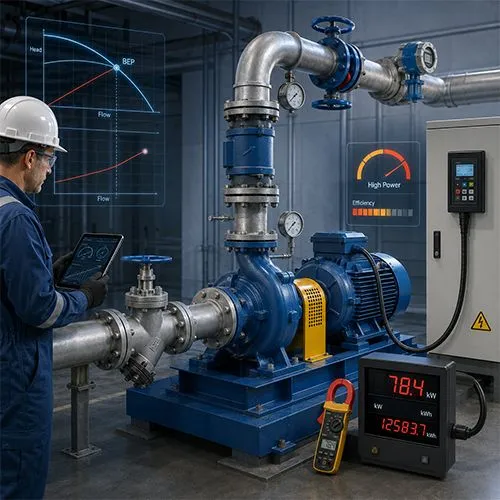
A pump consumes too much power when the actual hydraulic load, operating point, mechanical condition, motor load, or control method does not match the real system requirement. In most industrial pump systems, high power consumption is not caused by one isolated part. It is usually the result of oversized pump selection, excessive throttling, operation far from BEP, high system resistance, worn internal components, poor suction conditions, wrong control logic, unsuitable liquid properties, or motor overload.
For buyers and engineers, the correct question is not only “Why does this pump use too much electricity?” The better question is: which part of the pump system is forcing the motor to draw more kW than the process actually needs?
This guide explains how to diagnose pump high power consumption using flow, head, current, kW, pump curve, system curve, valve position, motor data, liquid data, and field symptoms. It is written for B2B buyers, plant engineers, maintenance teams, EPC contractors, and procurement managers who need to reduce pump electricity cost without creating reliability or process risks.
Quick Answer: Why Do Pumps Consume Too Much Power?
Pumps consume too much power when they produce more flow or head than the system needs, operate far from the Best Efficiency Point, run against excessive system resistance, suffer internal wear, use an oversized impeller, handle liquid with higher density or viscosity than expected, or operate with poor motor and control conditions. In many cases, the pump itself is not “bad”; the pump is working under the wrong duty condition.
Excessive pump power consumption means the measured input kW is higher than the useful hydraulic work required for the real flow and head, after considering pump efficiency, motor efficiency, drive efficiency, liquid properties, and operating hours.
The most common causes are:
- oversized pump selection
- discharge valve throttling
- pump operating far from BEP
- high pipe friction or clogged system components
- wrong impeller diameter
- high flow beyond design point
- poor suction condition or cavitation
- worn impeller, wear rings, or internal clearances
- wrong liquid density or viscosity
- misalignment, bearing friction, or mechanical rubbing
- motor overload or incorrect voltage
- unsuitable VFD settings
- continuous bypass flow
- wrong parallel pump operation
- inaccurate original duty data
Best answer: Pumps consume too much power when they are oversized, throttled, operated far from BEP, forced by high system resistance, affected by wear, or loaded by incorrect liquid, motor, or VFD conditions. The correct diagnosis starts with measured flow, head, kW, current, valve position, pump speed, and pump curve comparison.
30-Second Field Diagnosis: What Should You Check First?
High power consumption often shows clear field symptoms before a major failure happens. This table helps buyers and engineers decide where to start before replacing the motor, adding a VFD, or blaming the pump supplier.
| Field Observation | Likely Meaning | First Action |
|---|---|---|
| Motor current is above normal | Pump may be overloaded or running too far right on curve | Measure flow, head, kW, and compare with power curve |
| Discharge valve is partly closed all the time | Pump may be oversized or energy is being wasted through throttling | Check duty point, valve loss, and impeller size |
| Pump flow is higher than required | Pump may be running beyond design condition | Check system resistance and motor load |
| High discharge pressure but low useful flow | System restriction, clogged filter, closed valve, or wrong head calculation | Check valve position, strainer, filter, and pipe friction |
| VFD is installed but power is still high | Speed may not be reduced enough or static head dominates | Check system curve, setpoint, and actual kW |
| Bearing temperature rises | Mechanical friction or off-BEP load may be increasing stress | Check alignment, lubrication, vibration, and operating point |
| Pump noise or vibration increases | Cavitation, off-BEP operation, or mechanical wear may exist | Check suction condition and pump curve position |
| Electricity cost rises without higher production | Pump efficiency or system resistance may have changed | Compare current flow/head/kW with historical baseline |
| Bypass line is always open | Pump output may exceed useful system demand | Check whether bypass is required or wasting energy |
| Multiple pumps run when one is enough | Poor sequencing or parallel pump mismatch | Check control logic and system demand |
This first check prevents a common mistake: replacing the motor, bearing, seal, or VFD before proving the real energy loss source.
Scope of This Guide: Which Pump Systems Does This Apply To?
This guide mainly applies to centrifugal pump systems where power consumption depends on flow, head, efficiency, pump curve, system curve, motor load, speed, and operating conditions. It is especially useful for water supply, HVAC, cooling water, industrial transfer, municipal pumping, irrigation, RO pretreatment, wastewater transfer, booster systems, process water circulation, and general utility pumping.
It also helps buyers evaluate whether a high electricity bill comes from pump selection, system design, installation, operation, maintenance, or supplier quotation quality.
Applicable Pump Types
This guide is suitable for common industrial centrifugal pumps where power consumption changes with the operating point.
| Pump Type | High Power Risk | Common Cause |
|---|---|---|
| End suction pump | Medium to high | Oversizing, throttling, wrong impeller, worn parts |
| Split case pump | High | Large flow and long operating hours magnify electricity cost |
| Multistage pump | High | Excessive head, wrong stage selection, throttling loss |
| Inline pump | Medium to high | Poor HVAC control, unstable demand, wrong duty point |
| Pipeline pump | Medium to high | Pipe friction, valve loss, wrong system curve |
| Booster pump package | High | Poor pressure setpoint, wrong sequencing, oversized main pump |
| Vertical turbine pump | Medium to high | Wrong water level assumption, high head, worn bowls |
| Submersible pump | Conditional | Motor cooling, cable loss, clogging, solids load |
| Wastewater centrifugal pump | Conditional | Clogging, solids, impeller wear, wrong duty |
| Slurry pump | Special review required | Solids concentration, viscosity, wear, velocity limits |
Use With Adjustment for Special Pump Systems
This guide should be adjusted for slurry pumps, chemical pumps, dosing pumps, fire pumps, screw pumps, diaphragm pumps, and other positive displacement pumps.
For slurry pumps, power consumption may increase because of solids concentration, slurry density, pipe velocity, and wear. For chemical pumps, liquid density, viscosity, vapor pressure, temperature, and seal design may dominate the diagnosis. For fire pumps, required code flow and pressure come before energy saving. For positive displacement pumps, power behavior is different from centrifugal pump curves, so troubleshooting must include pressure relief, viscosity, displacement, and drive torque.
How Pump Power Consumption Is Calculated
Pump power consumption is related to flow, head, liquid density, pump efficiency, motor efficiency, and drive efficiency. A pump that moves more liquid, generates more head, or operates at lower efficiency will consume more power.
A simplified hydraulic power concept is:
Hydraulic Power ∝ Flow × Head × Liquid Density
For a practical metric estimate in water-based pump calculations, buyers can use:
Input Power (kW) ≈ Q (m³/h) × H (m) × SG ÷ 367 ÷ Pump Efficiency ÷ Motor Efficiency ÷ Drive Efficiency
Where:
- Q = flow rate in cubic meters per hour
- H = total dynamic head in meters
- SG = specific gravity of the liquid
- 367 = metric unit conversion factor for water-based calculations
- Pump Efficiency = hydraulic efficiency of the pump at the actual duty point
- Motor Efficiency = motor efficiency at the operating load
- Drive Efficiency = VFD or drive efficiency, if used
This formula is useful for preliminary diagnosis and procurement comparison. Final judgment should still be based on the supplier’s pump curve, power curve, efficiency curve, corrected liquid data, and measured field kW.
For field energy cost, use:
Annual Electricity Cost = Input kW × Operating Hours × Electricity Price
This means a pump can consume too much power for four main reasons:
- The pump is doing more hydraulic work than needed.
- The pump is operating at poor efficiency.
- The motor or drive is losing more energy than expected.
- The system condition forces unnecessary flow, pressure, throttling, or bypass.
A buyer should not judge power consumption by motor nameplate kW alone. Nameplate kW shows motor capacity, not actual pump input power.
High Current vs High kW: Why Buyers Should Not Confuse Them
High current and high kW are related, but they are not the same diagnosis. Current helps identify motor overload risk, while kW is more directly related to electricity cost and real power consumption.
A pump may show high current because hydraulic load is too high, but current can also rise due to low voltage, voltage imbalance, poor power factor, phase imbalance, motor winding issues, cable problems, or VFD output conditions. This is why buyers should not make an energy decision from current alone.
| Measurement | What It Tells You | Buyer Use |
|---|---|---|
| Current (A) | Motor loading and overload risk | Helps decide whether the motor is stressed |
| Input kW | Real power consumption | Helps calculate electricity cost |
| Voltage | Electrical supply condition | Helps explain abnormal current |
| Power factor | Electrical efficiency behavior | Helps interpret current and kVA |
| Frequency / speed | Fixed speed or VFD condition | Helps confirm operating point |
| Motor temperature | Thermal stress | Helps decide whether operation is safe |
| VFD output data | Drive-controlled motor condition | Helps diagnose control or parameter issues |
A site with high current but normal kW may have an electrical power factor or voltage issue. A site with high kW usually has a real energy-cost problem. For pump energy diagnosis, measured kW, flow, head, and pump curve position are more useful than current alone.
Why Oversized Pumps Consume Too Much Power
Oversizing is one of the most common reasons pumps consume too much power. An oversized pump produces more flow or head than the real system needs. To control the excess output, operators often close the discharge valve, open a bypass line, or let the pump operate far away from its efficient region.
This creates hidden energy waste. The pump still consumes power to generate pressure or flow, but part of that energy is destroyed through throttling, bypassing, heat, turbulence, or unstable operation.
Oversizing often happens because buyers or designers add too much safety margin to flow, head, future expansion, or unknown site conditions. While margin is sometimes necessary, excessive margin can turn into long-term electricity cost.
If your site has a pump that runs with permanent throttling, continuous bypass, or high power at low useful flow, this guide on why oversized pumps waste energy can help confirm whether oversizing is the root cause before replacing the motor or adding a VFD.
Why Pumps Running Far From BEP Consume More Power
BEP means Best Efficiency Point. It is the point on the pump curve where the pump operates at its highest hydraulic efficiency for a specific impeller and speed. When a pump runs far from BEP, hydraulic efficiency drops and mechanical stress often increases.
A pump running too far left of BEP usually has low flow and high head. This may cause internal recirculation, heat buildup, vibration, and wasted pressure. A pump running too far right of BEP may deliver excessive flow, increase motor load, reduce NPSH margin, and create cavitation risk.
Power consumption becomes worse when the pump delivers flow or head that the process does not need. A pump can appear to be “working normally” because it still moves liquid, but the operating point may be inefficient or mechanically stressful.
For buyers who need a more detailed method to compare duty point and BEP, this pump BEP operation guide explains how to measure actual flow and head, then plot the operating point on the pump curve.
How Do System Curve Problems Make Pumps Consume More Power?
The pump does not operate alone. It operates against a system curve, which represents static head, pipe friction, valve losses, fittings, filters, strainers, heat exchangers, and process pressure.
If the real system curve is higher or lower than expected, the pump operating point moves. This can increase power consumption.
| System Curve Problem | How It Increases Power | What to Check |
|---|---|---|
| Pipe friction is higher than expected | Pump must generate more head | Pipe diameter, length, elbows, fittings |
| Filter or strainer is clogged | System resistance increases | Differential pressure across filter/strainer |
| Valve is partly closed | Pump energy is wasted as valve loss | Valve position and pressure drop |
| Static head was underestimated | Pump works at higher head | Elevation and tank levels |
| System resistance is lower than expected | Pump may run too far right at high flow | Actual flow, motor current, NPSH margin |
| Heat exchanger or nozzle is restricted | Pump head increases | Pressure before and after equipment |
| Parallel pipe branch is open unexpectedly | Pump delivers extra flow | Valve routing and bypass lines |
| Bypass line is continuously open | Pump moves non-useful flow | Bypass necessity and return path |
A system curve problem is often misdiagnosed as a pump defect. The correct diagnosis requires flow, suction pressure, discharge pressure, valve position, and system layout review.
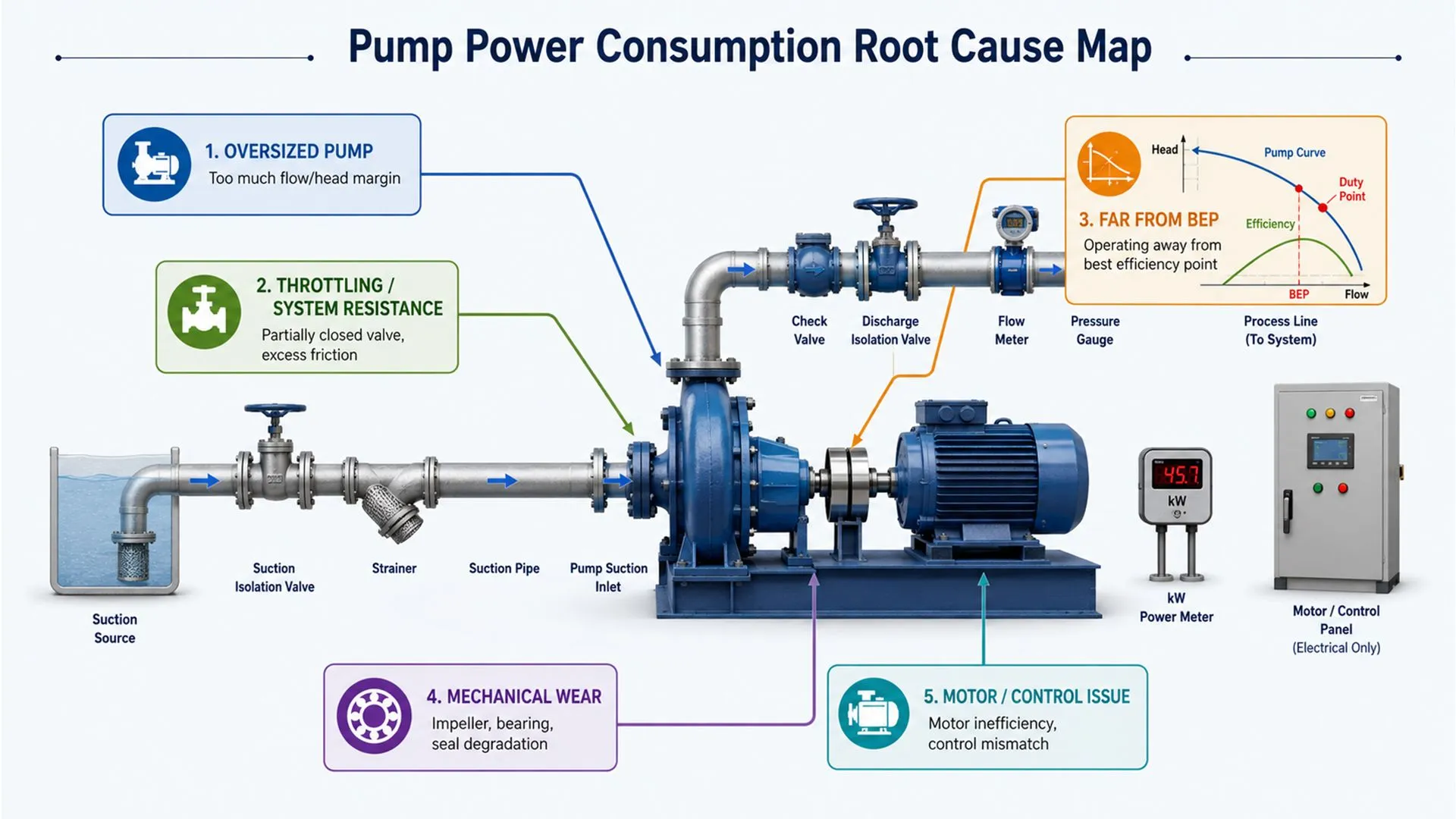
Why Does Discharge Valve Throttling Waste Pump Power?
Discharge valve throttling reduces flow by adding artificial resistance to the system. The pump still generates pressure, but part of the energy is wasted across the partially closed valve.
There is an important engineering nuance: in some centrifugal pumps, throttling may reduce measured kW compared with full-open high-flow operation. However, it still wastes energy compared with a correctly selected pump, impeller trim, or speed control that delivers the same useful duty with lower loss.
Occasional throttling may be acceptable for temporary adjustment. Permanent throttling usually means the pump selection, impeller diameter, control method, or system design should be reviewed.
A throttled pump may show:
- high discharge pressure
- lower useful flow
- high motor current under some conditions
- high kW relative to useful output
- valve noise
- heat generation
- vibration
- energy waste without production benefit
Buyer question: Why are we paying electricity to create pressure that we immediately destroy across a valve?
Corrective options may include impeller trimming, pump resizing, VFD control, multi-pump operation, pipe modification, or process setpoint adjustment.
Why Can Excessive Flow Increase Pump Power Consumption?
Many buyers assume more flow is always good. In reality, excessive flow can increase pump power and create reliability risks.
For many radial-flow centrifugal pumps, power increases as flow moves to the right side of the curve. However, buyers should always confirm this with the supplier’s actual power curve because different pump designs may behave differently.
If system resistance is lower than expected, the pump may run too far right on the curve. This can cause high motor current, high kW, low efficiency, cavitation risk, high pipe velocity, and reduced NPSH margin.
Excessive flow may happen when:
- pipe diameter is larger than assumed
- discharge valve is fully open in a low-resistance system
- bypass line is open
- operating head is lower than design
- the impeller is too large
- pump speed is too high
- multiple pumps run together unnecessarily
- downstream demand is uncontrolled
The solution is not simply to restrict flow blindly. The buyer should compare actual flow, actual head, and measured kW with the pump curve and power curve.
Why Worn Pump Components Increase Energy Use
A worn pump may consume more power per useful unit of flow because efficiency declines. The motor may not always draw more kW immediately, but the site may need longer runtime, more pumps, higher speed, or more pressure to achieve the same useful output.
Wear may reduce hydraulic output faster than it reduces input kW. As a result, the pump may consume more kWh per cubic meter even if motor current does not increase sharply.
Common worn components include:
- impeller
- wear rings
- casing internal surfaces
- diffuser or volute passages
- bearings
- mechanical seals
- shaft sleeves
- coupling
- internal clearances
When wear ring clearance increases, more liquid recirculates inside the pump instead of moving to the system. The pump may run longer to deliver the same useful flow. When impeller surfaces corrode or erode, hydraulic efficiency drops. When bearings or alignment deteriorate, mechanical friction and vibration can increase.
If the pump’s energy use has risen over time while the duty condition seems unchanged, this pump efficiency decline troubleshooting guide can help separate internal wear from system resistance and operating point problems.
Why Liquid Density and Viscosity Affect Pump Power
Pump power increases when the liquid is heavier or more viscous than expected. Many pump selections assume clean water or water-like liquid. If the real liquid has higher density, solids, chemicals, oil, sludge, slurry, or higher viscosity, the motor may draw more power.
Liquid density affects the hydraulic power required for the same flow and head. Viscosity can reduce pump efficiency, increase friction losses, and change the pump curve. Slurry can increase power through density, solids loading, pipe friction, and wear.
Buyers should check:
- liquid density
- viscosity
- temperature
- solids content
- chemical concentration
- specific gravity
- slurry concentration
- vapor pressure
- seasonal liquid changes
A pump selected for clean water may not be suitable for heavier industrial liquid without correction factors or a different pump design.
Why Motor and Electrical Problems Cause High Power Readings
Sometimes the pump is not the only issue. Motor and electrical conditions can make current or kW readings look abnormal. However, buyers must distinguish between high current and true hydraulic overload.
Electrical issues may include:
- low voltage
- voltage imbalance
- phase imbalance
- wrong motor connection
- poor cable sizing
- excessive cable length
- poor grounding
- motor insulation degradation
- incorrect frequency
- overloaded motor
- poor power factor
- VFD parameter errors
- harmonic distortion
A motor may draw high current because the pump load is too high, but it can also draw abnormal current because of electrical supply problems. This is why field diagnosis should include both pump-side and electrical-side measurements.
Important data include voltage, current, kW, power factor, frequency, motor temperature, VFD output, and motor nameplate data.
Why VFD Does Not Always Reduce Pump Power
A Variable Frequency Drive can reduce pump power when speed reduction matches real system demand. However, VFD does not automatically solve high power consumption.
VFD savings may be weak when:
- flow demand is stable
- static head is high
- minimum flow cannot be reduced
- pressure setpoint is too high
- the pump is severely oversized
- sensors are placed incorrectly
- operators run the pump at full speed most of the time
- the motor is not suitable for VFD operation
- the system curve does not support meaningful speed reduction
- commissioning does not verify kW savings
For buyers comparing control methods, this VFD vs fixed speed energy comparison guide explains when VFD saves energy and when fixed speed may be more cost-effective.
A VFD should be selected based on duty profile, system curve, static head, friction head, payback calculation, motor compatibility, and commissioning verification—not sales claims.
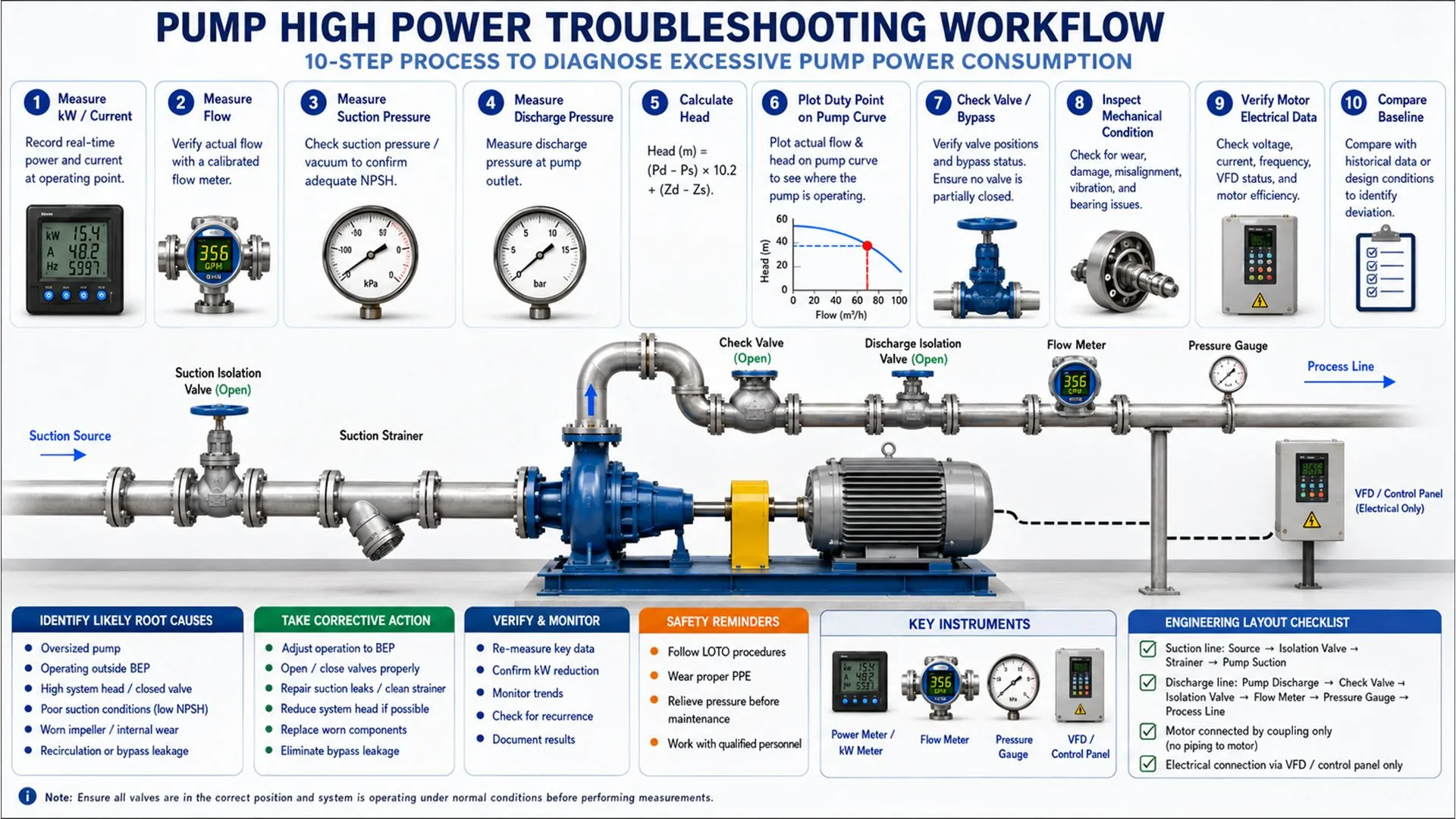
Step-by-Step Troubleshooting: How to Diagnose Pump High Power Consumption
High power consumption should be diagnosed in a sequence. If the buyer checks only the motor or only the pump, the root cause may be missed.
Step 1: Confirm Whether Power Is Actually Too High
First, confirm the difference between expected power and measured power. Compare measured kW, motor current, and operating hours with the supplier’s power curve, motor nameplate, previous operating baseline, and current production demand.
Do not rely only on current. Current can be affected by voltage, power factor, and motor conditions. Measured kW is more useful for energy cost analysis.
Step 2: Measure Actual Flow
Flow is essential. Without actual flow, the pump operating point cannot be located on the curve.
Use a permanent flow meter, temporary ultrasonic flow meter, tank drawdown method, process instrumentation, or calibrated site data. Document the method because inaccurate flow readings can lead to wrong conclusions.
Step 3: Measure Suction and Discharge Pressure
Suction and discharge pressure are required to calculate pump head. Discharge pressure alone is not enough.
Record suction pressure, discharge pressure, liquid level, elevation difference, gauge location, liquid density, and operating speed. For formal testing, velocity head and instrument accuracy may also be required.
Step 4: Calculate Actual Head
After measuring pressure and elevation, calculate actual pump head. Then compare it with the design duty head and pump curve.
If actual head is much higher than expected, the system may have restrictions, closed valves, clogged strainers, or wrong elevation assumptions. If actual head is much lower than expected and flow is high, the pump may run too far right and overload the motor.
Step 5: Plot the Operating Point on the Pump Curve
Plot actual flow and head on the pump curve. Then check the efficiency curve, power curve, BEP, preferred operating range, and NPSHr curve.
This step tells whether the pump is operating near a reasonable region or far from the intended selection point.
Step 6: Check Valve Position and Bypass Flow
Valve position can reveal hidden energy waste. A pump with a throttled discharge valve or continuous bypass may consume high power even when useful flow is low.
Check suction valve, discharge valve, check valve, control valve, bypass valve, recirculation line, and downstream branch valves.
Step 7: Inspect Mechanical Condition
Mechanical problems can increase power, vibration, heat, and failure risk. Check coupling alignment, bearing condition, lubrication, seal rubbing, shaft runout, impeller rubbing, internal clearances, and vibration trend.
If mechanical friction is severe, the pump should not continue running until the problem is understood.
Step 8: Check Motor and Electrical Data
Record voltage, current, kW, power factor, frequency, VFD speed, VFD output current, motor temperature, and phase balance. Compare the values with the motor nameplate and rated operating condition.
Electrical problems can make a pump appear overloaded even when the hydraulic load is acceptable.
Step 9: Compare With Historical Baseline
A baseline is extremely useful. Compare current flow, head, kW, valve position, operating hours, and production demand with previous months or commissioning data.
If kW increased but flow did not increase, look for efficiency decline, system restriction, mechanical friction, or control changes.
How to Decide Whether to Adjust, Repair, or Replace the Pump
After diagnosing the cause, buyers need a practical decision. The answer is not always replacement. The best action depends on whether the problem comes from selection, system resistance, mechanical wear, motor condition, or control strategy.
| Root Cause | Better Action | Buyer Caution |
|---|---|---|
| Oversized pump | Impeller trim, VFD, smaller pump, or multi-pump system | Do not approve without revised curve |
| Permanent throttling | Reduce artificial pressure loss | Check motor load before opening valve |
| High system resistance | Clean filters, open valves, redesign pipe, reduce fittings | Verify required process pressure |
| Excessive flow | Check system curve, reduce speed, adjust impeller | Avoid motor overload and cavitation |
| Worn impeller/wear rings | Repair or replace hydraulic parts | Compare efficiency before and after repair |
| High viscosity/density | Recalculate power and pump suitability | Standard water curve may not apply |
| Poor suction/cavitation | Fix suction layout and NPSH margin | VFD or motor replacement will not solve root cause |
| Motor electrical issue | Correct voltage, wiring, motor, or VFD settings | Separate electrical issue from hydraulic overload |
| Wrong VFD setting | Tune setpoint, speed range, PID, and protection | Avoid low-flow or unstable control |
| Parallel pump mismatch | Correct sequencing or pump combination | Running extra pumps may waste energy |
The safest decision is based on measured data, not assumption. A pump that consumes too much power may need system correction instead of a new pump.
When High Power Consumption Becomes a Safety Risk
High power consumption is not only an electricity cost issue. It can become a safety and reliability issue if the motor runs beyond rated current, bearing temperature rises, vibration increases, or cavitation damages the pump.
Buyers should treat the issue as urgent when:
- motor current exceeds safe operating limit
- motor temperature rises abnormally
- overload protection trips repeatedly
- bearing temperature increases
- vibration rises quickly
- pump produces abnormal noise
- seal leakage appears suddenly
- cable or control panel overheats
- VFD alarms occur repeatedly
- cavitation is suspected
- the pump runs dry or near shutoff condition
In these cases, the priority is equipment protection and process safety. Energy optimization should happen after the unsafe condition is controlled.
When Should You Stop the Pump Instead of Continuing Operation?
A pump with slightly elevated energy use may be monitored while data is collected. A pump showing rapid mechanical, electrical, or hydraulic deterioration should be stopped or unloaded before damage becomes more expensive.
| Condition | Continue Monitoring | Stop and Inspect |
|---|---|---|
| kW slightly above expected but stable | Yes, collect flow/head/kW data | Not usually immediate |
| Motor current above rated limit | No, reduce load if possible | Yes, if overload continues |
| Bearing temperature rising quickly | No | Yes |
| Severe cavitation noise | No | Yes, check suction and NPSH |
| Vibration increasing rapidly | No | Yes |
| Repeated overload trips | No | Yes |
| VFD alarms repeated | No | Yes, check control/electrical settings |
| Cable or panel overheating | No | Yes |
| Seal leakage suddenly increases | Monitor only if minor and stable | Yes, if leakage is abnormal |
| Pump runs near shutoff for long periods | No | Stop or restore minimum flow |
This table helps buyers avoid a dangerous mistake: continuing operation only because the pump is still moving liquid. A pump can still deliver flow while damaging the motor, bearings, seal, or impeller.
Who Is Responsible When a Pump Consumes Too Much Power?
When a pump consumes too much power, responsibility may belong to the buyer, designer, pump supplier, installer, electrical team, commissioning team, or maintenance team. The problem should be judged by data, not assumptions.
| Role | Responsibility | Common Failure |
|---|---|---|
| Buyer / End User | Provide real duty profile, operating hours, liquid condition, electricity price, and future demand | Only gives peak flow and design head |
| Engineering Designer | Calculate system curve, static head, pipe friction, valve losses, and suction condition | Underestimates real system resistance or ignores operating variation |
| Pump Supplier | Provide pump curve, efficiency curve, power curve, BEP, NPSHr, selected duty point, and motor load | Quotes only flow, head, and motor kW |
| Installer / Contractor | Build correct suction/discharge layout, valves, gauges, supports, and pipe routing | Adds extra elbows, restrictions, poor supports, or poor valve layout |
| Electrical Team | Verify voltage, current, phase balance, grounding, cable sizing, motor data, and VFD parameters | Treats hydraulic overload as only a motor issue |
| Commissioning Team | Measure flow, head, kW, current, vibration, valve position, and compare with curve data | Only checks whether the pump starts |
| Maintenance Team | Track wear, clogging, alignment, bearing condition, lubrication, valve changes, and baseline changes | Lets wear, blockage, or poor valve position become “normal operation” |
This responsibility boundary helps procurement teams handle disputes. If the pump matches its curve but the system curve was wrong, the root cause may be system design or duty data. If the pump does not match its published curve under valid test conditions, the supplier may need to explain the performance deviation.
Procurement Checklist: How to Avoid Buying a High-Power Pump System
Many high power problems start before the pump is installed. The RFQ may contain incomplete duty data, excessive safety margin, wrong liquid assumptions, or no requirement for curves.
A buyer should include the following information in the RFQ:
- normal flow
- peak flow
- minimum flow
- total dynamic head
- static head
- pipe length and diameter
- valve and fitting details
- liquid density
- viscosity
- temperature
- solids content
- operating hours per day
- annual operating hours
- electricity price
- control method
- VFD requirement if applicable
- duty profile
- required efficiency
- allowed motor load
- commissioning acceptance data
The buyer should not approve a pump only because the flow and head match one point. The supplier must show how much power the pump consumes at normal duty, peak duty, and part-load duty.
Supplier Verification: What Data Proves the Pump Will Not Waste Power?
A professional supplier should prove power consumption using curves and assumptions. If the supplier cannot show power at the actual duty point, the buyer cannot compare life-cycle cost.
| Required Data | Why It Matters |
|---|---|
| Pump curve | Shows flow-head relationship |
| Efficiency curve | Shows efficiency at duty point |
| Power curve | Shows shaft power across the operating range |
| NPSHr curve | Checks suction risk at selected duty |
| BEP location | Shows whether duty point is efficient |
| Preferred operating range | Shows safe continuous operating area |
| Impeller diameter | Helps evaluate trimming or future correction |
| Motor size and service factor | Confirms overload margin |
| Liquid correction data | Required for viscosity, density, slurry, chemicals |
| System curve | Shows whether selected pump matches real system |
| VFD calculation if used | Proves expected kW reduction |
| Annual energy estimate | Supports life-cycle cost comparison |
| Test report if required | Confirms performance before shipment |
| Commissioning checklist | Confirms field performance after installation |
A supplier who only quotes model, flow, head, and motor kW is not giving enough information for energy-sensitive projects.
Supplier Red Flags When Discussing Pump Power Consumption
A buyer should be cautious when a supplier makes energy claims without data. High power consumption problems are expensive, and poor quotation quality often becomes a field problem later.
| Supplier Red Flag | Why It Is Risky | What Buyers Should Request |
|---|---|---|
| No power curve | Pump kW cannot be verified | Ask for shaft power curve |
| No efficiency curve | Energy performance is unclear | Ask for efficiency at normal duty |
| Duty point not marked | Buyer cannot see curve position | Ask supplier to mark normal and peak duty |
| Only motor kW is shown | Motor size does not prove energy use | Ask for input kW or shaft power |
| No system curve review | Pump may not match real site | Provide site data and request curve comparison |
| No liquid correction | Viscosity or density may be ignored | Ask for corrected power calculation |
| No VFD payback calculation | Energy saving claim is unproven | Ask for duty-profile-based estimate |
| No minimum flow check | Pump may be damaged at low flow | Ask for minimum continuous stable flow |
| No commissioning plan | Field energy use cannot be verified | Ask for flow, head, kW, and vibration checks |
| “High efficiency” without numbers | Marketing claim only | Ask for efficiency value at actual duty |
These red flags help procurement teams separate engineering suppliers from price-only suppliers.
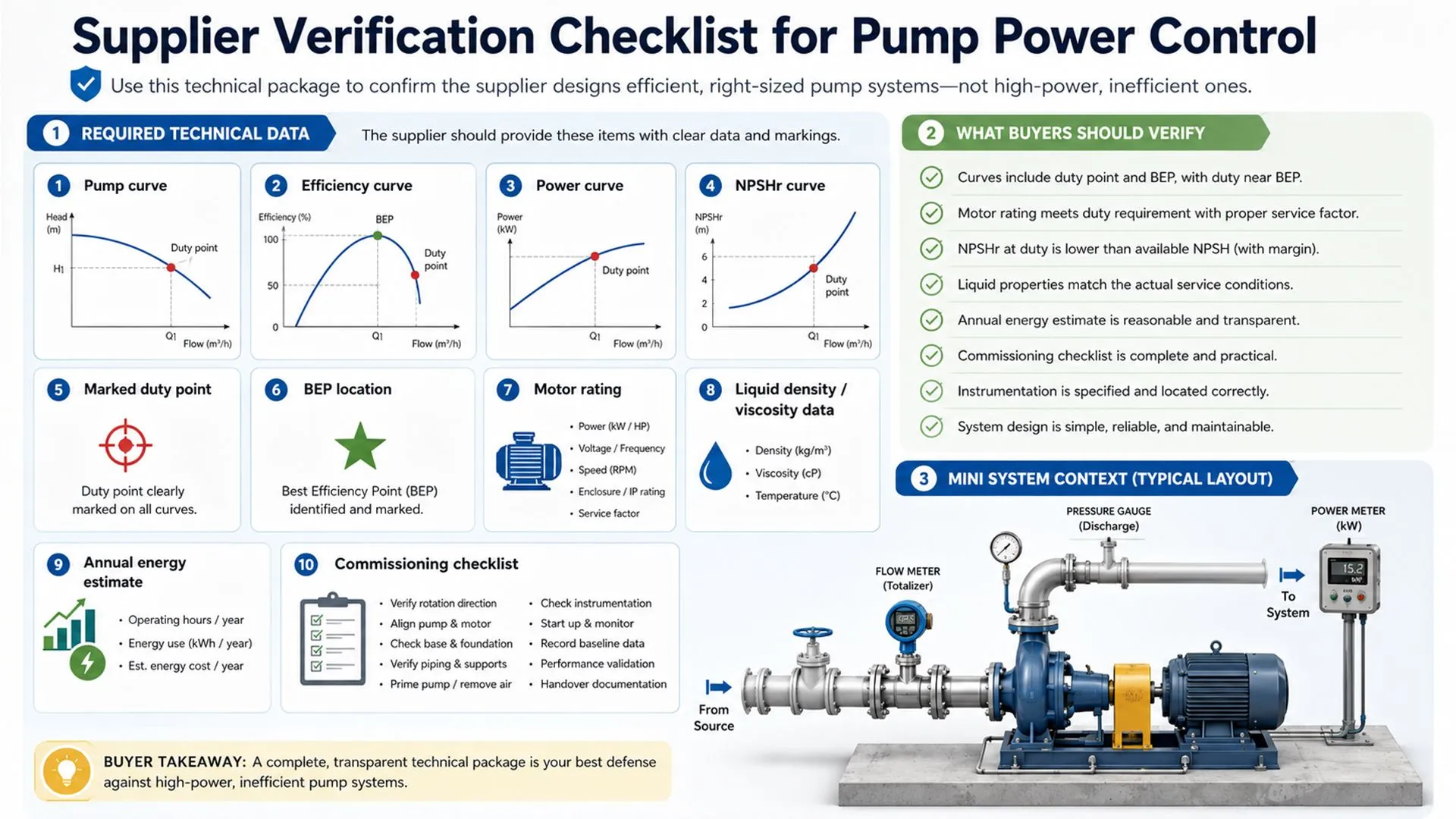
Commissioning Checklist: How to Confirm the Pump Is Not Consuming Excessive Power
Commissioning should verify that the pump works at the expected duty point and power level. A pump that starts successfully is not necessarily operating efficiently.
Buyers should record the following data during commissioning:
| Commissioning Check | Why It Matters | Acceptable Result |
|---|---|---|
| Actual flow | Locates operating point | Matches process requirement |
| Suction pressure | Checks inlet condition | Stable and sufficient |
| Discharge pressure | Helps calculate head | Matches expected head |
| Total dynamic head | Confirms curve position | Close to selected duty |
| Measured kW | Confirms energy use | Matches power curve |
| Motor current | Checks overload risk | Within safe limit |
| Voltage and phase balance | Checks electrical supply | Within acceptable range |
| Pump speed | Confirms fixed or VFD condition | Matches selection basis |
| Valve position | Finds throttling | No unnecessary permanent throttling |
| Bypass flow | Finds wasted flow | No excessive bypass unless required |
| Vibration | Checks hydraulic/mechanical stability | Within site or supplier limit |
| Bearing temperature | Checks mechanical load | Stable |
| Seal leakage | Checks operating stability | No abnormal leakage |
| VFD setpoint | Confirms control logic | Matches process need |
| Baseline data | Supports future comparison | Recorded and stored |
Commissioning data should be kept for future troubleshooting. Without baseline data, buyers may not know whether power consumption increased because of wear, system changes, or control changes.
How to Reduce Pump Power Consumption Safely
Reducing pump power consumption should never compromise process flow, cooling duty, fire safety, slurry velocity, minimum flow, or equipment protection. The right method depends on the root cause.
Practical reduction methods include:
- confirm real duty profile before resizing
- reduce unnecessary throttling
- trim impeller if pump is moderately oversized
- replace severely oversized pump
- use VFD when demand varies and system curve supports speed reduction
- clean strainers, filters, and blocked lines
- correct valve positions
- reduce pipe friction where possible
- repair worn impeller or wear rings
- correct alignment and bearing problems
- verify liquid density and viscosity
- tune control setpoints
- optimize parallel pump sequencing
- record kW baseline after correction
The best energy-saving action is the one that reduces wasted power while still meeting required flow, head, reliability, and safety conditions.
When NOT to Reduce Pump Power Aggressively
Reducing pump power is not always safe. In some applications, lowering speed, trimming impeller, or reducing flow can create a process or equipment risk.
Do not reduce pump power blindly when:
- the pump serves fire protection
- minimum cooling flow is required
- slurry velocity must be maintained
- chemical dosing accuracy is critical
- boiler feed pressure must stay stable
- seal flush flow depends on pump operation
- minimum continuous stable flow is close
- suction conditions are already marginal
- downstream equipment requires fixed pressure
- process safety depends on flow margin
Energy saving should be treated as a system optimization, not a simple reduction in motor load.
FAQ: Buyer Questions About Why Pumps Consume Too Much Power
Buyers usually ask these questions when electricity cost increases, motor current rises, overload trips occur, or suppliers disagree about responsibility. The answers below focus on practical diagnosis and procurement decisions.
Why does my pump consume too much power even though flow looks normal?
The pump may be generating more head than needed, operating at low efficiency, running against a restriction, suffering internal wear, or consuming extra power through mechanical friction. Measure flow, head, kW, and valve position, then compare the operating point with the pump curve.
Why is pump current high but flow is low?
High current with low flow can happen when the pump is running against high system resistance, a closed or throttled valve, clogged filter, mechanical rubbing, bearing problems, wrong voltage, or poor power factor. Measure actual kW, suction pressure, discharge pressure, flow, and motor electrical data before deciding whether the root cause is hydraulic or electrical.
Can an oversized pump cause high power consumption?
Yes. An oversized pump can produce more flow or head than the system needs. If operators throttle the discharge valve or use a bypass to control output, the pump may consume high power while part of the energy is wasted.
Does high motor current always mean the pump is overloaded?
Not always. High current can come from hydraulic overload, excessive flow, wrong voltage, phase imbalance, motor problems, or VFD settings. Measured kW, voltage, power factor, and pump curve position should also be checked.
Can throttling a pump increase electricity cost?
Yes. Throttling wastes energy by adding artificial resistance. The pump still consumes power to generate pressure, but part of that pressure is lost across the valve instead of doing useful work. In some pump curves, measured kW may decrease when throttled, but the system can still be inefficient compared with proper pump selection, speed control, or impeller trimming.
Why does a pump consume more power after maintenance?
Possible causes include wrong impeller diameter, incorrect assembly clearance, rubbing parts, misalignment, bearing issues, changed valve position, or different operating flow. Compare post-maintenance flow, head, kW, and vibration with the previous baseline.
Can a VFD reduce pump power consumption?
Yes, if demand varies and speed reduction matches the system curve. A VFD may not save much energy if the system has mostly static head, constant demand, poor sensor placement, minimum flow limits, or severe oversizing.
Why does a pump consume too much power when the discharge valve is fully open?
The pump may be running too far right on the curve, delivering excessive flow and overloading the motor. Check actual flow, head, power curve, motor current, and NPSH margin.
Can worn pump parts increase power consumption?
Yes. Worn impellers, wear rings, internal clearances, and rough hydraulic surfaces can reduce efficiency. The pump may consume more kWh per cubic meter even if motor current does not rise sharply.
Does liquid viscosity increase pump power?
Yes. Higher viscosity can increase friction losses, reduce pump efficiency, and change pump performance. A pump selected for clean water may consume too much power when handling viscous liquids or slurry.
Should I replace the motor if the pump consumes too much power?
Not before diagnosing the root cause. A larger motor may avoid overload trips, but it does not solve hydraulic waste, oversizing, throttling, poor efficiency, or system resistance. First measure flow, head, kW, and curve position.
Can a larger motor solve high pump power consumption?
A larger motor may prevent overload trips, but it does not reduce energy waste. If the pump is oversized, throttled, worn, or operating far from BEP, the larger motor may simply allow the system to keep wasting power safely. The root hydraulic or system problem should still be corrected.
Why does pump power rise after changing the impeller?
Pump power may rise after changing the impeller if the new impeller has a larger diameter, different hydraulic design, tighter clearance, incorrect assembly, or causes the pump to run at a higher flow point. The new impeller should be checked against the revised pump curve and measured kW.
How do I prove whether the pump or the system is responsible?
Measure actual flow, suction pressure, discharge pressure, kW, current, valve position, and speed. Plot the operating point on the pump curve and compare it with the system curve. If the pump matches its curve but the operating point is wrong, the system or selection data may be responsible.
What should I ask suppliers before buying a pump to avoid high power cost?
Ask for pump curve, efficiency curve, power curve, NPSHr curve, selected duty point, BEP, preferred operating range, motor load, liquid correction, annual energy estimate, and commissioning checklist. Do not approve only based on flow, head, and motor kW.
Conclusion: How Buyers Should Reduce Excessive Pump Power Consumption
Pumps consume too much power when the pump system uses more hydraulic, mechanical, or electrical energy than the process actually needs. The cause may be oversized selection, throttling, off-BEP operation, high system resistance, excessive flow, worn hydraulic parts, wrong liquid assumptions, poor suction, motor issues, VFD problems, or weak commissioning.
The correct solution is not to guess. Buyers should measure actual flow, head, kW, current, speed, valve position, vibration, and operating hours, then compare those values with the pump curve, power curve, efficiency curve, system curve, and historical baseline.
For procurement teams, the most important lesson is simple:
Do not buy a pump only by flow, head, and price. Buy it by verified duty point, power curve, efficiency at real operation, system compatibility, energy cost, supplier transparency, and commissioning proof.
A pump that costs less on the purchase order may become expensive if it consumes too much power for years. A well-selected pump system should deliver the required flow and head with the lowest safe life-cycle cost, not only the lowest initial price.
Get A Quote

Get A Quote
0 Comments