
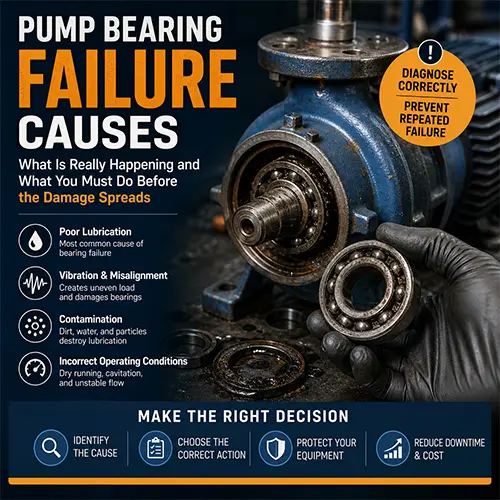
Pump Bearing Failure Causes: What Is Really Happening and What You Must Do Before the Damage Spreads
Introduction
Pump bearing failure is one of the most common warning signals in industrial rotating equipment systems, but it is also one of the most frequently misjudged problems.
In most real-world situations, users see noise, vibration, or overheating and immediately conclude that the bearing itself has failed. They replace the bearing, restart the pump, and then face the same failure again. This repeated cycle does not happen because of poor bearing quality. It happens because the operating conditions of the system are wrong.
A pump bearing (a rolling element component that supports the shaft and reduces friction) depends on several critical conditions to operate correctly: stable load, proper lubrication, correct alignment, low vibration, and clean operating environment. When any of these conditions become unstable, the bearing does not simply “wear out”—it is forced into failure.
From a user or maintenance perspective, the key questions are not about the bearing itself, but about decision-making:
- Should you stop the pump immediately or keep it running?
- Is the bearing the root cause or just the first failed component?
- Will replacing the bearing solve the problem, or create repeated downtime?
This guide is written to answer those questions step by step, so you can act based on evidence instead of guesswork.
How to Judge the Severity Before Taking Any Action
Before opening the pump or planning any repair, the first step is always to understand the severity of the situation. Bearing failure develops progressively, but once instability starts, the damage accelerates quickly.
If the pump is producing a slight, stable noise and the temperature remains within a normal range, the system is still in an early stage. In this condition, short-term operation may be acceptable while preparing for inspection.
However, if noise is accompanied by rising temperature or increasing vibration, the situation has already moved beyond a stable condition. The internal rolling elements are likely experiencing surface damage, and continued operation will increase friction and heat.
If you hear grinding noise or feel strong vibration, the bearing is no longer functioning correctly. At this stage, the failure is advanced, and continued operation can damage the shaft, mechanical seal (a device used to prevent fluid leakage along the shaft), and even the motor.
| Observed Condition | What It Indicates | Recommended Action |
| Slight stable noise | Early wear or lubrication issue | Monitor and plan inspection |
| Noise + rising temperature | Internal damage starting | Plan shutdown within hours |
| Noise + increasing vibration | Mechanical instability | Stop as soon as possible |
| Grinding / seizure | Severe failure | Immediate shutdown |
A practical rule used in field maintenance is:
If temperature or vibration is increasing over time, the system is no longer stable and should not continue running.
Why Pump Bearings Fail in Real Systems
In textbooks, bearing failure is usually explained through categories such as lubrication failure, misalignment, or contamination. While these categories are correct, they do not fully explain what happens in real systems.
In practice, most bearing failures come from system-level problems, not isolated component issues.
Field data shows that lubrication-related problems account for more than half of bearing failures. However, this does not always mean “no grease.” It often means incorrect lubrication—wrong type, contamination, or over-lubrication.
Misalignment between the pump and motor shafts (the rotational centerline of the rotating assembly) is another major cause. Even small deviations create uneven load distribution, which gradually damages the bearing.
Contamination is often underestimated. Water, dust, or process fluid entering the bearing housing can destroy the lubrication film and cause rapid surface damage.
Finally, operating conditions such as running away from the Best Efficiency Point (BEP, the flow rate at which the pump operates most efficiently), cavitation (formation and collapse of vapor bubbles in liquid), or blocked discharge can significantly increase the load on the bearing.
The most important principle is:
Bearings do not fail randomly. They fail because operating conditions exceed what they are designed to handle.
How Flow Problems Can Indirectly Damage Bearings
One of the most overlooked causes of bearing failure is unstable hydraulic operation.
If the pump is not delivering a stable flow—due to air entering the suction line (the inlet piping of the pump), loss of prime (the condition where the pump loses its internal liquid fill), or blockage—the load on the rotating components becomes unstable.
This unstable load is transmitted directly to the bearing. Over time, it leads to fatigue, overheating, and eventual failure.
If your system has experienced conditions such as dry running (operation without sufficient liquid), unstable discharge, or repeated priming issues, you should first verify whether the pump is operating correctly.
If you need to confirm whether your system is experiencing hidden flow instability, the pump runs but no water flow troubleshooting guide can help you identify suction problems, air leaks, or blockage that may be placing abnormal stress on the bearing.
A key decision rule here is:
If the pump is not operating under stable flow conditions, replacing the bearing alone will not solve the problem.
How Lubrication Failure Leads to Rapid Bearing Damage
Lubrication is the most critical factor for bearing survival.
A bearing relies on a thin lubrication film to separate metal surfaces. This film reduces friction and carries heat away from the contact zone. When this film is lost or degraded, metal-to-metal contact occurs, causing rapid temperature increase and surface damage.
When inspecting lubrication, the condition tells you the story:
- Burnt or dry grease indicates overheating or lack of lubrication
- Milky oil indicates water contamination
- Dark or dirty lubricant indicates contamination or aging
- Excess lubricant indicates over-lubrication
| Lubrication Condition | Interpretation | Required Action |
| Dry or burnt | Severe overheating | Replace bearing and restore lubrication |
| Contaminated | External ingress | Clean system and improve sealing |
| Excess grease | Over-lubrication | Reduce lubrication quantity |
| Contamination Type | Source | Correct Action |
| Water ingress | Seal failure or environment | Improve sealing system |
| Dust or dirt | External environment | Upgrade protection |
| Metal particles | Internal wear | Inspect internal components |
If contamination is not eliminated, replacing the bearing will only restart the failure cycle.
When Bearing Failure Is Actually a System-Level Problem
In many cases, bearing failure is not a standalone issue. It is part of a broader system problem.
For example, if a pump operates under unstable conditions—such as cavitation, low flow, or fluctuating pressure—the entire rotating assembly is affected. Bearings and mechanical seals (shaft sealing components) often fail together under these conditions.
If your system shows both bearing failure and seal leakage, you should not treat them separately. Understanding how seal failure develops under unstable conditions can help prevent repeated damage. The pump seal troubleshooting guide explains how these failures are connected.
How to Decide: Keep Running or Shut Down
This is the most important decision from a user perspective.
If the system is stable—no increasing temperature, no rising vibration—you may continue operating for a limited period while preparing maintenance.
If instability appears, such as rising temperature or increasing vibration, the risk is no longer controlled. Continued operation may cause secondary damage.
If severe symptoms appear, such as grinding noise or sudden vibration spikes, shutdown is mandatory.
| Condition | Decision |
| Stable condition | Short-term operation allowed |
| Increasing instability | Plan shutdown immediately |
| Severe symptoms | Immediate shutdown required |
A practical decision rule is:
If you are unsure whether it is safe to continue running, it usually is not.
Cost Impact: Why Correct Diagnosis Matters
From a business perspective, bearing failure is not just a technical issue—it is a cost decision.
Replacing a bearing is relatively inexpensive. However, repeated failures lead to:
- Increased labor cost
- Production downtime
- Secondary damage (shaft, seal, motor)
In many industrial cases, early diagnosis and correct action reduce total cost significantly.
FAQ — What You Need to Decide in the Field
This section answers the most critical real-world questions that engineers and maintenance teams face when dealing with pump bearing failure. Instead of general explanations, each answer focuses on decision-making—helping you determine whether to continue running, shut down, or take corrective action immediately.
Should I stop the pump immediately if the bearing is noisy?
If the noise is slight and stable, and there is no increase in temperature or vibration, you can continue running for a short period under monitoring. However, if the noise becomes louder, irregular, or is combined with rising temperature or vibration, you should stop the pump as soon as possible.
The key decision factor is whether the condition is stable or worsening.
If it is worsening, continued operation will rapidly increase damage risk.
How long can a failing bearing keep running?
The remaining operating time depends on how quickly the condition is deteriorating.
- Stable condition → may run for hours to days with monitoring
- Increasing vibration or heat → typically hours before failure
- Severe symptoms (grinding, rapid heat rise) → failure can occur within minutes
In practical terms, once instability begins, bearing failure accelerates exponentially rather than linearly.
Why does a new bearing fail again quickly after replacement?
A new bearing fails quickly when the root cause has not been corrected.
The most common causes include improper lubrication, shaft misalignment, vibration, or contamination. In these cases, the bearing is not the problem—it is reacting to system conditions.
If the system continues operating under the same conditions, the new bearing will fail faster than the previous one.
Can I keep running a pump with a damaged bearing?
You can only continue running under strict conditions:
- Temperature must remain stable
- Vibration must not increase
- Noise must not worsen
Even under these conditions, operation should be limited to a short period while preparing for shutdown and repair.
Long-term operation with a damaged bearing will lead to secondary failures, including shaft wear and mechanical seal damage.
How can I tell whether the problem is lubrication or vibration related?
Lubrication-related problems usually present as overheating and abnormal grease condition, such as burnt, dry, or contaminated lubricant.
Vibration-related problems typically present as unstable operation, increasing noise, and uneven wear patterns.
If both heat and vibration are present, the issue is likely a combination of lubrication breakdown and mechanical instability.
When should I replace the entire pump instead of repairing it?
Pump replacement should be considered when failures are repeated and multiple components are affected, such as bearings, seals, and shaft surfaces.
If the system cannot maintain stable operating conditions or repair costs continue to increase, replacement may be more economical than repeated maintenance.
Conclusion
Pump bearing failure is not just a component problem—it is a system signal.
If you replace the bearing without understanding the cause, the failure will repeat. If you diagnose the system correctly, you solve the problem once.
The correct approach is always:
- Observe the symptoms
- Identify the cause
- Correct the system
- Then replace the bearing
A bearing does not fail on its own. It fails because the system forces it to.
Get A Quote

Get A Quote
0 Comments