
Why Pump Won’t Prime or Start: Full Troubleshooting Guide to Get It Running Again
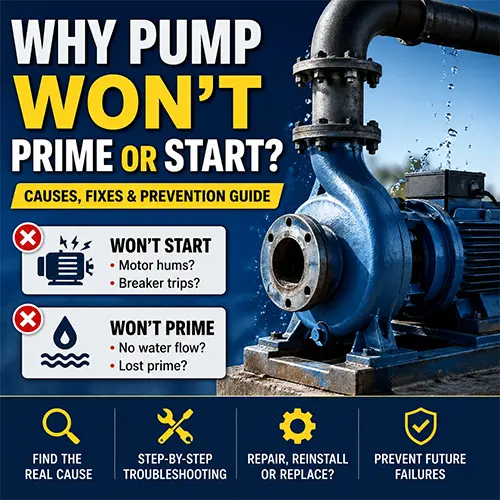
Introduction
When a pump refuses to prime or start, most users are not looking for technical theory. They usually need water, pressure, cooling, irrigation, drainage, or production restored as soon as possible. The pump may have worked yesterday and failed today. A new installation may never have worked correctly. The motor may hum but not turn, or it may run normally while no water comes out.
At that moment, most people ask the same practical questions. Is the pump seriously damaged? Can I fix it myself? Should I keep trying to restart it? Is the problem electrical, mechanical, or related to suction? Is it smarter to repair this unit or replace it?
The good news is that many pump no-start and no-prime problems are caused by basic issues such as air leaks, empty casing, valve position, wrong rotation, blocked strainers, weak capacitors, or poor installation conditions. These problems are often much cheaper to solve than users expect.
This guide is written for maintenance teams, contractors, irrigation users, building operators, and pump owners who need a logical way to diagnose the problem. If you follow the sequence below, you can usually narrow the fault quickly and avoid unnecessary replacement costs.
If you manage pumps regularly, it is also worth reviewing the LIQEN Pump Insights Blog for additional maintenance and pump selection guides.
The goal is simple:
Separate the real cause fast, restore operation safely, and avoid damaging the motor through guesswork.
First Decide: Is It a Starting Problem or a Priming Problem?
Before checking parts, first identify which type of failure you are facing. Many users lose time because they treat every pump failure as the same issue.
If the motor does not run correctly, you are dealing with a starting problem. The motor may be silent, hum only, trip the breaker, or attempt to start and stop immediately.
If the motor rotates normally but no water moves, you are dealing with a priming or suction problem. In this case, the electrical side may be healthy, but the pump cannot establish flow.
This distinction matters because the repair path is completely different.
| What You See | Likely Direction |
| Motor silent | Power or control issue |
| Motor hums only | Capacitor or jammed shaft |
| Breaker trips | Electrical overload or locked rotor |
| Motor runs but no water | Priming or suction issue |
| Low pressure only | Air leak or wrong rotation |
A useful rule is simple:
If the shaft does not turn, think start problem. If the shaft turns but no water moves, think priming problem.
If the Pump Will Not Start at All
When the pump is completely silent, begin with the simplest possibilities first. Many users assume the motor is burned out, but the real cause is often upstream.
Check whether the breaker is on, the fuse is intact, the control panel has power, and any emergency stop circuit is reset. On commercial systems, overload relays may also need resetting after a trip event.
If power is available and the pump still remains silent, control components such as pressure switches, float switches, contactors, timers, or relay circuits may be interrupting the start signal.
Before replacing the motor, always confirm the pump is actually receiving power.
If the Motor Hums but Does Not Turn
A humming motor usually means electricity is reaching the motor, but the motor cannot create enough starting torque.
On many single-phase pumps, the most common cause is a failed capacitor. Capacitors weaken with age, heat, and moisture. When they fail, the motor hums but struggles to rotate.
Mechanical resistance is another common cause. Worn bearings, seized shafts, rust after long idle periods, or debris trapped in the impeller can prevent rotation.
Repeatedly leaving a humming motor energized is risky because heat rises quickly.
Turn power off first. If the design allows safe inspection, check whether the shaft rotates manually. If it turns freely, starting components become more likely. If it is stiff or locked, solve the mechanical issue before applying power again.
If the Breaker Trips Every Time You Start It
When a breaker trips instantly, the system is protecting itself from excessive current draw or short-circuit conditions.
This often happens when the rotor is locked, bearings are seized, wiring is damaged, or the motor windings are internally faulty. In some cases, the breaker itself may be incorrectly sized.
Do not keep resetting the breaker repeatedly. Each forced restart may create more damage.
Instead, isolate the unit and inspect whether the shaft turns freely. If it does not, the motor may be overloaded mechanically. If it turns normally, electrical testing becomes the next step.
If the Motor Runs but No Water Comes Out
This is one of the most common pump complaints. The motor sounds normal, but the pump delivers no flow.
In many cases, the pump is simply not primed. Centrifugal pumps that are not self-priming require the casing to be filled with liquid before startup. If the casing contains air, the impeller may spin without creating useful suction.
Another common cause is an air leak in the suction line. Even a small leak at a threaded joint, gasket, hose clamp, or cracked pipe can stop the pump from pulling water.
Blocked strainers, closed valves, low source water level, or excessive suction lift height can also prevent priming.
Start by filling the casing fully, then inspect the suction side carefully.
If your system has always struggled to prime, review the efore You Buy a Pump Checklist because many persistent priming issues come from choosing the wrong pump type or installation layout.
If the Pump Loses Prime After Shutdown
Some pumps work normally after manual priming but fail again the next morning. This usually means the system cannot hold water in the suction line after shutdown.
The most common cause is a faulty foot valve or check valve allowing water to drain backward. Once the suction line empties, the next startup begins dry and the pump cannot re-prime itself.
Air leaks can create the same effect. Water drains back slowly while air enters the line.
To diagnose this, prime the pump, shut it down, then inspect whether the suction line remains full hours later.
If recurring suction loss continues, some systems perform better after redesign or by using a Pipeline Pump in a pressurized layout rather than depending on difficult suction lift conditions.
If the Pump Stopped Working Right After Electrical Work
This is especially common on three-phase motors.
The pump may sound normal and rotate, but performance is weak or zero because the motor is spinning in the wrong direction after rewiring.
Check the rotation arrow on the casing. If rotation is reversed, performance may collapse even though the motor sounds healthy.
Correcting phase sequence often solves what appears to be a serious pump failure.
What to Check in the First 10 Minutes
When users panic, they often jump straight to replacement. A better approach is to check the basics first.
| Check Item | Why It Matters |
| Power supply | Confirms start signal exists |
| Motor sound | Gives fast fault clues |
| Shaft movement | Separates electrical vs mechanical issues |
| Pump casing full | Needed for priming |
| Suction leaks | Stops water lift |
| Valve position | Can block flow |
| Water source level | No water in means no water out |
Get A Quote

Get A Quote
0 Comments