
How to Choose the Right Water Pump for Any Application (Complete Buyer’s Guide 2026)
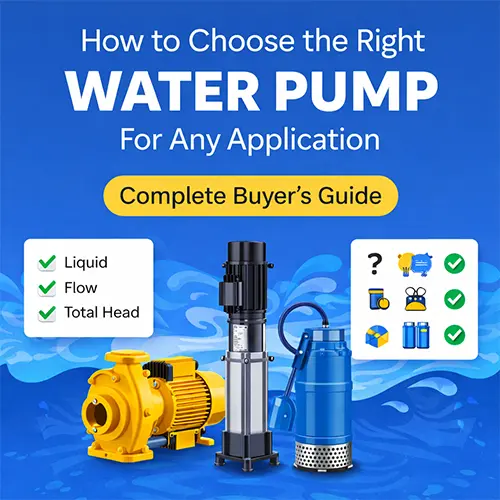
Choosing the right water pump is not about picking the biggest model, the cheapest quotation, or the most familiar pump type. For buyers, the real question is whether the pump can deliver the required water volume, at the required pressure, under the actual site conditions, without creating unnecessary operating cost or maintenance problems.
This is why pump selection should always begin with the application rather than the product catalog. A pump that works well in one project may perform badly in another, even if both projects appear to involve “water transfer.” Clean water, wastewater, booster service, irrigation, RO feed, and long-distance transfer all place different demands on the pump. The liquid itself may be different. The piping system may create more resistance than expected. The required endpoint pressure may be ignored during purchasing. In many failed projects, the pump is not poor-quality; it is simply mismatched to the duty.
This guide is written from the buyer’s point of view. It is designed to help project owners, contractors, engineers, sourcing teams, and distributors understand what should be checked before ordering a pump. The goal is not only to explain the formulas, but also to explain what the numbers mean, how to estimate them in real projects, and how those results affect the final pump choice.
Why Correct Pump Selection Matters
A water pump is part of a complete hydraulic system, not a standalone machine. If the selected pump does not match the real flow, head, liquid condition, and operating environment, the system may still run, but it will not run well. Correct selection reduces risk before purchase and improves long-term reliability after installation.
Many buyers only discover a selection error after the pump has already been installed. At that stage, the cost is no longer only the pump price. It may also include rework, delayed commissioning, extra piping changes, repeated troubleshooting, and customer complaints. That is why pump selection is not just a technical exercise. It is a purchasing decision with direct cost consequences.
A correctly selected pump helps the system reach its design purpose. It delivers the required flow at the required head, works within a reasonable efficiency range, and avoids unnecessary stress on the pump, motor, and piping. A badly selected pump may still move water, but it may do so with weak pressure, excessive noise, unstable flow, high energy use, or short service life.
In practical terms, incorrect selection often causes low pressure at the endpoint, insufficient water during peak demand, excessive electricity consumption, cavitation, seal leakage, vibration, or repeated shutdowns. These are not random failures. In many cases, they are the predictable result of starting the purchasing process from the wrong input.
A professional buyer therefore does not begin by asking, “Which model is cheapest?” A professional buyer begins by asking, “What exactly must this pump do?”
Define the Liquid Type First
Before calculating flow or comparing pump types, define the liquid clearly. The liquid determines the basic pump category, material suitability, seal requirements, and hydraulic passage design. Treating every liquid as ordinary water is one of the most common reasons buyers choose the wrong pump.
From a buyer’s perspective, the liquid is the first filter in pump selection. If this step is wrong, the later calculations may still be correct, but the final recommendation can still fail in operation.
When people say “I need a water pump,” that phrase is often too broad to be useful. The liquid may be clean water from a storage tank, groundwater containing sand, sewage containing fibers, hot process water, mildly corrosive liquid, or slurry with suspended solids. These are not small differences. They directly affect which pump designs are even suitable for consideration.
For example, clean water transfer may start with a centrifugal or end suction pump. A high-pressure clean-water duty may lead toward a multistage pump. Wastewater service may require a submersible sewage pump with solids-handling capability. If the liquid is abrasive, a slurry pump may be more appropriate. If corrosion is a concern, material selection becomes critical, and even a hydraulically suitable pump may still be a poor purchasing choice if the construction material is wrong.
The liquid affects more than one component at the same time. It affects the pump casing, the impeller passage, the seal arrangement, and the expected wear rate. This means buyers should not treat liquid definition as a small descriptive detail. It is a primary selection condition.
In practical purchasing work, buyers should try to answer several basic questions before sending an inquiry. Is the liquid clean or dirty? Are solids present? If so, what kind of solids and how large are they? Is the liquid corrosive? Is it hot? Does it behave like normal water, or is it thicker? Does it contain foam or trapped gas? Even if the answers are approximate, they help move the project toward the correct pump family much faster.
The table below shows how liquid condition changes the likely pump direction.
| Liquid Condition | Typical Example | Common Pump Direction | Main Buyer Concern |
| Clean Water | Tank transfer, domestic water | Centrifugal / End suction | General efficiency and cost |
| High-Pressure Clean Water | RO feed, booster service | Multistage | Pressure capability |
| Dirty Water | Construction drainage | Trash pump | Solids handling |
| Sewage | Pit or sump drainage | Submersible sewage pump | Anti-clogging ability |
| Abrasive Slurry | Mining or sludge transfer | Slurry pump | Wear resistance |
| Corrosive Liquid | Process transfer | Stainless / alloy pump | Material compatibility |
What matters here is not memorizing pump names. What matters is understanding that the liquid tells you whether the pump can both move the liquid and survive the liquid.
A clean-water pump may perform very well in standard transfer service, but the same model may clog or wear quickly in dirty water. A cast iron pump may be cost-effective for ordinary water, but it may corrode rapidly in aggressive liquid. A standard seal may work well at normal temperature, but not in high-temperature service. This is why buyers should never reduce liquid definition to one word if the project is more complex.
The buyer conclusion at this stage is simple: before choosing a pump type, first define the liquid honestly and as specifically as possible.
Calculate the Required Flow Rate
Flow rate tells you how much liquid the system must receive in a given period of time. It is one of the two most important sizing inputs in pump selection. Buyers should not guess this value casually, because both undersized and oversized flow assumptions create purchasing problems.
The most useful way to think about flow is not as a catalog number, but as an operating requirement.
Flow is usually expressed in cubic meters per hour, liters per minute, or gallons per minute. In simple terms, it answers the question: how much liquid must move, and how fast must it move?
For a tank-filling project, the logic is straightforward. If a known tank volume must be filled within a known time, the flow requirement can be estimated directly. The basic formula is:
Flow = Volume ÷ Time
This formula is simple, but what buyers often miss is the meaning behind the result. The calculation does not tell you that any pump with the same catalog flow number will work. It tells you the flow the system must receive under actual operating resistance.
For example, imagine a buyer needs to fill a 30 m³ tank in 2 hours. The calculation is:
Flow = 30 ÷ 2 = 15 m³/h
That means the system needs around 15 cubic meters of water every hour if the tank is to be filled on schedule. The key interpretation is that the selected pump must be able to deliver 15 m³/h at the required total head, not simply under ideal no-resistance conditions.
This distinction matters. A pump curve may show 15 m³/h as one possible point, but if that point occurs only at low head and your system resistance is much higher, the actual installed flow may be lower than planned. The pump would not be “broken”; it would simply be operating away from the required duty point.
A second example makes this easier to understand. Suppose the same 30 m³ tank is supposed to be filled in 2 hours, but after installation the system only receives 10 m³/h. In that case, the actual filling time becomes:
Time = Volume ÷ Flow = 30 ÷ 10 = 3 hours
So the difference between 15 m³/h and 10 m³/h is not just a number on paper. It directly changes operating time, production timing, and user expectations.
Not every system starts from tank volume. In building service or domestic water systems, the flow requirement often comes from simultaneous usage. A buyer may need to estimate how much water is likely to be used at the same time rather than how much water a single outlet can consume.
For example, if a building may simultaneously operate two showers, two faucets, one toilet refill, and one service outlet, the correct flow target should be based on realistic combined demand. It should not be based only on one outlet, and it should also not be based on the unrealistic assumption that every outlet will run at full demand continuously.
This is where buyers often make one of two mistakes. The first mistake is underestimating flow and causing weak system performance. The second mistake is assuming that “more flow is safer,” which often leads to oversizing. Oversized flow can increase motor size, cost, power consumption, and system instability. More flow is not always better. Appropriate flow is better.
The table below provides practical starting ranges for common applications. These are not final design values, but they help buyers think in the right range.
| Application | Approximate Starting Flow Range | What the Buyer Should Consider |
| Small Home Supply | 1–3 m³/h | Number of outlets and peak use |
| Villa / Multi-bathroom House | 3–8 m³/h | Simultaneous demand and pressure comfort |
| Small Irrigation | 5–20 m³/h | Area covered and watering time |
| Commercial Building | 10–50 m³/h | Peak use periods and floor count |
| Industrial Transfer | Case-specific | Process timing, tank size, duty cycle |
The buyer conclusion for flow is this: flow should come from real operating need, not from habit, pipe diameter, or guesswork. Once the target flow is estimated, the next step is to determine how much resistance the system creates. That is where total head becomes critical.
Determine Total Head Correctly
If flow tells you how much water must move, total head tells you how difficult it is to move that water through the system. This is the part of pump selection that many buyers misunderstand, because they look only at vertical lift and ignore pipe resistance and endpoint pressure requirements.
In professional pump buying, total head is not optional. It is one of the core values that determines whether a pump will actually perform in the field.
The most practical simplified formula is:
Total Head = Static Head + Friction Loss + Required Pressure Head
This formula looks simple, but it only becomes useful when each part is clearly understood.
Static head is the visible height difference between the source liquid level and the discharge point. If water is pumped from a ground tank to a roof tank 18 meters above, then the static head is 18 meters. This is the easiest part to visualize, because it is literally the lifting height the water must overcome.
However, many buyers stop at this number and assume the head requirement is finished. That is where the mistake begins. A pump does not only fight height. It also fights resistance inside the piping.
Friction loss is the energy lost as water moves through pipes, bends, valves, filters, strainers, and check valves. In simple terms, the system pushes back against the flow. The longer the pipeline, the smaller the pipe diameter, and the more fittings in the line, the greater this resistance becomes.
Think of water moving through a short, wide, straight pipe. It meets relatively low resistance. Now compare that to water moving through a long, narrower pipe with many elbows and valves. Even if both systems lift water to exactly the same height, the second system demands more pump head because the piping itself consumes more energy.
The table below shows why two systems with the same lift can still need different pump head.
| System | Static Head | Pipe Condition | Expected Friction Loss | Buyer Interpretation |
| System A | 15 m | Short, wide, straight pipe | Low | Lower additional head required |
| System B | 15 m | Long, narrower pipe with many bends and valves | Higher | More pump head required |
This is why buyers should never choose a pump by elevation alone. Two systems can have the same height and still require different pumps.
The third part of total head is required pressure head. In many applications, it is not enough for water to simply arrive at the endpoint. It must arrive with useful pressure.
This matters in building booster systems, shower supply, RO feed systems, process equipment supply, and nozzle or spray applications. If water reaches the endpoint but the remaining pressure is too weak, the pump has not truly met the duty.
A practical rule of thumb is:
1 bar ≈ 10 meters of head
That means:
| Required Pressure | Approximate Head Equivalent |
| 1 bar | 10 m |
| 2 bar | 20 m |
| 3 bar | 30 m |
This conversion helps buyers combine pressure requirement with height and friction into one common unit.
Now consider a full example.
A buyer needs to pump clean water with these conditions:
- Vertical lift = 20 m
- Estimated friction loss = 8 m
- Required endpoint pressure = 2 bar
First, convert the pressure into head:
2 bar ≈ 20 m head
Then apply the formula:
Total Head = 20 + 8 + 20 = 48 m
This is the calculation. But the more important part is the interpretation.
This result does not mean the buyer should simply purchase any pump advertised with a 48-meter maximum head. It means the buyer needs a pump that can deliver the required flow while operating around 48 meters of total head.
If the project also requires 15 m³/h flow, then the real duty point becomes:
15 m³/h @ 48 m head
That is the condition the supplier should match on the pump curve.
This is one of the most important ideas in professional pump buying. Pumps are not selected from one number alone. They are selected from the combination of flow and head at the same time.
Common buyer mistakes in this step include ignoring friction loss, ignoring endpoint pressure, or misunderstanding maximum head as usable working head. These errors often produce a pump that can run, but cannot meet the real application.
The buyer conclusion here is clear: total head is not just the lifting height. It is the complete resistance the system places on the pump.
Choose the Right Pump Type
Once the liquid, required flow, and total head are reasonably clear, pump type selection becomes much easier. This is the stage where many buyers make faster and better decisions, because they are no longer comparing every pump on the market. They are comparing only the pump categories that actually fit the duty.
No pump type is “best” for every application. Each design has strengths, limitations, and typical use cases. The right question is not “Which pump is the best brand or model?” The right question is “Which pump design naturally fits my operating conditions?”
A buyer who understands this avoids wasting time comparing products that were never suitable in the first place.
Centrifugal Pump
A centrifugal pump is one of the most common and widely used pump types for clean-water service. It is often the first option considered for general transfer applications because it is simple, proven, widely available, and cost-effective.
Typical uses include:
- Tank-to-tank transfer
- Cooling water circulation
- Agricultural water movement
- General industrial water service
- Basic supply systems
Buyers often prefer centrifugal pumps because spare parts are easier to source, service teams are familiar with them, and installation is straightforward in many projects.
However, a centrifugal pump is not automatically ideal for high-pressure duties or heavy solids service. Its suitability depends on the required flow and head range.
Multistage Pump
A multistage pump uses multiple impellers in sequence to build higher pressure more efficiently than many single-stage designs.
Typical uses include:
- RO system feed water
- High-rise building boosting
- Boiler feed systems
- Long pressure pipelines
- High-head transfer systems
From a buyer’s perspective, multistage pumps become attractive when the required head is relatively high but the flow demand is moderate or controlled.
For example, if a system needs strong pressure rather than extremely high volume, a multistage pump may be a more natural fit than a standard transfer pump.
End Suction Pump
End suction pumps are a common industrial form of centrifugal pump, usually horizontal and easy to maintain.
Typical uses include:
- HVAC systems
- Municipal water systems
- Factory utility systems
- Cooling and circulation duty
Buyers often like this design because it is standardized, service-friendly, and familiar across many industries.
Submersible Pump
A submersible pump operates underwater or below liquid level.
Typical uses include:
- Wells
- Sumps
- Sewage pits
- Flood drainage
- Underground tanks
Its major advantage is practical installation. Because the pump sits in the liquid, priming problems are often reduced, and it is highly suitable where surface-mounted suction arrangements are difficult.
If the project involves deep wells, pits, or drainage basins, buyers often move quickly toward submersible options.
Self-Priming Pump
A self-priming pump is designed to restart even when air enters the suction line or the casing is not fully flooded.
Typical uses include:
- Portable transfer systems
- Tank unloading
- Temporary site pumping
- Intermittent operation
This design is often chosen not because it is more efficient than every alternative, but because it solves a practical operating problem.
Pump Type Quick Selection Table
| If the Main Need Is | Common Pump Direction | Why |
| General clean-water transfer | Centrifugal | Cost-effective and versatile |
| High pressure | Multistage | Better for higher head duty |
| Easy maintenance industrial use | End suction | Standardized service design |
| Pit, well, sewage, drainage | Submersible | Good for submerged duty |
| Frequent restart with suction lift | Self-priming | Easier startup conditions |
Buyer Conclusion
Do not choose pump type first and then try to force the system around it. First understand the duty, then choose the pump type that naturally suits that duty.
That approach reduces cost, speeds sourcing, and lowers installation risk.
Choose Material Carefully
A pump can be hydraulically correct and still become a poor purchase if the material is wrong. Material selection affects corrosion resistance, wear life, hygiene, maintenance frequency, and long-term ownership cost.
Many buyers compare cast iron and stainless steel only by purchase price. That is often too narrow.
Why Material Matters
The liquid touches the internal wetted parts of the pump. If the material is unsuitable, the result may include:
- Rust or corrosion
- Pitting damage
- Leakage
- Contamination risk
- Faster wear
- Shorter service life
A cheaper material may therefore create higher lifecycle cost.
Common Pump Materials
| Material | Best For | Buyer Advantage | Main Limitation |
| Cast Iron | Standard clean water | Lower purchase cost | Lower corrosion resistance |
| SS304 | Clean water / mild corrosion | Better hygiene and durability | Higher cost than cast iron |
| SS316 | Chlorides / stronger corrosion | Better chemical resistance | Higher price |
| Bronze | Special water service | Good corrosion performance | Niche applications |
| Wear-resistant alloy / lined | Abrasive slurry | Better wear life | Higher specialized cost |
How Buyers Should Decide
If the liquid is ordinary clean water and the environment is controlled, cast iron may be economically reasonable.
If water quality, corrosion risk, or cleanliness matters, stainless steel often becomes more attractive.
If abrasive solids are the real issue, wear resistance may matter more than corrosion resistance.
Buyer Conclusion
Do not ask only: “Which material is cheaper today?”
Ask instead:
Which material gives the lowest real cost over the expected service life?
Select the Right Power Source
The correct pump hydraulically can still be the wrong project decision if the available power source is unsuitable. Power selection affects installation practicality, operating continuity, automation, and long-term running cost.
Electric Motor Drive
Electric motors are the most common option where stable power is available.
Advantages:
- High efficiency
- Lower routine maintenance
- Quieter operation
- Easier automation and control
- Suitable for permanent installations
Common uses:
- Buildings
- Factories
- Water treatment systems
- Utility pumping systems
Diesel Engine Drive
Diesel-driven pumps are common where electrical infrastructure is weak, unavailable, or unreliable.
Advantages:
- Independent of grid power
- Good for remote sites
- Useful for backup duty
- Suitable for mobile or temporary projects
Common uses:
- Agriculture
- Construction sites
- Emergency drainage
- Fire standby systems
Solar Pump Systems
Solar pump systems are often used in remote areas with lower daytime demand.
Advantages:
- Lower daytime energy cost
- Useful off-grid solution
- Good for some irrigation applications
Power Source Comparison Table
| Site Condition | Better Direction | Why |
| Stable building or factory power | Electric motor | Efficient and practical |
| Remote project site | Diesel | Independent operation |
| Backup emergency use | Diesel | Power security |
| Remote daytime irrigation | Solar | Off-grid practicality |
Buyer Conclusion
Do not only ask whether the pump can move water.
Also ask whether the site can reliably power the pump under real working conditions.
Compare Total Ownership Cost
Many buyers compare quotation price only. Professional buyers compare total ownership cost. The cheapest pump to buy is not always the cheapest pump to own.
Real Cost Includes More Than Purchase Price
True cost often includes:
- Equipment price
- Installation cost
- Electricity or fuel
- Spare parts
- Maintenance labor
- Downtime losses
- Replacement interval
- Efficiency penalties
Example Buyer Logic
Suppose Pump A is cheaper initially.
Pump B costs more upfront, but:
- Uses less electricity
- Needs fewer repairs
- Lasts longer
- Creates less downtime
In a low-use project, Pump A may still be acceptable.
In a daily industrial project, Pump B may become the lower-cost decision over time.
Ownership Cost Comparison
| Factor | Lower-Cost Pump | Better Pump |
| Initial Price | Lower | Higher |
| Efficiency | Lower | Higher |
| Maintenance Frequency | Higher | Lower |
| Downtime Risk | Higher | Lower |
| Long-Term Value | Often weaker | Often stronger |
Buyer Conclusion
If the pump runs occasionally, upfront cost may deserve more weight.
If the pump runs every day, lifecycle economics usually matter far more.
Common Buying Mistakes
Many pump problems are created during purchasing, not during manufacturing. The following mistakes are common and expensive.
Buying by Horsepower Only
Horsepower alone does not define whether a pump matches the required flow and head.
Ignoring Pipe Layout
Long pipelines, narrow pipes, elbows, filters, and valves all increase resistance.
Oversizing “for Safety”
A much larger pump may increase capital cost, waste energy, and run inefficiently.
Choosing Lowest Price Supplier Only
Quality consistency, technical support, documentation, and spare parts support matter.
No Pump Curve Confirmation
Always verify that the required flow is available at the required head.
Best Pump by Application
If the buyer only knows the application scenario, this quick guide can help narrow the starting direction.
| Application | Common Starting Direction | Main Reason |
| Home pressure boosting | Multistage booster | Pressure comfort |
| RO system | Stainless multistage | High pressure + water quality |
| Irrigation field | Diesel centrifugal | Remote practicality |
| Wastewater pit | Submersible sewage | Solids handling |
| Factory circulation | End suction | Industrial simplicity |
| Long-distance transfer | Multistage / split case | Head capability |
Final Buyer Checklist
Before placing an order, a buyer should be able to answer the following clearly.
| Item | Confirmed |
| Liquid type | □ |
| Required flow | □ |
| Total head | □ |
| Temperature | □ |
| Solids present | □ |
| Material need | □ |
| Power source | □ |
| Duty cycle | □ |
| Spare parts support | □ |
| Pump curve matched | □ |
Get A Quote

Get A Quote
0 Comments