
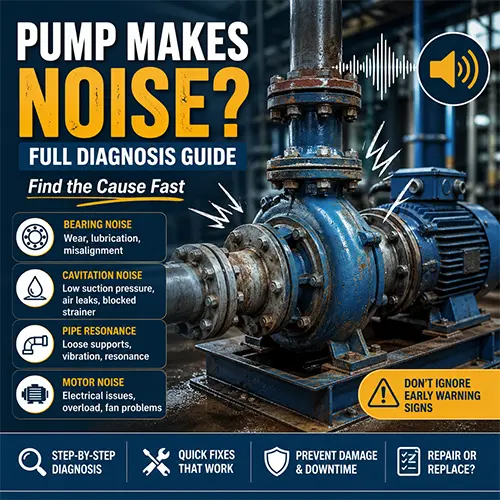
Pump Makes Noise? Full Diagnosis Guide to Find the Cause Fast
Introduction
When a pump starts making noise, most users immediately worry about the same things: Is something broken? Can I keep running it? Will this become expensive if I ignore it?
Those concerns are valid. A pump that suddenly becomes louder, rougher, or develops a new sound pattern is often telling you that operating conditions have changed. In many cases, the noise begins before serious damage appears. That means early diagnosis can save money, avoid downtime, and prevent secondary failures such as seal leakage, motor burnout, shaft damage, or impeller wear.
However, not every noisy pump needs emergency replacement. Some sounds come from loose pipe supports, clogged strainers, mild cavitation, alignment drift, worn bearings, or electrical imbalance. Some can be corrected quickly. Others require immediate shutdown.
The key is to avoid guessing.
This guide is written for plant maintenance teams, facility managers, irrigation operators, contractors, distributors, and building engineers who need a practical way to diagnose pump noise. It explains what common sounds usually mean, how to inspect step by step, when it is safe to continue operating, and when repair or replacement becomes the smarter decision.
If you are unsure whether the installed pump type is suitable for the application itself, it can also help to review broader system matching principles in the , where sizing, pump types, and selection guides are covered in more detail.
The goal of this article is simple:
Help you understand the sound, find the likely cause, and make the right next decision before the problem grows.
Why Pump Noise Should Never Be Ignored
Many users wait too long because the pump is “still working.” That is one of the most common mistakes.
A pump can continue running while internal damage is already progressing. Bearings may be wearing. Cavitation may be eroding the impeller. Motor windings may be overheating. Pipe supports may be loosening. Shaft alignment may be drifting.
At first, the only visible symptom may be noise.
Weeks later, the same issue becomes:
- Higher power consumption
- Reduced pressure or flow
- Leakage at the seal
- Strong vibration
- Frequent overload trips
- Expensive emergency shutdown
This is why unusual sound should be treated as an early warning, not as a minor annoyance.
A useful rule is:
If the pump sounds different, something changed.
Your job is to identify what changed before failure forces the decision.
First Decision: Can You Keep Running the Pump?
Before diagnosing the exact source, first decide whether continued operation is safe.
Some noises are low risk and allow controlled inspection. Others require immediate shutdown because continued running can multiply damage.
Stop the Pump Immediately If You Notice:
- Strong burning smell
- Smoke or electrical odor
- Loud grinding metal sound
- Sudden loss of pressure or flow
- Severe vibration shaking the base
- Repeated breaker trips
- Rapid temperature rise on motor or bearing housing
- Heavy leakage near seal area
- Coupling guard moving abnormally
These symptoms often indicate mechanical contact, electrical overload, severe bearing failure, dry running, or major hydraulic damage.
Usually Safe for Short Observation:
- Mild humming only
- Slight resonance at one speed
- Small startup rattle that disappears
- Minor pipe vibration without heat rise
- Stable performance with moderate sound increase
Even then, inspection should not be delayed.
| Noise Situation | Immediate Action |
| Burning smell + noise | Stop now |
| Grinding + heat | Stop now |
| Mild hum, normal flow | Inspect soon |
| Crackling + low pressure | Diagnose urgently |
| Startup-only rattle | Check mounting |
Start Diagnosis by Listening Carefully
Many people rush to replace bearings or motors too early. First identify where the sound is strongest.
Stand safely near the equipment and compare the sound level around:
- Pump casing
- Bearing housing
- Motor rear fan end
- Coupling area
- Suction pipe
- Discharge pipe
- Pipe support structure
This first step is extremely valuable.
If the sound is strongest at the motor rear, the issue may be electrical or fan related. If it is strongest at the bearing housing, wear or lubrication becomes more likely. If the pump casing itself sounds like gravel moving inside, cavitation becomes a strong suspect. If the piping shakes loudly while the pump body sounds normal, structural resonance may be the real issue.
Users often describe the whole machine as “noisy,” but the location usually narrows the cause faster than the loudness alone.
If the Noise Sounds Like Grinding or Metal Contact
A harsh grinding, scraping, or metal-rubbing sound usually deserves urgent attention.
This type of noise often comes from:
- Bearing failure
- Shaft misalignment
- Coupling damage
- Loose rotating hardware
- Internal impeller contact with casing
- Severe wear inside the pump
If the sound increases with speed or becomes worse under load, the risk level rises.
Check whether one bearing housing is hotter than the other. Compare vibration by touching the base lightly and safely. Look for grease leakage or metal dust around housings.
If grinding continues, plan shutdown quickly. Continued operation can turn a simple bearing replacement into shaft repair, housing damage, or full pump rebuild.
If the unit is old and repeatedly failing, it may be worth comparing replacement options such as for general transfer duty or other modern alternatives.
If the Noise Sounds Like Gravel, Crackling, or Popping
This is one of the most common pump complaints, and it often indicates cavitation.
Cavitation happens when liquid pressure at the inlet drops low enough for vapor bubbles to form. Those bubbles then collapse violently inside the pump, creating noise and damaging internal metal surfaces.
Many users describe it as:
- Stones inside the pump
- Gravel rattling
- Popping noise
- Rough crackling sound
Common Causes of Cavitation
The most common reasons are:
- Suction valve partly closed
- Low source tank level
- Blocked suction strainer
- Air leak on suction line
- Liquid too hot
- Pump running beyond design flow range
- Suction pipe too small or too long
What You Should Do First
Reduce flow slightly if possible. Clean strainers. Check tank level. Fully open suction valves. Inspect suction fittings for air leaks.
If the problem continues, the pump may be mismatched to the system duty point.
That often happens when pump sizing was based only on price or pipe size. If you suspect that, review selection principles in the because the same flow/head mismatch causes noise in many pressure systems.
Ignoring cavitation can rapidly damage impellers and reduce efficiency.
If the Motor Is Humming Loudly
Sometimes users assume the pump is noisy when the motor is actually the source.
A loud electrical hum often suggests:
- Voltage imbalance
- Single-phasing on three-phase power
- Overload condition
- Rotor issue
- Tight bearings increasing load
- Fan cover contact or loose hardware
If the motor frame is getting hot, current draw is high, or overload trips occur, the problem should be corrected quickly.
Check supply voltage on all phases. Look for loose terminals. Inspect cooling fan and cover. Confirm the motor is not overloaded because the pump is operating too far outside its design range.
Electrical faults often become more expensive if delayed because motors tolerate heat poorly over time.
If the Whole Pipe System Is Shaking
Sometimes the pump itself is healthy, but the piping system is noisy.
This often happens because vibration energy transfers into pipework, supports, or base structures. If the operating frequency matches the natural frequency of the piping system, resonance occurs.
Users often notice:
- Loud shaking only at one speed
- Pipe clamps vibrating
- Noise strongest away from pump
- Noise reduces when speed changes
Common Causes
- Weak pipe supports
- Long unsupported spans
- Flexible baseplate
- Misalignment putting stress on flanges
- Operating speed resonance with VFD systems
What to Do
Tighten supports. Add anchors or guides. Recheck alignment. Improve base rigidity. If using a VFD, move away from the resonance speed band.
When buying new systems, supplier engineering support matters greatly here. This is one reason serious buyers compare technical capability—not just price—in the .
Bearing Noise: One of the Most Common Real Causes
Bearing wear is among the most common causes of persistent pump noise.
A failing bearing may sound like:
- Growling
- Rumbling
- Rough rolling sound
- High-pitched whine
- Noise increasing steadily over weeks
Why Bearings Fail
Common reasons include poor lubrication, wrong grease type, over-greasing, seal leakage contaminating lubricant, misalignment, overload, or simply normal life exhaustion.
How to Check
Compare both bearing housings. If one side is clearly hotter and louder, suspicion increases.
Review lubrication history. If grease intervals were missed—or too much grease was added—bearing life may have shortened.
What to Do Next
If early symptoms are caught, planned replacement is usually affordable. If ignored, the bearing may damage shaft journals or housings, multiplying repair cost.
Quick Fixes That Often Solve the Problem Early
Not every noise requires major repair. Some issues are simple if found early.
| Quick Fix | Best Used For |
| Tighten base bolts | Rattle / movement |
| Clean suction strainer | Crackling + low flow |
| Fully open suction valve | Cavitation symptoms |
| Realign coupling | Vibration + noise |
| Replace damaged fan cover | Motor rattling |
| Add pipe support | Resonance |
However, quick fixes should not be used to hide serious problems. If heat, grinding, overload, or repeated symptoms continue, deeper inspection is needed.
Should You Repair or Replace the Pump?
This is usually the financial decision users care about most.
Repair is often sensible when:
- Bearings are worn but casing is sound
- Seal leakage is the main issue
- Alignment drift caused noise
- Motor fan or mounting hardware is damaged
- Spare parts are available easily
Replacement becomes more logical when:
- The unit is old and inefficient
- Cavitation damage is repeated
- Shaft + housing + bearings all need work
- Spare parts are difficult to source
- Downtime cost is high
- The installed pump was wrong for the application from the start
If replacement is likely, compare correct categories such as for high-pressure duty or for circulation systems.
The cheapest repair is not always the best decision if the same failure keeps returning.
FAQ About Noisy Pumps
When a pump becomes noisy, most users are not asking for engineering theory. They are asking practical questions:
- Is it dangerous?
- Can I keep running it?
- Is this expensive to fix?
- Can I solve it myself?
- Is the pump failing or only the motor?
- Should I repair it or replace it?
- How do I stop this from happening again?
This FAQ section answers the real concerns customers usually have when pump noise appears.
My Pump Is Noisy but Still Working. Is That Serious?
Yes, it can be.
Many pump problems begin while the unit still appears to run normally. Bearings may be wearing, cavitation may be damaging the impeller, alignment may be drifting, or the motor may be overheating internally.
A pump that still runs today can fail unexpectedly later.
If the sound is new, louder than normal, rougher than normal, or increasing over time, it should be inspected.
Can I Keep Running a Noisy Pump for a Few Days?
Sometimes yes, sometimes no.
If the noise is mild and performance is normal, short-term controlled operation may be acceptable while planning maintenance.
If the noise is severe or combined with heat, leakage, vibration, pressure loss, breaker trips, or grinding sound, continued operation is risky.
Use this quick rule:
- Mild hum only = usually short-term manageable
- Crackling + low flow = inspect urgently
- Grinding + heat = stop immediately
How Do I Know If It Is the Pump or the Motor?
Listen to where the sound is strongest.
If the noise is loudest near the rear fan side of the motor, the motor is more likely involved. If it is loudest at the pump casing, bearing housing, or suction side, the pump or hydraulic condition is more likely responsible.
Motor-related signs often include:
- Electrical hum
- Overheating motor frame
- Tripped overload relay
- Burning smell
Pump-related signs often include:
- Crackling cavitation sound
- Leakage
- Bearing growl
- Pressure loss
- Vibration through piping
What Does Cavitation Sound Like?
Cavitation often sounds like:
- Gravel inside the pump
- Popping
- Crackling
- Stones hitting metal
It is caused when liquid pressure at the inlet becomes too low and vapor bubbles collapse inside the pump.
It should not be ignored because it can erode impellers and reduce pump life quickly.
What Does a Bad Bearing Sound Like?
A failing bearing often sounds like:
- Growling
- Rough rolling sound
- Rumbling
- High-pitched whine
- Noise increasing with speed
Bad bearings may also create rising temperature and vibration.
If caught early, bearing replacement is usually manageable. If ignored, shaft and housing damage may follow.
Can I Fix Pump Noise Myself?
Some causes can be corrected by users or maintenance staff, especially if they are external issues.
Examples:
- Tightening loose base bolts
- Cleaning blocked suction strainers
- Opening suction valves fully
- Tightening pipe supports
- Replacing damaged fan covers
- Correcting obvious alignment issues (if trained)
However, internal bearing failure, motor electrical faults, shaft damage, seal failure, or severe cavitation usually require experienced technicians.
Is It Expensive to Repair a Noisy Pump?
It depends on the cause and how early it is found.
Low-cost repairs often include:
- Tightening hardware
- Cleaning strainers
- Replacing fan covers
- Basic alignment correction
- Early bearing service
Higher-cost repairs often include:
- Bearing collapse with shaft damage
- Motor rewind or replacement
- Impeller replacement after cavitation
- Mechanical seal damage plus shaft wear
- Repeated failures requiring full rebuild
Early diagnosis usually lowers repair cost.
Should I Repair or Replace the Pump?
Repair is usually better when the pump body is in good condition and the issue is isolated, such as:
- Bearings
- Seal leakage
- Coupling wear
- Minor motor issue
- Alignment problem
Replacement is often smarter when:
- The unit is old and inefficient
- Repeated breakdowns continue
- Spare parts are difficult to find
- Major shaft/casing damage exists
- The original pump was wrong for the application
If replacement is being considered, reviewing suitable categories like or can help avoid repeating the same mismatch.
Why Did the Noise Start Suddenly After Maintenance?
This is common.
After maintenance, noise often comes from:
- Misalignment after reinstallation
- Loose bolts
- Incorrect lubrication
- Pipe strain after reconnecting flanges
- Fan cover contact
- Wrong rotation direction after rewiring
If noise started immediately after service, review the last maintenance action first.
Why Is the Pump Quiet at Startup but Noisy Later?
When noise appears after warming up, common causes include:
- Bearing condition worsening with temperature
- Lubrication thinning when hot
- Thermal expansion causing contact
- Motor electrical stress under load
- Cavitation after flow demand rises
This pattern usually means the system should be inspected rather than ignored.
Why Is the Pump Only Noisy at One Speed?
This often indicates resonance.
The pump and piping may be interacting at one operating frequency. If using a variable frequency drive (VFD), changing speed slightly may reduce the issue.
Pipe support improvement or alignment correction may also be needed.
Why Is My Pump Noisy but Pressure Still Looks Normal?
This can happen early in a fault cycle.
The pump may still meet demand while:
- Bearings are degrading
- Cavitation has started mildly
- Motor load is increasing
- Supports are loosening
Do not rely on pressure alone as proof that everything is healthy.
Can Dirty Water Cause Pump Noise?
Yes.
Dirty water, sand, sludge, or solids can create:
- Internal abrasion
- Impeller imbalance
- Blockage
- Seal wear
- Grinding or rough sound
If the application changed from clean water to dirty water, the installed pump may no longer be the right type.
How Can I Prevent Pump Noise in the Future?
The best prevention methods are:
- Use the correct pump for the application
- Keep suction strainers clean
- Maintain proper lubrication schedule
- Check alignment after service
- Tighten supports and base bolts regularly
- Monitor vibration and temperature trends
- Avoid running far outside design duty point
Choosing the correct pump at the start matters greatly. If you are evaluating new systems, useful buying guidance is available in the .
Conclusion
When a pump becomes noisy, most users want one clear answer: What should I do next?
The right next step depends on the sound, operating condition, and severity. But in nearly all cases, the wrong response is to ignore it.
A noisy pump may still run today while damage grows internally. Bearings wear gradually. Cavitation erodes slowly until performance drops. Electrical overload builds heat before shutdown happens. Loose supports become vibration problems later.
That is why smart users respond early.
Use this decision path:
- Identify the sound type
- Check whether heat, vibration, leakage, or pressure loss also exists
- Determine whether operation is still safe
- Correct simple external causes first
- Plan repair before minor damage becomes major damage
- Replace the unit if repeated failures make repair uneconomical
In practical terms:
- Mild noise caught early is usually manageable
- Severe noise ignored too long is usually expensive
The most cost-effective maintenance decision is rarely made after failure. It is made when the pump first starts sounding different.
Get A Quote

Get A Quote
0 Comments