
Stainless Steel vs Cast Iron Pump Buying Guide
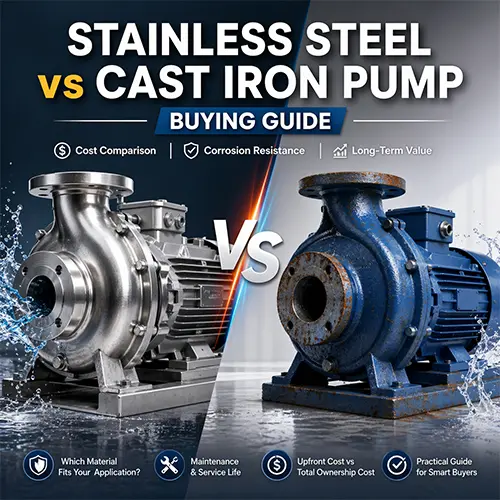
How Smart Buyers Choose the Right Pump Material Based on Cost, Corrosion Risk, and Long-Term Value
When comparing industrial pumps, one of the most common purchasing questions is simple:
Should I choose stainless steel or cast iron?
It sounds like a straightforward material decision, but many costly pump failures, unnecessary upgrades, and poor procurement choices begin with oversimplified thinking.
Some buyers assume stainless steel is automatically better because it costs more and looks more premium. Others default to cast iron because it is cheaper and widely used.
Neither approach is reliable.
A stainless steel pump installed in a mild indoor system may offer little financial advantage. A cast iron pump placed in a humid coastal facility may become an expensive replacement problem much sooner than expected.
The right decision depends on real operating conditions:
- what liquid is being pumped
- whether salt or chlorides are present
- whether sand or solids are present
- indoor or outdoor installation
- maintenance difficulty
- expected operating hours
- financial impact of downtime
- target service life
These factors matter far more than the material name on the quotation sheet.
This guide is written for buyers, contractors, distributors, OEM brands, maintenance managers, and engineers who want to make safe commercial decisions based on reality—not assumptions.
By the end of this article, you should be able to judge:
- when cast iron is the smarter value choice
- when stainless steel is worth the premium
- when 304 stainless is enough
- when 316 is justified
- how to estimate real ownership cost
- how to avoid repeating past failures
- what to ask suppliers before ordering
For broader technical resources, buyers can also review:
https://liqenpower.com/blog/
Stainless Steel vs Cast Iron Pump: What Is the Real Difference?
The real difference is not “premium vs budget.” The real difference is how each material behaves in your environment over time.
Cast iron is widely trusted because it is strong, affordable, and performs well in many standard systems. Stainless steel is often selected where corrosion resistance, hygiene, visual appearance, or long-term durability create measurable value.
Why Buyers Often Compare the Wrong Things
Many pump purchases focus too heavily on:
- quotation price
- delivery time
- external appearance
- supplier claims
- brand familiarity
Those factors matter, but they do not answer the most important buying question:
Which material creates the lowest total cost and lowest risk over the next several years?
That is the decision that affects profit.
What Cast Iron Usually Delivers
Cast iron remains popular because it often offers:
- lower purchase cost
- strong structural rigidity
- dependable performance in mild duty
- easy market availability
- economical replacement cost
This is why many common pumping systems still use it successfully.
What Stainless Steel Usually Delivers
Stainless steel often offers:
- stronger corrosion resistance
- reduced visible rust risk
- cleaner surface finish
- better fit for humid or washdown environments
- stronger suitability for hygiene-sensitive systems
Practical Buyer View
If your system pumps ordinary indoor water in a clean mechanical room, stainless steel may add little practical value.
If your site is coastal, humid, customer-facing, or difficult to maintain, stainless steel may save money over time.
When Cast Iron Pumps Are the Smarter Buying Decision
Cast iron is often the best commercial choice when operating conditions are mild and budget efficiency matters.
Many buyers wrongly dismiss cast iron because it is common. In reality, materials become common because they solve common problems well.
Clean Water Transfer Applications
If the liquid is standard clean water with low corrosive content, cast iron may be entirely suitable.
Typical examples include:
- building water transfer
- tank circulation
- municipal support systems
- general utility water movement
In these situations, paying significantly more for stainless steel may not improve performance enough to justify the cost.
HVAC and Closed-Loop Systems
Closed-loop heating or cooling systems usually operate with controlled water quality. That often reduces corrosion pressure and makes cast iron a strong long-term value choice.
Budget-Controlled Projects
Many projects require dependable results under cost constraints.
If service conditions are mild, cast iron often creates stronger upfront ROI because money can be allocated elsewhere in the project.
Easy Access Maintenance Locations
If the pump is easy to inspect, easy to remove, and inexpensive to replace, over-specifying material may not be the smartest use of budget.
Many standard end suction pump systems are selected on this logic.
When Cast Iron Stops Being Cheap
Cast iron can become expensive when:
- corrosion shortens service life
- repainting becomes frequent
- replacement labor is costly
- shutdown losses are high
- visible rust creates complaints
Cheap purchase price does not guarantee cheap ownership.
When Stainless Steel Pumps Are Worth Paying More For
Stainless steel becomes financially smart when it prevents predictable future cost.
That cost may come from corrosion, repeated maintenance, hygiene failure, appearance complaints, or downtime.
Coastal and Marine Environments
Salt in air can be just as important as salt in water.
Many buyers only evaluate the pumped liquid and ignore atmospheric corrosion. This is a common mistake near coastlines.
Hotels, ports, marine facilities, seafood plants, and seaside residential projects often justify stainless steel more easily than inland projects.
Humid Mechanical Rooms
Poor ventilation and constant condensation can damage painted ferrous surfaces over time.
Stainless steel may reduce maintenance burden in these environments.
Food and Beverage Systems
Visible rust, difficult cleaning, and sanitation concerns often make stainless steel the safer professional choice.
Expensive Downtime Operations
If one failed pump stops a production line, delays deliveries, or damages customer commitments, a more durable material can be a strong financial decision.
Difficult Service Locations
Remote sites, rooftops, confined rooms, hazardous zones, or offshore areas make every repair more expensive.
Longer-life materials often justify themselves there.
304 vs 316 Stainless Steel: What Buyers Need to Know
Many quotations simply say “stainless steel pump,” but that description is incomplete.
304 and 316 stainless steels are common grades, yet they perform differently in several real-world environments.
Where 304 Stainless Is Commonly Suitable
304 is often used successfully in:
- indoor clean-water systems
- low chloride environments
- general commercial applications
- moderate humidity areas
It is popular because it balances cost and corrosion resistance well.
Where 316 Stainless Is Often Better
316 contains molybdenum, which usually improves resistance to chlorides and harsher corrosive conditions.
It is frequently preferred for:
- coastal installations
- brackish water exposure
- chloride cleaning processes
- aggressive humid environments
| Comparison Item | 304 Stainless Steel | 316 Stainless Steel |
| Initial Cost | Lower | Higher |
| Mild Indoor Use | Strong | Strong |
| Chloride Resistance | Moderate | Better |
| Coastal Suitability | Fair | Better |
| Long-Term Harsh ROI | Moderate | Often Stronger |
Should Buyers Always Upgrade to 316?
No.
If the application is mild, indoor, and easy to maintain, 304 may already be sufficient.
If corrosion failure would be expensive, 316 may be the better business decision.
For pressure boosting systems, buyers often compare multistage pump options using these materials.
Total Cost Comparison: Which Pump Is Actually Cheaper?
The cheapest quotation often becomes the more expensive ownership choice.
Serious buyers compare lifecycle cost, not just purchase price.
Hidden Costs Buyers Commonly Ignore
Many pump budgets overlook:
- maintenance labor
- shutdown losses
- spare parts lead times
- emergency freight
- customer dissatisfaction
- internal management time
- repeated installation cost
Real Example Logic
A cast iron pump may save a few hundred dollars upfront.
But if it fails early in a corrosive site and causes one urgent shutdown, the total loss may exceed the original savings many times over.
Practical Comparison Table
| Cost Factor | Cast Iron | Stainless Steel |
| Initial Price | Lower | Higher |
| Mild-Service ROI | Often Strong | Depends |
| Corrosion Risk | Higher | Lower |
| Shutdown Risk in Harsh Duty | Higher | Lower |
| Replacement Frequency | Often Higher | Often Lower |
Buyer Rule
When downtime cost is high, purchase price matters less than reliability.
Corrosion, Rust, and Wear: What Usually Causes Early Pump Failure?
Many buyers say a pump “failed from rust,” but the real cause may be more specific.
Understanding the true failure mode helps prevent repeating mistakes.
Why Cast Iron Rusts
Cast iron can oxidize when exposed to moisture, oxygen, and damaged protective coatings.
That process may accelerate in humid or salt-laden environments.
Why Stainless Steel Can Still Fail
Stainless steel is corrosion-resistant, not immune.
It may still suffer:
- pitting corrosion (small deep attack points)
- crevice corrosion (hidden-gap corrosion)
- chloride damage
- contamination-related attack
When Wear Is the Bigger Problem
If the liquid contains sand, grit, slurry, or suspended solids, abrasion may matter more than corrosion.
Some buyers upgrade to stainless steel and still fail because wear—not rust—was the real issue.
For abrasive service, dedicated slurry pump designs are often safer.
Smart Diagnostic Questions Before Rebuying
Ask:
- Did visible rust appear first?
- Did flow drop first?
- Did seals leak first?
- Were solids present?
- Did vibration rise over time?
Those answers guide smarter replacement decisions.
Buyer Scenarios: Which Material Makes Sense for Your Industry?
Real buying scenarios often help more than theory.
Apartment Booster Room
Indoor clean water, controlled environment, easy access.
Cast iron may offer stronger value.
Hotel Near the Coast
Salt air, appearance sensitivity, service complaints risk.
Stainless steel is often easier to justify.
Farm Irrigation with Sandy Well Water
Wear may matter more than corrosion.
A wear-focused solution may outperform a basic stainless upgrade.
Food Factory Washdown Area
Frequent cleaning and hygiene expectations often favor stainless steel.
Sewage Contractor Project
Material matters, but solids handling design often matters equally.
Buyers often compare submersible sewage pump options in these cases.
Questions Smart Buyers Should Ask Suppliers Before Ordering
Strong questions expose weak quotations quickly.
Ask These Questions
- Is the impeller the same material as the casing?
- Is the entire pump stainless, or only some parts?
- Which stainless grade is used?
- What seal material is included?
- What service life is typical in similar sites?
- What does the warranty exclude?
- Which spare parts fail most often?
Why These Questions Matter
Two quotations can look similar while offering very different ownership outcomes.
Details decide real value.
Stainless Steel vs Cast Iron Quick Decision Guide
Use this as a fast starting point only.
| If You Need... | Better Starting Option |
| Lowest upfront cost | Cast Iron |
| Mild indoor water duty | Cast Iron |
| Coastal installation | Stainless Steel |
| Better appearance | Stainless Steel |
| Lower corrosion risk | Stainless Steel |
| Easy low-cost replacement | Cast Iron |
Common Buying Mistakes Buyers Make When Choosing Stainless Steel vs Cast Iron Pumps
Most pump buying mistakes do not happen because buyers are careless. They happen because buyers are busy, supplier quotations look similar, and material decisions seem simpler than they really are.
The goal is not to blame buyers. The goal is to help buyers avoid expensive shortcuts.
Mistake 1: Assuming Stainless Steel Is Always the Safer Choice
Many buyers choose stainless steel automatically because it sounds stronger and more premium.
Sometimes that is correct. Sometimes it only increases purchase cost.
If the pump will run indoors with clean water, low humidity, and easy maintenance access, cast iron may deliver similar practical results at lower cost.
The right question is not:
Is stainless steel better?
The right question is:
Will stainless steel create enough extra value in my real application?
Mistake 2: Assuming Cast Iron Is Always the Cheapest Option
Cast iron may have a lower quotation price, but it is not always the lower ownership-cost option.
If the pump operates near the coast, in a wet mechanical room, or where replacement labor is expensive, early corrosion can turn a cheaper purchase into a costly long-term decision.
Low price and low cost are not always the same thing.
Mistake 3: Comparing Only the Pump Body Material
Some buyers compare only casing material and ignore what is inside the pump.
That can be risky because many failures begin with:
- mechanical seals
- shafts
- bearings
- impellers
- sleeves
A stainless casing with weak internal components may still create major service problems.
Always ask for the material breakdown of critical parts.
Mistake 4: Ignoring the Real Installation Environment
Many buyers think only about the liquid being pumped.
But surrounding conditions matter too:
- coastal salt air
- condensation
- poor ventilation
- outdoor rain exposure
- chemical washdown cleaning
- dust and dirt buildup
Two identical pumps may perform very differently in two different rooms.
Mistake 5: Buying Only by Lowest Quotation
The lowest quotation may use:
- lower-grade seals
- lower-grade bearings
- thinner coatings
- weaker motors
- less testing
- limited after-sales support
This does not mean low price is always bad. It means buyers should understand why the price is lower.
Mistake 6: Not Calculating Downtime Cost
Many teams negotiate hard to save a few hundred dollars on purchase price, then lose thousands when one unexpected failure stops operations.
If downtime affects:
- production output
- tenant water supply
- customer commitments
- service reputation
Then reliability deserves more weight in the decision.
Mistake 7: Buying Without Asking for Two Options
One of the smartest buyer strategies is to request:
- Most economical safe option
- Best long-term value option
This helps compare price against expected life, maintenance, and risk.
Many buyers skip this step and lose valuable decision clarity.
Step-by-Step Buyer Checklist Before Final Decision
Before approving a stainless steel pump or cast iron pump, buyers should slow the decision down and check the real operating conditions one by one. Most wrong purchases do not happen because the buyer knows nothing. They happen because one or two important conditions were assumed instead of confirmed.
A good final check should help you answer two questions:
- What material is technically safe for this application?
- What material makes the most business sense over time?
The checklist below is designed to help buyers move from “general preference” to “real decision.”
Step 1 – Define the Liquid Clearly
Start with the liquid, because material choice should always begin there.
Do not describe the fluid only as “water” unless it is truly just clean water. Many pumps fail because the buyer says “water,” but the real liquid contains salt, sand, cleaning chemicals, minerals, chlorides, sewage content, or suspended solids.
Before asking a supplier for a final recommendation, confirm:
- is it clean water, hard water, wastewater, seawater, brackish water, chemical liquid, or slurry
- are there solids, fibers, or sand in the liquid
- is the liquid treated, recycled, or mixed with additives
- is the liquid food-related or hygiene-sensitive
If the liquid description is weak, the material recommendation will also be weak.
| What to Confirm About the Liquid | Why It Matters |
| Clean or dirty | Affects corrosion and wear risk |
| Salt or chlorides present | Strongly affects cast iron and stainless choice |
| Sand or solids present | May cause abrasion, not just corrosion |
| Chemical additives present | May require upgraded materials |
| Hygiene-sensitive liquid | May favor stainless steel |
Step 2 – Confirm Temperature and Pressure
Many buyers focus on the liquid itself but forget that temperature and pressure change how materials behave over time.
Higher temperature can accelerate corrosion, shorten seal life, and make some non-metal components less reliable. Higher pressure increases mechanical stress and makes leakage or casing weakness more serious.
This does not mean every hot or high-pressure system needs premium material, but it does mean buyers should not leave these conditions vague.
A supplier should know:
- normal operating temperature
- maximum temperature
- normal working pressure
- whether pressure surges happen
| Operating Condition | Why Buyers Should Check It |
| Normal liquid temperature | Affects material life and seal stability |
| Maximum temperature | Prevents hidden overload risk |
| Normal pressure | Helps match casing and seal strength |
| Pressure fluctuation | May increase fatigue and leakage risk |
Step 3 – Confirm the Real Environment Around the Pump
A pump does not live only inside the liquid. It also lives in an environment.
Two identical pumps can have very different service lives if one is installed in a clean indoor plant room and the other is installed in a wet coastal utility area.
This is where many cast iron vs stainless steel decisions become clearer.
Ask yourself:
- Is the pump indoors or outdoors?
- Is the room humid all year?
- Is the site near the sea?
- Will there be washdown cleaning?
- Will rain, salt air, or condensation reach the pump exterior?
Many buyers only think about the liquid and ignore the atmosphere. That is a mistake.
| Installation Environment | Material Impact |
| Indoor dry room | Lower external corrosion risk |
| Humid room | Higher rust risk on external surfaces |
| Coastal location | Salt air can accelerate corrosion |
| Outdoor exposed area | Weather affects coating and metal life |
| Washdown area | Frequent cleaning may favor stainless |
Step 4 – Estimate the Cost of Failure
This is one of the most important buying steps, and it is also one of the most ignored.
A pump is not just a product. It is part of a system. If that system stops, the cost may be much larger than the pump price itself.
Before making the final material decision, ask:
- If this pump fails, does production stop?
- Does a building lose water pressure?
- Does a customer complain immediately?
- Is emergency repair expensive?
- Is replacement access difficult?
If failure cost is low, a lower-cost material may still be the right answer.
If failure cost is high, a stronger material may be worth paying for even if the quotation is higher.
| Failure Consequence | Buyer Meaning |
| Easy replacement, low impact | Lower-cost material may be acceptable |
| Service interruption | Reliability becomes more important |
| Production downtime | Better material may save money long-term |
| Customer-facing failure | Reputation risk should be considered |
| Difficult access for repair | Longer-life material becomes easier to justify |
Step 5 – Ask Suppliers for Two Material Options
Do not force yourself into a yes-or-no decision too early.
One of the smartest buyer methods is to ask the supplier for two versions:
- the most economical safe option
- the best long-term value option
This approach does three things:
- It shows whether the supplier actually understands your application.
- It helps you compare price difference against expected life difference.
- It prevents buying only by habit or fear.
For example, the supplier may recommend:
- Cast iron for mild indoor clean-water duty
- 316 stainless steel for coastal duty with high corrosion risk
That comparison is much more useful than receiving only one quotation and guessing whether it is enough.
| Option Type | What It Helps You Understand |
| Economical safe option | Minimum material level that is still acceptable |
| Long-term value option | Upgrade path with lower future risk |
| Price difference | How much the upgrade really costs |
| Service life difference | Whether upgrade is commercially justified |
Step 6 – Compare Total Ownership Cost, Not Just Purchase Price
Once you have two options, do not stop at quotation price.
Compare:
- expected service life
- maintenance frequency
- replacement difficulty
- downtime cost
- spare-parts availability
- labor cost for future service
A cheaper pump body can become expensive if it needs earlier replacement or repeated maintenance.
A more expensive pump can become the cheaper business decision if it reduces shutdowns and service calls.
| Comparison Point | Lower-Cost Material | Upgraded Material |
| Purchase price | Lower | Higher |
| Corrosion resistance | Lower | Higher |
| Expected life in harsh duty | Shorter | Longer |
| Maintenance frequency | Higher | Lower |
| Downtime risk | Higher | Lower |
| Long-term commercial confidence | Lower | Higher |
Step 7 – Confirm Warranty, Spare Parts, and Supplier Clarity
Before final approval, do not look only at the material itself. Look at the supplier’s support around that material decision.
Confirm:
- what warranty applies to corrosion-related failure
- whether spare parts are easy to obtain
- what material critical parts use
- whether the supplier explains 304 vs 316 clearly
- whether the supplier gives vague marketing words or exact details
A supplier that cannot explain material choices clearly before payment may be difficult to rely on after installation.
| Final Support Check | Why It Matters |
| Warranty clarity | Reduces future disputes |
| Spare-parts availability | Helps lower downtime |
| Internal part material disclosure | Prevents hidden weak points |
| Supplier explanation quality | Reflects real expertise |
| Responsiveness to technical questions | Indicates long-term support level |
FAQ: What Buyers Really Want to Know Before Choosing Stainless Steel or Cast Iron
Most buyers are not trying to become metallurgy experts. They want practical answers that help them buy safely, control budget, and avoid regret later.
I Only Need a Standard Water Pump. Do I Really Need Stainless Steel?
Not always.
If your system uses clean water, indoor installation, low humidity, and normal maintenance access, cast iron may already be the best-value choice.
Many buyers overspend by choosing stainless steel where no real benefit is created.
My Project Is Near the Coast. Is Cast Iron Too Risky?
It may be.
Even if the pumped liquid is normal water, coastal air often contains salt that can accelerate corrosion on standard ferrous materials.
This does not automatically eliminate cast iron, but it means corrosion risk should be taken seriously.
In many coastal projects, stainless steel becomes easier to justify.
We Bought Stainless Steel Before. Why Did It Still Rust?
Several reasons are possible:
- wrong stainless grade
- chloride exposure
- poor ventilation
- contamination during fabrication
- aggressive cleaning chemicals
- neglected maintenance
“Stainless steel” does not mean immune to all corrosion.
The correct response is diagnosis, not assuming stainless steel was a bad choice.
Is 316 Always Better Than 304?
Not always.
316 is often better in chloride or coastal environments, but if your application is mild and indoors, 304 may already be enough.
The better grade is the one that matches your conditions—not simply the more expensive one.
Should I Choose Cast Iron If My Budget Is Tight?
Possibly yes.
If service conditions are mild and failure cost is manageable, cast iron often delivers strong commercial value.
If corrosion risk is high or downtime would be expensive, buying only on budget may create larger future cost.
How Do I Know If Downtime Is Important Enough to Upgrade Material?
Ask one simple question:
If this pump fails unexpectedly next month, what would it cost us?
Include:
- lost production
- repair labor
- emergency freight
- delayed service
- customer complaints
That answer often makes material decisions clearer.
My Supplier Says “Stainless Pump” but Gives No Details. What Should I Ask?
Ask:
- Is it 304 or 316?
- Which parts are stainless?
- Is the impeller stainless too?
- What is the shaft material?
- What seal material is included?
- What warranty applies?
The word “stainless” alone is not enough for serious purchasing.
I Am Not an Engineer. How Can I Choose Safely?
You do not need to be an engineer.
Give suppliers accurate information:
- liquid type
- temperature
- solids content
- indoor or outdoor use
- operating hours
- site location
Then ask for two clearly explained options.
That method is safer than guessing based only on price.
If Both Quotes Look Similar, How Should I Decide?
Compare:
- exact material grade
- internal component quality
- warranty terms
- delivery reliability
- spare-parts support
- supplier responsiveness
- expected service life
The better quote is not always the lower quote.
Which Material Is Better for Long-Term Peace of Mind?
There is no universal answer.
For mild service, cast iron may be completely sufficient.
For corrosive, humid, coastal, or difficult-access applications, stainless steel often provides stronger long-term confidence.
Peace of mind comes from matching material to reality.
Get A Quote

Get A Quote
0 Comments