
2026 Pump Materials Procurement Guide
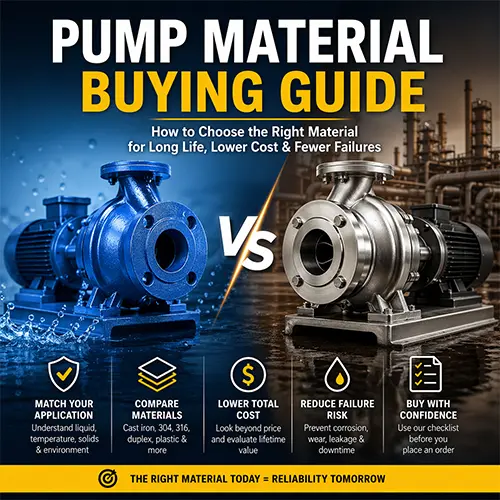
How Smart Buyers Choose the Right Pump Material to Reduce Failure, Lower Cost, and Protect Long-Term Performance
When buyers compare pumps, they often focus first on price, flow rate, head, delivery time, and motor power. Those factors are important, but many expensive pump problems begin somewhere else:
the wrong material choice.
A pump can meet required performance on paper and still fail early if the material does not match the real liquid, temperature, solids content, or installation environment.
This is one of the most common avoidable mistakes in industrial purchasing.
Many buyers only discover the problem after installation, when corrosion appears, seals begin leaking, impellers wear quickly, or the pump needs replacement much earlier than expected.
That is why pump material selection should never be treated as a minor specification line on a quotation.
For importers, distributors, contractors, OEM brands, and procurement teams, the real objective is not to buy the cheapest material.
The real objective is to buy the material that creates the lowest long-term ownership risk.
This guide explains how smart buyers evaluate pump materials, compare common options such as cast iron and stainless steel, and avoid expensive mistakes before placing an order.
For more pump engineering insights, buyers can also review:
https://liqenpower.com/blog/
Why Pump Material Choice Matters More Than Most Buyers Realize
Pump material directly affects service life, maintenance frequency, downtime risk, and total ownership cost. It is not only about whether the pump looks stronger or more expensive.
Many quotations list material in only one short line:
- Cast Iron
- SS304
- SS316
- Bronze
- Plastic
But those simple words hide major performance differences.
For example, a cast iron pump may run for years in clean indoor water service. The same pump body may corrode much faster in coastal air or chloride-rich water. A stainless steel pump may resist rust well but still wear quickly if the liquid contains abrasive sand.
This means material should always be selected according to what the pump must survive, not according to what sounds premium.
Why Wrong Material Choices Become Expensive
The purchase price is only the first cost.
If material selection is poor, later costs may include:
- repair labor
- spare parts
- shutdown losses
- customer complaints
- emergency freight
- repeat replacement
Many buyers save a small amount upfront and spend far more later.
Why Good Material Decisions Protect Profit
When the right material is chosen, pumps usually last longer, require fewer service calls, and create fewer operational surprises.
That often protects profit more effectively than negotiating a slightly lower unit price.
Pump Material Means More Than the Casing
Many buyers think pump material means only the outer body of the pump. In reality, several internal parts may use different materials, and one weak component can cause failure.
This is one reason buyers sometimes say:
We bought a stainless steel pump, but it still had problems.
The casing may have been stainless steel, while other important parts were not.
Key Components Buyers Should Understand
The casing is the pressure-containing outer body. It needs structural strength and corrosion resistance.
The impeller is the rotating component that moves liquid. It often sees higher wear than the casing because liquid velocity and particles strike it directly.
The shaft transfers motor power to the impeller. If shaft material is weak, corrosion or wear can shorten life.
The mechanical seal prevents leakage around the rotating shaft. Seal material often determines whether a pump remains dry and reliable.
Bolts, washers, sleeves, and smaller hardware also matter. Cheap small parts can create expensive service problems.
Buyer Action
Do not ask only:
Is this a stainless steel pump?
Ask instead:
- What is the casing material?
- What is the impeller material?
- What material is the shaft?
- What seal material is used?
- What stainless grade is used where?
That level of detail reduces risk significantly.
What Buyers Must Confirm Before Choosing Any Material
The best pump material for one application may be the wrong choice for another. Buyers should begin with operating conditions, not catalog habits.
What Liquid Is Being Pumped
This is the first and most important question.
Examples include:
- clean water
- hard water
- wastewater
- seawater
- acidic liquid
- alkaline liquid
- slurry
- food-grade liquid
Each liquid affects materials differently.
What Temperature Will the Pump See
Higher temperature can accelerate corrosion, reduce seal life, and weaken some non-metal materials.
A pump suitable for room-temperature water may not be ideal for hot liquid service.
Are Solids or Sand Present
Many pumps fail from wear, not rust.
If the liquid contains sand, crystals, slurry, or fibers, internal components may wear quickly.
Is the Pump Indoors or Outdoors
Outdoor environments may introduce:
- rain
- UV exposure
- salt air
- freezing conditions
These factors can strongly influence material life.
How Important Is Downtime
If failure only causes inconvenience, one decision may be acceptable.
If failure stops production or damages customer trust, stronger material may be worth the higher cost.
Cast Iron Pumps: When They Are the Smartest Choice
Cast iron remains one of the most practical and widely used pump materials. In many applications, it is the correct engineering choice.
It should not automatically be viewed as low quality.
Why Cast Iron Is Popular
Cast iron offers:
- good structural strength
- economical cost
- wide market availability
- strong value in mild water service
Because of this balance, many common systems use cast iron successfully.
Where Cast Iron Works Well
Cast iron is often suitable for:
- clean water transfer
- HVAC circulation
- building water systems
- irrigation with low-corrosion water
- general industrial water movement
Many buyers comparing standard systems begin with an end suction pump because cast iron versions are widely available and cost-efficient.
Where Cast Iron Has Limits
Cast iron is less ideal where corrosion risk is higher, especially with:
- seawater
- chloride-rich water
- aggressive chemicals
- severe cosmetic requirements
Buyer Decision Logic
If water conditions are mild and maintenance access is easy, cast iron may offer the best total value.
If corrosion consequences are costly, material upgrade should be considered.
Stainless Steel Pumps: When Buyers Should Upgrade
Stainless steel is often selected when corrosion resistance, hygiene standards, or cleaner appearance justify higher cost.
The key question is not whether stainless sounds better.
The key question is whether stainless creates enough practical value in the real application.
Why Stainless Steel Costs More
Usually because:
- raw material cost is higher
- fabrication is more difficult
- finishing standards are higher
Where Stainless Steel Often Makes Sense
Stainless steel is commonly chosen for:
- mildly corrosive water
- food and beverage service
- humid environments
- washdown areas
- cleaner appearance requirements
304 vs 316 Stainless Steel Explained
This is one of the most common buyer questions.
304 stainless steel is a widely used general-purpose grade suitable for many moderate environments.
316 stainless steel contains molybdenum, which usually improves resistance to chlorides and harsher conditions.
| Comparison Item | 304 Stainless Steel | 316 Stainless Steel |
| Purchase Cost | Lower | Higher |
| General Corrosion Resistance | Good | Better |
| Chloride Resistance | Moderate | Stronger |
| Coastal Use | Limited | Better |
| Long-Term Harsh Duty | Moderate | Better |
When 304 Is Usually Enough
304 is often suitable when:
- water is clean
- chloride exposure is low
- indoor conditions are moderate
When 316 Is Worth Paying More For
316 is often justified when:
- installation is coastal
- water is brackish
- chloride exposure exists
- downtime risk is expensive
For higher-pressure systems, buyers often compare multistage pump options using stainless wet-end materials.
Important Buyer Warning
Stainless steel is not magic.
Wrong grade stainless can still pit, stain, or fail.
Non-Metal Pump Materials: Plastics, Rubber, and Composite Options
Not every pump should be metal. Some services are better handled by non-metal materials.
Plastic Pumps for Chemical Duty
Certain chemicals attack metals but are compatible with engineered plastics.
Rubber-Lined Pumps for Abrasive Duty
Rubber linings may perform well in slurry service because they resist wear differently than bare metal.
Composite Materials
Some specialty pumps use composite construction for corrosion resistance or reduced weight.
Buyer Warning
Always verify:
- temperature limits
- pressure limits
- impact resistance
- UV resistance
Non-metal materials solve some problems but create others if selected carelessly.
Corrosion Types Buyers Should Understand
Not all corrosion looks the same. Understanding failure type helps buyers choose better materials.
Uniform corrosion means general surface rusting or thinning.
Pitting corrosion means small deep holes that can penetrate quickly.
Crevice corrosion happens inside hidden gaps or under deposits.
Galvanic corrosion occurs when two dissimilar metals contact each other in conductive liquid.
This matters because two pumps may both “rust,” but for very different reasons.
If the real cause is misunderstood, the next purchase may repeat the same failure.
Abrasion vs Corrosion: Which Is Really Damaging the Pump
Many buyers assume corrosion is the problem when the real issue is wear caused by solids.
Sand, grit, slurry, or crystals can gradually remove material from impellers and passages.
This reduces efficiency and shortens pump life.
For severe solids service, dedicated slurry pump designs are usually safer than adapting a clean-water pump.
If solids are present, wear resistance may matter more than rust resistance.
Buyer Scenarios: What Material Makes Sense by Industry
Real examples help buyers decide faster.
Agriculture Irrigation Buyer
Cast iron may be suitable if water chemistry is mild, but sand content should be checked carefully.
Building Booster System Buyer
Cast iron or stainless may both work depending on water quality, appearance expectations, and service goals.
RO / Water Treatment Buyer
Some sections may justify stainless depending on treated water chemistry and hygiene needs.
Sewage Contractor Buyer
For solids handling, buyers often compare submersible sewage pump options with wear-resistant construction.
Marine Buyer
Salt air and seawater usually justify stronger corrosion-resistant materials.
How to Compare Two Material Options Correctly
Do not compare only purchase price.
Compare lifetime business impact.
| Factor | Lower-Cost Material | Upgraded Material |
| Purchase Price | Lower | Higher |
| Expected Life | Shorter | Longer |
| Maintenance Need | Higher | Lower |
| Downtime Risk | Higher | Lower |
| Customer Confidence | Lower | Higher |
Buyer Logic
If replacement is easy and low-cost, the cheaper material may remain the best decision.
If failure creates major downtime or reputation damage, upgraded material often wins.
Common Pump Material Buying Mistakes
Many failures begin before installation because the buying logic was weak.
Common mistakes include:
- buying by lowest price only
- assuming stainless solves every problem
- ignoring salt or chlorides
- ignoring solids content
- forgetting seal material
- trusting vague “anti-corrosion” claims
Professional buyers ask for specific material details, not general promises.
Step-by-Step Buyer Checklist for Choosing Pump Material
Use this simple process before placing orders.
Step 1: Identify the Exact Liquid
Get accurate fluid information.
Step 2: Confirm Temperature and Pressure
Use real operating values.
Step 3: Check for Solids or Sand
Wear risk changes everything.
Step 4: Check Salt or Chemicals
Corrosion risk must be defined clearly.
Step 5: Ask for Full Material Breakdown
Do not accept vague wording.
Step 6: Compare Two Options by Total Cost
Think beyond invoice price.
Step 7: Review Warranty and Spare Parts
After-sales support matters.
FAQ: What Buyers Really Want to Know About Pump Materials Before Ordering
Most buyers do not ask about metallurgy theory. They ask practical questions that affect budget, reliability, maintenance, and whether they are making a safe purchasing decision.
These are the real questions many buyers care about before placing an order.
My Application Uses Normal Water. Do I Really Need Stainless Steel?
Not always.
If your liquid is normal clean water, chloride content is low, and the installation environment is dry and controlled, cast iron may already be the most cost-effective choice.
Many buyers overspend by choosing stainless steel when the real operating conditions do not require it.
The better question is not:
Is stainless steel better?
The better question is:
Will stainless steel create enough extra value in my real application?
If corrosion risk is low and maintenance is easy, cast iron may be the smarter business decision.
Why Is One Supplier Much Cheaper Than Another for the “Same Material”?
Because the pumps may not truly be the same.
Two quotations may both say “stainless steel pump,” but differences may exist in:
- stainless steel grade (304 vs 316)
- impeller material
- shaft material
- seal quality
- bearing quality
- motor efficiency
- testing standards
- thickness of components
This is why professional buyers compare full specifications, not only the headline material name.
If one quotation is much lower, ask:
What exactly is different inside the pump?
That question often reveals the real reason.
We Bought Stainless Steel Before. Why Did It Still Rust?
Because stainless steel does not mean rust-proof in every condition.
Many buyers assume stainless steel solves all corrosion issues. It does not.
Common reasons stainless pumps still fail include:
- wrong stainless grade
- chloride-rich water
- coastal atmosphere
- chemical cleaning agents
- trapped moisture
- contamination during fabrication
For example, 304 stainless may perform well in many indoor applications but may not be ideal for aggressive chloride exposure.
The lesson is not “stainless is bad.”
The lesson is:
Stainless grade must match service conditions.
Is 316 Stainless Always Worth the Extra Cost?
No.
316 stainless steel is often a smart upgrade in coastal, brackish, chloride, or difficult-maintenance environments.
But in mild clean-water indoor service, paying more for 316 may not create enough practical benefit.
Buyers should compare:
- extra purchase cost
- expected life increase
- maintenance reduction
- failure consequence
If downtime is expensive, 316 may be easy to justify.
If service is mild, 304 may already be enough.
My Water Has Sand. Should I Focus on Corrosion Resistance?
Not first.
If sand or solids are present, wear damage may be a bigger issue than corrosion.
Many buyers replace pumps with stainless steel expecting improvement, but the real problem was abrasion from particles.
When solids exist, ask suppliers about:
- impeller wear resistance
- solids handling design
- slurry suitability
- casing wear life
Sometimes a better solids-handling design matters more than upgrading to stainless steel.
What Is the Biggest Material Buying Mistake Buyers Make?
Buying based on price only.
The lowest purchase price can become the highest total cost if the pump fails early, leaks often, or creates downtime.
The second biggest mistake is buying a “premium material” without confirming it is actually needed.
Smart buyers avoid both extremes.
They buy based on application fit, not fear or marketing language.
How Can I Choose Safely If I Am Not a Pump Engineer?
You do not need to be an engineer.
You need to provide accurate operating information and ask the right questions.
Tell suppliers:
- what liquid is pumped
- temperature
- solids content
- indoor or outdoor use
- operating hours per day
- consequences of downtime
Then ask for two options:
- Most economical safe option
- Best long-term value option
That approach often produces better decisions than chasing one cheap quotation.
Should I Ask for Two Material Options Before Buying?
Yes—this is one of the smartest buying methods.
Ask suppliers to quote:
- Standard option
- Upgraded option
Then compare:
- price difference
- service life difference
- maintenance difference
- warranty difference
This turns pump buying into a business decision instead of guesswork.
Final Conclusion: Buy for Real Conditions, Not for Labels or Fear
The best pump material is not the cheapest material, and it is not automatically the most expensive material.
It is the material that correctly matches your liquid, environment, operating hours, maintenance reality, and cost of failure.
Many buyers lose money in two ways:
- Buying too cheap and replacing early
- Buying too premium without real need
Both mistakes come from ignoring real operating conditions.
The smartest buyers start with simple questions:
- What liquid am I pumping?
- Is there salt, sand, or chemicals?
- How costly is downtime?
- Is maintenance easy or difficult?
- How long do I expect this pump to last?
Those answers usually lead to the right material choice.
If you are uncertain, ask suppliers for two clearly explained options: one lower-cost safe choice and one higher-value long-life choice.
That single comparison often saves more money than negotiating price alone.
In pump purchasing, the safest strategy is simple:
Buy for the real job, not for the label.
Get A Quote

Get A Quote
0 Comments