
Best Pump Warranty Terms Buyers Should Ask For
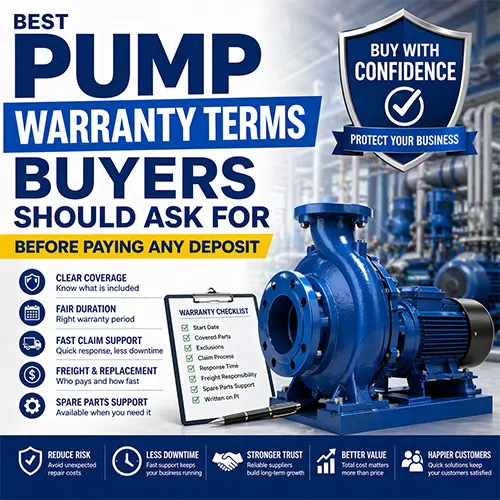
Before Paying Any Deposit: A Complete Buyer Protection Guide for Importers, Distributors, and Project Buyers
When buyers compare pumps, most attention goes to price, delivery time, flow rate, pressure, and brand reputation. Those factors matter, but many expensive mistakes happen somewhere else: the warranty terms were never discussed clearly before payment.
This is common in international trade.
A buyer receives a competitive quotation, places a deposit, receives the shipment, sells the pumps, and then months later a customer reports leakage, overheating, bearing noise, electrical failure, or weak performance. Only then does the buyer ask:
- Is this covered by warranty?
- Who pays for replacement parts?
- How fast will the supplier respond?
- Is freight included?
- What evidence is required?
- Will the supplier help immediately or delay the claim?
If those answers are unclear, the “cheap” pump may become the expensive pump.
For importers, distributors, contractors, procurement teams, and OEM brand owners, warranty is not a small after-sales detail. It is part of purchasing strategy, customer satisfaction, and long-term profitability.
This guide explains exactly what warranty terms buyers should ask for before paying any deposit, how to compare suppliers fairly, and how to reduce future disputes.
Why Warranty Terms Matter More Than Many Buyers Realize
A pump warranty is not just a sentence on a quotation. It affects future cost, downtime risk, customer trust, and the supplier relationship after payment.
Many first-time buyers think:
If the pump works when delivered, warranty may not matter.
That is risky thinking.
Even good products can face real-world issues such as:
- transport damage discovered later
- incorrect assembly in a small batch
- seal leakage after early use
- capacitor failure in storage
- motor overheating caused by hidden defect
- casting porosity causing leakage under pressure
The true value of a supplier often appears after a problem happens, not before.
A supplier that responds fast, sends parts quickly, explains causes clearly, and helps solve the issue can protect your reputation. A supplier that disappears, argues vaguely, or delays responses can cost far more than the original product discount.
| Buyer Focus | Short-Term Thinking | Long-Term Thinking |
| Price | Lowest quotation | Total ownership cost |
| Warranty | Ask later | Compare before order |
| Supplier value | Good salesperson | Reliable support partner |
| Risk | Ignore until failure | Prevent early |
Buyer Decision Logic
When comparing two suppliers, do not ask only:
Which pump is cheaper today?
Also ask:
Which supplier will cost me less trouble over the next 12 months?
That second question often leads to the smarter decision.
Step 1: Ask Exactly When the Warranty Starts
The start date is one of the most misunderstood warranty terms.
Many quotations say:
12-month warranty
But 12 months from when?
That single detail changes real buyer value.
Common Warranty Start Dates
| Start Method | Meaning | Buyer Value |
| Shipment Date | Starts when goods leave China | Lower |
| Invoice Date | Starts when invoice issued | Low |
| Arrival Date | Starts when goods arrive destination | Better |
| Installation Date | Starts after local installation | Strong |
| Commissioning Date | Starts after successful startup | Strongest for projects |
Why This Matters for Overseas Buyers
If sea shipping takes 45 days, customs clearance takes 10 days, and local delivery takes another week, a shipment-date warranty may lose two months before the pump is even installed.
That is why distributors often prefer arrival date, while project buyers may prefer installation date or commissioning date.
Commissioning means the first successful startup after installation and testing.
Buyer Action
Ask the supplier to write this clearly on the PI (Proforma Invoice):
Warranty starts from arrival date at destination port.
PI means the official commercial document used before payment.
Step 2: Ask Exactly What Parts Are Covered
Warranty length means little if the coverage scope is unclear.
Many buyers hear “12 months warranty” and assume everything is covered. That is often false.
Some suppliers cover only manufacturing defects. Some cover the motor but not wear items. Some cover parts only, not labor or freight.
Components Buyers Should Clarify
| Component | Function | Why It Matters |
| Motor | Powers the pump | Expensive replacement |
| Mechanical Seal | Stops leakage at shaft | Common failure point |
| Bearings | Support rotation | Noise / heat risk |
| Impeller | Moves liquid | Performance critical |
| Capacitor | Starts some motors | Frequent low-cost failure |
| Pump Casing | Main body | Casting defect risk |
Important Explanation
Mechanical seal means the sealing assembly that prevents water leaking where the rotating shaft exits the housing.
If seal quality is weak, buyers may see:
- early leakage
- customer complaints
- repeated maintenance calls
Buyer Action
Ask the supplier:
Please list covered parts and non-covered parts in writing.
That one sentence prevents many future arguments.
Step 3: Ask What Is Excluded from Warranty
Many warranty disputes happen because exclusions were never discussed.
The buyer says:
Pump failed under warranty.
The supplier says:
Failure caused by misuse.
This conflict is common.
Common Exclusions
| Exclusion | Plain Meaning |
| Dry Running | Pump ran without liquid |
| Wrong Voltage | Incorrect electrical supply |
| Wrong Wiring | Bad connection or phase issue |
| Abrasive Solids | Sand/slurry used in wrong pump |
| Chemical Corrosion | Liquid attacked materials |
| Freezing Damage | Ice cracked housing |
| Unauthorized Repair | Third-party modification |
Why Dry Running Is Serious
Many pumps depend on liquid for cooling and lubrication. Running dry can damage seals quickly.
Why Wrong Voltage Matters
A pump designed for 50Hz may perform differently on 60Hz systems if not matched properly.
Buyer Action
Ask:
Please send all warranty exclusions now so we can train our installers and customers correctly.
This shows professionalism and reduces blame later.
Step 4: Ask How Warranty Claims Actually Work
A warranty with no clear claim process has weak practical value.
Some suppliers advertise strong coverage but become slow once a claim starts.
Questions Every Buyer Should Ask
| Question | Why It Matters |
| What proof is required? | Faster preparation |
| Photos or video needed? | Claim speed |
| How many days to reply? | Downtime control |
| Who judges root cause? | Fairness |
| Replacement or credit? | Cash flow impact |
| Immediate shipment or next order? | Service reality |
Real Buyer Example
A distributor with leaking units may not care about policy language first. They care about one thing:
How fast can I solve this for my customer?
That is why claim speed matters as much as claim approval.
Buyer Action
Prefer suppliers who can explain the claim process clearly in simple language.
If they are vague before payment, support may be weaker after payment.
Step 5: Ask Who Pays Freight for Replacement Parts
This is one of the most ignored hidden costs in pump sourcing.
A supplier may say:
Free replacement parts under warranty.
That sounds good—but if the buyer must pay international courier freight every time, real value drops sharply.
Common Freight Models
| Model | Buyer Value |
| Supplier pays express freight | Strong support |
| Supplier gives free parts, buyer pays freight | Medium |
| Added to next shipment only | Slow support |
| Buyer pays all freight | Weak |
Real Example
A buyer saved $500 on initial pricing but later paid multiple urgent courier charges for seals and capacitors. The savings disappeared.
Buyer Action
Ask directly:
For approved warranty claims, who pays replacement freight?
Get the answer in writing.
Step 6: Compare Warranty Length Correctly
Longer is not always better.
A weak 24-month warranty may be worth less than a responsive 12-month warranty.
Compare Real Value
| Offer | Practical Buyer Value |
| 6 months + fast support + stocked parts | Useful |
| 12 months + clear written policy | Strong |
| 18 months + slow response | Medium |
| 24 months marketing only | Verify carefully |
What Buyers Often Miss
If products are resold quickly, a clear 12-month policy may be enough.
If products sit in warehouse for months before sale, start date matters even more than duration.
Buyer Action
Compare:
- months
- start date
- response speed
- stocked parts
- freight responsibility
not only headline duration.
Step 7: Ask About Spare Parts Support Before Ordering
For distributors, spare-parts support can be more valuable than warranty wording.
Customers with a failed seal usually want repair now—not policy discussion.
Ask Supplier These Questions
| Question | Why Ask |
| Which parts are stocked now? | Immediate support |
| Dispatch time? | Downtime reduction |
| Can I buy kits with first order? | Better planning |
| Will old models be supported later? | Long-term trust |
Recommended First Shipment Spare Parts
- mechanical seals
- bearings
- gaskets
- capacitors
- O-rings
- common wear parts
Buyer Action
Include a small spare-parts kit in your first shipment. This often solves customer issues faster than waiting for warranty approval.
Step 8: Put Warranty Terms on the PI
Verbal promises are weak. Written commercial documents are stronger.
Many disputes begin with:
Salesperson told us something different.
If it is not written, it becomes harder to enforce.
Ask the PI to Include
| Item | Example |
| Warranty duration | 12 months |
| Start date | Arrival date |
| Covered parts | Motor, seal, defects |
| Claim response | Reply within 3 working days |
| Remedy | Replace parts / credit |
Buyer Action
Read the PI line by line before deposit payment. If warranty terms are missing, request revision first.
Step 9: Compare Two Suppliers Like a Procurement Manager
Professional buyers compare future cost, not just current price.
Example Comparison
| Item | Supplier A | Supplier B |
| Unit Price | Lower | Higher |
| Warranty Months | 6 | 12 |
| Covered Parts | Limited | Clear |
| Claim Speed | Unknown | 48h |
| Spare Parts Stock | Weak | Strong |
| Freight Support | Buyer pays | Shared |
| Overall Risk | Higher | Lower |
Real Decision Logic
Supplier A may look cheaper on day one.
Supplier B may cost less across one year after fewer claims, faster support, and better customer retention.
Buyer Action
Ask:
Which supplier creates fewer headaches after payment?
That is often the right answer.
Real Example: Cheap Pump, Expensive Failure
A buyer selected a supplier 8% cheaper than competitors.
Four months later:
- multiple seals leaked
- customers complained
- supplier agreed free seals
- buyer paid repeated urgent courier freight
- local technicians spent time replacing parts
- reputation weakened
The original savings disappeared.
Buyer Lesson
Low purchase price does not equal low ownership cost.
Red Flags in Pump Warranty Terms
These phrases often signal future trouble.
| Red Flag | What It Usually Means |
| “Depends on situation” | No clear rule |
| “We decide after inspection only” | One-sided control |
| “No written warranty needed” | Weak accountability |
| “All user fault” | Resistance mindset |
| Slow answers now | Slower later |
| No spare parts stock | Future delays |
Buyer Action
Treat vague warranty wording as a commercial risk signal.
FAQ: What Buyers Really Need to Know Before Paying Deposit
Most buyers do not worry about warranty theory. They worry about what happens when something goes wrong after payment, after shipment, or after resale. These are the practical questions real importers, distributors, and project buyers usually ask.
Is a 12-month pump warranty enough for my business?
In many cases, yes—but only if the terms are clear and the supplier responds quickly.
A 12-month warranty with clear covered parts, fast replies, and available spare parts is usually more valuable than a vague 24-month promise that is difficult to claim.
If you sell quickly after receiving stock, 12 months is often acceptable. If products may sit in warehouse for several months before resale, then the warranty start date becomes very important.
Buyer Tip
Ask for warranty to start from arrival date if shipping time is long.
What if the pump fails after I already sold it to my customer?
This is one of the most important buyer concerns.
If a pump fails after resale, your customer usually contacts you, not the factory. That means your reputation is now involved.
Before ordering, confirm:
- How fast supplier replies to claims
- Whether spare parts can be sent immediately
- Whether replacement units are possible for serious defects
- What evidence supplier needs (photos, video, serial number)
Buyer Tip
Choose suppliers who help you solve customer problems quickly, not suppliers who only debate responsibility.
Who normally pays freight for warranty replacement parts?
There is no universal rule. It depends on what was agreed before order confirmation.
Some suppliers provide free parts but ask buyers to pay courier freight. Some share freight cost. Some include replacement parts in the next shipment only.
Buyer Tip
Always ask this question before deposit payment:
For approved warranty claims, who pays shipping cost?
If this is not discussed early, future disputes are common.
What parts usually fail first, and should I stock them locally?
For many pump types, the first common service items are:
- mechanical seals
- bearings
- capacitors (for some motors)
- gaskets
- O-rings
These parts may fail earlier than the pump body or motor, especially in harsh environments.
Buyer Tip
For distributors and resellers, ordering a small spare-parts kit with the first shipment is often smarter than relying only on warranty claims later.
If I do not understand pump warranty wording, what should I ask simply?
Use direct plain-language questions:
- What exactly is covered?
- What is not covered?
- When does warranty start?
- How fast do you reply to claims?
- Do you keep spare parts in stock?
- Who pays replacement freight?
- Can you write this on the PI?
Simple questions often reveal more than complicated legal wording.
Can I negotiate better warranty terms?
Yes—especially if you are:
- buying larger quantity
- planning repeat annual orders
- launching your own brand
- becoming an exclusive distributor
- buying multiple models together
Suppliers are often more flexible when they see long-term potential.
Buyer Tip
Instead of asking only for lower price, ask for:
- better warranty start date
- faster claim response
- spare parts included
- shared freight support
These can create more value than a small unit-price discount.
What if supplier says every failure is user misuse?
That is a warning sign if used too quickly or too often.
Real suppliers understand that some failures are genuine defects, some are misuse, and some need investigation.
Buyer Tip
Choose suppliers who ask for evidence first and help diagnose the cause, instead of blaming the customer immediately.
How can I protect myself if I am buying from a new supplier?
Use a safer first-order process:
- Start with moderate quantity
- Request written warranty terms
- Keep all communication records
- Ask for testing photos/videos
- Confirm spare-parts support
- Use staged payment terms
- Inspect before shipment if possible
Trust should grow through performance, not promises.
Final Conclusion: Smart Buyers Use Warranty Terms to Choose Better Suppliers
Warranty is not just protection after failure. It is a tool buyers can use before ordering to judge supplier quality, support attitude, and long-term business fit.
A supplier who gives clear answers about warranty usually also tends to be clearer about production, delivery, and after-sales service. A supplier who avoids warranty questions often creates more uncertainty later.
When comparing suppliers, do not ask only:
Who has the lowest price?
Also ask:
Who will support me best when problems happen?
That second question often leads to better long-term profit, fewer customer complaints, and stronger repeat business.
What Smart Buyers Check Before Paying Deposit
| Item | Why It Matters |
| Warranty start date | Real usable coverage |
| Covered parts | Prevent disputes |
| Exclusions | Reduce misuse risk |
| Claim response speed | Protect customers |
| Freight responsibility | Avoid hidden costs |
| Spare-parts support | Faster repairs |
| Written PI terms | Stronger accountability |
Final Buyer Advice
If two suppliers are close in price, the supplier with clearer warranty support is often the safer and more profitable choice.
Because in real business, the true cost of a pump is not only what you pay today—it is what problems cost you tomorrow.
Get A Quote

Get A Quote
0 Comments