
How to Compare Water Pump Suppliers Before Ordering
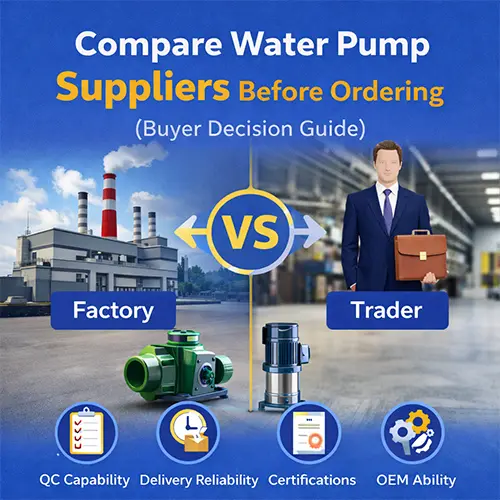
Choosing a water pump supplier is often more difficult than choosing the pump itself. Many buyers assume that if two suppliers offer similar pump parameters, the decision should come down to price. In real sourcing, that is rarely safe. Two suppliers may quote the same flow, head, and motor power, yet differ significantly in manufacturing control, testing discipline, delivery reliability, documentation quality, spare parts support, and OEM execution.
This is why supplier comparison should be treated as a structured buying decision rather than a quotation exercise. A weak supplier can create problems long after the payment is made: unstable product quality, shipment delays, missing certifications, inconsistent branding, poor after-sales response, or repeated arguments over what was actually promised. A strong supplier, by contrast, reduces uncertainty before the order is placed and lowers risk after the pumps arrive.
This guide is written from the buyer’s point of view. It is designed for importers, distributors, project buyers, OEM customers, procurement teams, and brand owners who need to compare water pump suppliers before placing an order. The goal is not only to explain what to check, but also to explain how to judge suppliers step by step and how to turn supplier information into a real decision.
Why Supplier Comparison Matters Before You Order
Many sourcing mistakes happen before production starts. Buyers often compare only visible items such as price, lead time, and catalog appearance, while the real commercial risk sits in areas that are harder to see: factory control, QC discipline, support speed, packaging consistency, and willingness to confirm details in writing.
A supplier is not just a seller. In practice, the supplier becomes part of your supply chain. That means their weaknesses can become your weaknesses. If they miss delivery dates, your project may be delayed. If their QC is inconsistent, your customer may blame your brand rather than theirs. If their documents are incomplete, customs clearance or client approval may become more difficult. If their OEM execution is weak, your market positioning can be damaged even when the pump itself is technically usable.
This is why experienced buyers do not ask only, “Who is cheaper?” They ask, “Who is safer to build business with?”
The purpose of supplier comparison is not to find perfection. It is to reduce avoidable risk. A buyer usually needs to know five things before ordering: whether the supplier is the right type of business partner, whether they can control quality consistently, whether they can ship reliably, whether their certifications are relevant and usable, and whether they can execute OEM requirements accurately.
The table below shows why supplier comparison matters.
| Comparison Area | If Buyer Ignores It | Likely Result |
| Supplier type | Does not know who controls production | Weak accountability |
| QC capability | Assumes all pumps are tested equally | Quality inconsistency |
| Delivery reliability | Believes promised lead time without validation | Shipment delays |
| Certifications | Accepts certificate names without checking scope | Compliance problems |
| OEM ability | Assumes logo printing means real OEM support | Branding errors |
The more customized, urgent, or commercially sensitive the order is, the more important supplier comparison becomes.
Factory vs Trader: Which Supplier Type Fits Your Order Best
Many buyers ask whether a factory is always better than a trader. In reality, that is the wrong question. The better question is which type of supplier gives you better control, communication, flexibility, and accountability for your specific order.
A factory is usually preferred when the buyer wants stronger manufacturing control, better cost transparency, more direct technical discussion, or long-term OEM cooperation. A trader may still be useful when the buyer needs broader product sourcing, easier communication, faster commercial coordination, or mixed-container purchasing across categories.
The key point is this: factory and trader are not quality levels by themselves. They are different business models. A well-managed trader can be more responsive than a weak factory, and a real factory can still give poor service if it lacks export discipline.
How buyers should evaluate a factory
When a supplier claims to be a factory, the buyer should not stop at that statement. The practical question is whether the supplier actually controls meaningful production steps and can answer detailed production-related questions directly.
A real and capable factory usually shows consistency in several areas. It can normally provide clear workshop photos or videos, explain machining or assembly processes, describe testing procedures, and answer technical questions without excessive delay. It often has stronger confidence when discussing customization, material changes, or packaging modifications because those functions are controlled internally or at least managed directly.
However, buyers should also understand that “factory” does not automatically mean “best supplier.” Some factories are good at manufacturing but weak in export communication, documentation, response speed, or order follow-up. A factory may produce pumps competently yet still create frustration if the commercial side is poorly managed.
How buyers should evaluate a trader
A trader should not be dismissed automatically. In some cases, traders solve problems that factories do not solve well. For example, if a buyer needs several related products from different factories, a capable trader can simplify coordination. A trader may also offer faster quotation response, better English communication, clearer export paperwork, and more flexible commercial support.
The risk is that some traders have limited technical depth and limited control over production. If the buyer asks detailed questions about testing, materials, or lead time, the trader may need to “check with the factory” repeatedly. That slows decision-making and sometimes hides where responsibility truly sits.
For buyers, the real issue is not whether a supplier is a trader. It is whether the trader adds control and value, or merely adds margin and uncertainty.
How to decide between factory and trader in practice
If your order is technically straightforward, low customization, and you need a smooth export process, either model can work.
If your order involves private label, recurring volume, packaging control, custom manuals, or product adaptation, direct factory capability becomes more important.
If your order involves mixed sourcing, low volume, or several categories from different supply chains, a strong trader may be practical.
The table below helps buyers think more clearly.
| Situation | Factory Often Better | Trader Can Still Work |
| Large recurring OEM orders | Yes | Sometimes |
| Custom packaging and branding | Yes | If trader has strong control |
| Mixed product sourcing | Less convenient | Often useful |
| Deep technical discussion | Usually yes | Depends on trader depth |
| Direct cost transparency | Usually yes | Less transparent |
| Fast coordination across multiple factories | Limited | Often better |
The buyer conclusion should not be “factory good, trader bad.” The smarter conclusion is: choose the supply model that gives your order the strongest control and the lowest communication risk.
How to Verify QC Capability Before You Pay
Quality control is one of the most misunderstood parts of supplier comparison. Many buyers ask, “Do you have QC?” and receive an automatic “yes.” That answer by itself means almost nothing. The real question is whether the supplier has a repeatable quality process that can reduce batch variation and catch mistakes before shipment.
A serious buyer should not evaluate QC by promises alone. QC capability becomes visible when the supplier can explain what they check, when they check it, how they record it, and what they do when something fails.
What real QC capability looks like
A supplier with real QC capability usually has more than a final inspection step. It often has some combination of incoming inspection, in-process checks, final assembly checks, and shipment verification. The exact process varies by factory size and product type, but the pattern matters: good suppliers do not wait until the end to discover problems.
For water pumps, QC capability often includes checking castings or components before assembly, verifying key dimensions, confirming motor and pump matching, inspecting nameplates and labels, performing performance or pressure-related tests when applicable, and reviewing packaging before shipment.
The buyer does not need a perfect internal audit to judge this. What matters is whether the supplier can describe the process concretely instead of speaking only in generalities.
What buyers should ask to verify QC
Instead of asking “Do you test every pump?”, which often produces a vague yes, buyers should ask more specific questions.
Ask what type of tests are performed. Ask whether they perform routine testing, sample testing, or order-specific testing. Ask whether they can provide testing photos, videos, or reports. Ask what records are retained. Ask how nonconforming units are handled. Ask whether OEM labels and cartons are checked before packing, not after the shipment is already closed.
A supplier with real process discipline usually answers these questions clearly. A weak supplier often replies with marketing language instead of process details.
What warning signs buyers should notice
If the supplier cannot explain the difference between inspection and testing, that is a warning sign. If every answer sounds copied from a brochure, that is another warning sign. If they promise full QC but cannot show a simple inspection checklist, sample report, or shipment verification example, buyers should slow down.
Another red flag appears when the supplier is highly confident about quality but avoids discussing what happens when defects are found. Real factories know that problems occur and have a process to isolate and correct them. Weak suppliers often talk as if defects never happen.
QC verification table for buyers
| What Buyer Asks | Strong Supplier Behavior | Weak Supplier Behavior |
| What do you inspect before shipment? | Gives specific checkpoints | Gives vague assurances |
| Can you provide test records? | Shares sample reports or formats | Avoids or delays |
| How do you handle failed units? | Explains correction process | Changes subject |
| Can you verify OEM labels/cartons? | Confirms inspection stage | Treats it casually |
| Do you test every unit or samples? | Explains actual method | Says “all good quality” |
The buyer conclusion here is simple: QC capability should be judged by process evidence, not by confident wording.
Delivery Reliability Is More Than the Lead Time Written on the Quote
Many suppliers can write an attractive lead time on a quotation. Fewer suppliers can deliver consistently according to that promise. Buyers who compare only the written lead time often make avoidable mistakes, especially when the order is urgent or linked to a project schedule.
Delivery reliability means more than how many days a supplier claims to need. It includes whether the supplier’s timeline is realistic, whether key materials are actually available, whether production is overloaded, whether export preparation is disciplined, and whether the supplier communicates early when delays appear.
Why buyers get misled by lead time
A supplier may quote 20 days because it sounds competitive, not because the order can truly be completed in 20 days. Sometimes the supplier assumes materials are in stock when they are not. Sometimes motor lead time is ignored. Sometimes production capacity is already full. Sometimes the quoted date is only the expected production finish date and does not include inspection, packing, or export preparation.
This is why buyers should not treat lead time as a single number. They should treat it as a chain of events.
What buyers should validate
Buyers should ask whether the lead time is based on stock, semi-finished stock, or full production from zero. They should ask whether the motor brand affects timing, whether OEM cartons require extra time, whether nameplate confirmation is included, and whether the quoted date refers to EXW readiness or actual shipment readiness.
If the project is time-sensitive, buyers should also ask whether peak-season pressure, holiday shutdowns, or component shortages could affect the schedule.
A serious supplier can usually explain these timing risks clearly. A weak supplier often treats delivery promises as sales language rather than operational commitments.
How to judge whether a delivery promise is realistic
If one supplier quotes much faster than others, that is not automatically good news. It may be good news, but it deserves investigation.
The buyer should ask why. Is the product in stock? Is a standard motor used? Is packaging simple? Or is the supplier simply more aggressive in sales? The explanation matters. A faster lead time supported by logic is useful. A faster lead time with no supporting explanation can become a delay later.
Delivery reliability comparison table
| Question | Why It Matters | What Buyer Wants to Hear |
| Is lead time based on stock or production? | Reveals true timing risk | Clear production basis |
| Does OEM packaging add time? | Affects final readiness | Honest extra timing if needed |
| Is motor availability confirmed? | Common hidden delay | Yes, with timing clarity |
| Does quote mean packed or only assembled? | Avoids misunderstanding | Exact readiness stage |
| What happens if delay appears? | Tests communication quality | Early notice and updated plan |
The buyer conclusion is that reliable delivery is not the shortest promise. It is the most credible promise.
Certifications Matter, But Only When They Match the Order and Market
Certifications are often overused in supplier marketing and misunderstood in sourcing decisions. Many buyers see a list of certificate names and assume the supplier is fully qualified. In practice, the important question is not how many certificates a supplier claims. The important question is whether the certifications are relevant, current, verifiable, and applicable to the actual product and target market.
A certificate has value only when it solves a real commercial or compliance need.
What buyers should check first
Buyers should begin by asking what the destination market requires. A project in one country may require different documentation from a distribution business in another market. Some buyers need management system certification from the supplier. Others need product-level certification for specific models. Some need test reports rather than certification marks. These are not the same requirement.
If the buyer does not clarify what the target customer or market actually needs, certification comparison can become superficial and misleading.
Why certificate lists can be misleading
A supplier may show an ISO certificate, but that does not mean every product is certified for every market. A supplier may show a CE-related document, but the buyer still needs to understand whether it applies to the specific product configuration being ordered. A supplier may show test documents from previous orders that are not identical to the current order.
This is why document relevance matters more than document quantity.
What buyers should verify in practice
Buyers should verify the document name, scope, issuing body, validity status, and product applicability. If a certificate is important to the project, the buyer should not rely on a blurred image in a sales brochure. The document should be checked carefully before final order approval.
The buyer should also confirm whether the supplier can place compliant labels, manuals, warning stickers, and packaging markings consistent with the destination market.
Certification check table
| Buyer Checkpoint | Why It Matters |
| Is the certificate current? | Expired documents create risk |
| Does it apply to this model? | Avoids false assumption |
| Does target market actually require it? | Prevents wasted focus |
| Is the issuing body credible? | Reduces compliance risk |
| Can supplier align labels/manuals? | Supports final shipment readiness |
The buyer conclusion is that certifications should be judged for relevance and usability, not for visual impact in a PDF.
OEM Ability Is More Than Printing a Logo on the Pump
Many suppliers claim OEM ability because they can add a customer logo. Real OEM support is broader than logo printing. It includes packaging accuracy, label control, document customization, confidentiality discipline, and the ability to keep branding consistent across repeat orders.
For brand owners, distributors, and marketplace sellers, this part of supplier comparison is extremely important. Weak OEM execution can damage brand credibility even if the product itself is functional.
What real OEM support includes
A serious OEM-capable supplier can usually support multiple branding elements at the same time. That may include private nameplates, color requirements, cartons, manuals, inner labels, barcode stickers, spare parts labeling, pallet marks, and export documents that align with the buyer’s commercial identity.
The supplier should also understand that branding accuracy is part of quality control. A wrong label, wrong model number, or mixed carton design is not a minor issue for an OEM buyer. It can create customs confusion, distributor complaints, or marketplace problems.
What buyers should ask before trusting OEM claims
Buyers should ask whether the supplier has experience with recurring OEM orders, whether they keep artwork approval records, how they confirm final carton layout, whether manual language can be adjusted, and how they prevent mixed-brand mistakes during packing.
If confidentiality matters, the buyer should also examine how the supplier handles customer branding internally and whether they are comfortable confirming non-disclosure expectations in writing.
OEM warning signs buyers should notice
A supplier that treats OEM casually may say “no problem” to everything but fail at details later. If the supplier cannot show previous OEM examples, approved carton mockups, or label confirmation procedures, the buyer should be cautious.
Another warning sign is when the supplier seems focused only on the first print sample but cannot explain how consistency is maintained across repeat orders.
OEM capability comparison table
| OEM Area | Strong Supplier | Weak Supplier |
| Nameplate/logo control | Confirms artwork and approval flow | Says “we can print” only |
| Carton design | Shares mockup/confirmation process | Treats as simple afterthought |
| Manual customization | Can adjust professionally | Offers generic manual only |
| Repeat-order consistency | Keeps approval records | Relies on memory or chat history |
| Brand confidentiality | Understands commercial sensitivity | Acts casually |
The buyer conclusion is straightforward: OEM ability should be evaluated as an execution system, not as a printing service.
How Buyers Can Compare Suppliers Step by Step Before Ordering
Once the buyer has reviewed supplier type, QC, delivery, certifications, and OEM ability, the final step is to compare the suppliers in a way that leads to action rather than confusion. Many buyers collect information well but still make poor decisions because they do not turn that information into a structured comparison.
A practical supplier decision should combine qualitative judgment with simple scoring.
The buyer can begin by asking one question in each area. Who gives the clearest accountability for production? Who explains QC most concretely? Who gives the most credible delivery promise? Who provides the most relevant and verifiable documentation? Who demonstrates the strongest OEM control?
Then the buyer should compare all suppliers against the same standard rather than reacting to whichever response sounds most confident.
The table below gives a simple buyer-friendly scorecard.
| Comparison Area | Supplier A | Supplier B | Supplier C |
| Supplier structure fit | |||
| QC capability confidence | |||
| Delivery reliability confidence | |||
| Certification relevance | |||
| OEM execution confidence | |||
| Communication clarity | |||
| Overall risk level |
FAQ: Real Buyer Questions Procurement Teams Ask Before Ordering Water Pumps
Most buyers do not stop asking questions after reading supplier comparison criteria. In real procurement work, teams still need answers about pricing risk, payment safety, lead time truthfulness, supplier trustworthiness, and how to avoid first-order mistakes. A strong FAQ section should therefore reflect real buying concerns, not generic textbook questions.
The questions below are written from the perspective of importers, distributors, project buyers, procurement managers, and sourcing teams preparing to place an order.
How many water pump suppliers should I compare before making a decision?
For standard purchases, comparing three qualified suppliers is usually enough to create a strong decision base.
With only one quotation, you have no benchmark. With two quotations, comparison is possible but still limited. With three qualified quotations, buyers can usually compare pricing logic, communication quality, lead time realism, and technical consistency more effectively.
Comparing too many suppliers often creates noise rather than clarity, especially when some are unqualified or quoting different scopes.
The better strategy is not more suppliers. It is better suppliers.
Is the cheapest supplier usually risky?
Not always, but a significant price gap should always be investigated.
A lower price may be legitimate if the supplier has lower overhead, better production efficiency, or stock availability. However, unusually low pricing may also reflect:
- Missing accessories
- Lower component grade
- Reduced testing scope
- Weak warranty support
- Inexperienced export handling
- Unrealistic lead time promises
Professional buyers do not reject low prices automatically. They verify what created the low price.
Should I choose a factory instead of a trader?
Not automatically.
A factory may offer better direct production control, stronger OEM capability, and better cost transparency. A capable trader may offer faster communication, broader sourcing options, mixed-container convenience, and smoother export coordination.
The correct decision depends on your order.
If you need private label, recurring volume, packaging control, or technical customization, factory capability often becomes more valuable.
If you need several products from multiple supply chains in one shipment, a strong trader may still be practical.
How can I verify a supplier if I cannot visit the factory in person?
Remote verification is common and can still be effective when done properly.
Buyers should request:
- Recent factory video walkthrough
- Production line photos
- Testing area photos or videos
- Sample inspection reports
- Packaging examples
- Export references
- Video meeting with sales + technical staff
A serious supplier usually cooperates confidently. A weak supplier often delays, avoids detail, or sends only generic marketing photos.
What payment terms are safest for a first order?
For first transactions, balanced payment terms usually reduce risk for both sides.
Common examples include:
- Deposit + balance before shipment
- Deposit + balance after inspection
- Letter of Credit for larger orders
- Milestone payments for custom projects
Many buyers prefer not to pay 100% upfront on a first order unless the supplier relationship is already proven.
The safest structure is one that links payment to visible progress and verified readiness.
How do I know if the promised lead time is realistic?
Do not judge lead time by the number alone. Ask what the number is based on.
Useful follow-up questions include:
- Is the product in stock or made to order?
- Are motors already available?
- Does OEM packaging add time?
- Does quoted lead time include testing and packing?
- Are holidays affecting production?
A realistic 30-day lead time is safer than an unrealistic 18-day promise.
What should I ask before placing a branded OEM order?
OEM buyers should confirm more than logo printing.
Ask about:
- Nameplate customization
- Carton design approval process
- Manual language options
- Barcode / label accuracy
- Color consistency
- Repeat-order consistency controls
- Confidentiality handling
Weak OEM execution can damage your brand even when the pump works normally.
If two suppliers look similar, how should I make the final choice?
Use total commercial confidence, not instinct.
Compare:
- Scope completeness
- Communication speed
- Technical clarity
- Delivery credibility
- Spare parts support
- Warranty strength
- Documentation quality
- Overall responsiveness
When two prices are close, buyers often benefit more from choosing the supplier who is easier to work with long term.
What is the biggest mistake first-time import buyers make?
One of the most common mistakes is assuming that fast replies and attractive pricing equal reliable supply.
Good sales communication is useful, but it is not the same as manufacturing discipline, QC control, or after-sales support.
The smartest first-time buyers verify before trusting.
Should I place a trial order first?
In many cases, yes.
A trial order can help buyers validate:
- Product quality consistency
- Packaging execution
- Delivery accuracy
- Communication during production
- Document handling
- After-sales attitude
For long-term sourcing plans, a smaller first order often reduces larger future risk.
How important are spare parts when choosing a supplier?
For many buyers, spare parts become important only after the first failure. That is too late.
Ask before ordering:
- What parts are commonly stocked?
- Standard lead times?
- Can emergency shipments be arranged?
- Are models stable for future support?
Strong spare support often matters more than small unit-price savings.
When should I walk away from a supplier?
Buyers should slow down or exit if they see repeated warning signs such as:
- Vague answers to direct questions
- Constantly changing promises
- Refusal to confirm details in writing
- No evidence of testing or production control
- Unrealistic low pricing with no explanation
- Poor communication before payment
Problems seen before the PO often become larger after payment.
Final Conclusion: Choose the Lowest-Risk Supplier, Not Just the Lowest Price
The best supplier decision is rarely the cheapest quotation on the spreadsheet. It is the supplier that gives your business the strongest combination of reliability, clarity, consistency, and long-term support.
Many buyers focus heavily on unit price because it is easy to compare. But real sourcing success is usually determined by what happens after the payment is made:
- Was production controlled properly?
- Did shipment leave on time?
- Were OEM details executed correctly?
- Did the pumps arrive consistent with expectations?
- Were documents complete?
- Was support responsive when needed?
These are the moments that define whether a supplier was truly competitive.
A professional procurement decision should therefore balance price with operational confidence. Saving a small percentage upfront may be meaningless if delays, defects, or weak support later consume far more value.
Before placing the order, ask one final question:
Which supplier gives us the highest confidence with the lowest manageable risk?
That question usually leads to better decisions than asking only who is cheapest.
The strongest suppliers are not always the fastest to say yes. They are the ones who make it easier for you to succeed after the order is placed.
Buyer Action Step
Before issuing your next PO, shortlist your top three suppliers and score each one on:
- Price fairness
- Quality confidence
- Delivery confidence
- OEM capability
- Communication quality
- Long-term support confidence
The supplier with the best total score is often the smartest commercial choice.
Get A Quote

Get A Quote
0 Comments