
How Smart Buyers Reduce Cost, Delay, and Supplier Risk in 2026
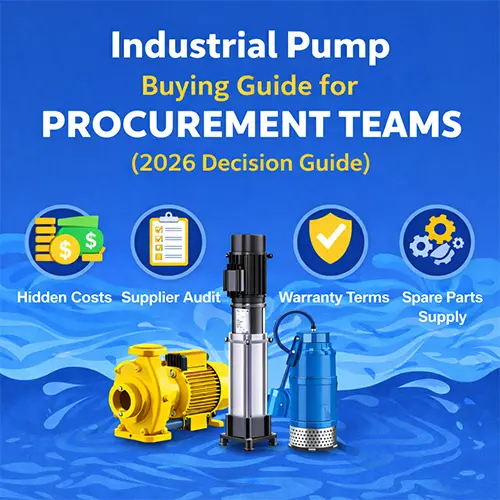
Industrial pump purchasing is often misunderstood as a simple price comparison exercise. In reality, it is a risk-management decision that can affect production uptime, project schedules, maintenance workload, operating cost, and supplier relationships for years. A pump that looks inexpensive during quotation review may become expensive after installation if it fails early, consumes excess power, or creates repeated downtime. A premium-priced pump may also become a poor purchase if spare parts are unavailable or the supplier cannot support urgent failures.
This is why experienced procurement teams do not buy pumps the way they buy generic consumables. They evaluate technical suitability, total ownership cost, delivery reliability, documentation quality, warranty enforceability, and long-term service continuity.
Many articles about industrial pumps are written for engineers only. They discuss impeller types, hydraulic theory, or pump curves, but they do not answer the questions procurement teams ask internally before approving a purchase order:
- Which supplier gives the lowest total risk, not just the lowest price?
- What costs are missing from the quotation?
- How do we compare three suppliers fairly?
- What warranty language actually protects us?
- Can this supplier support us two years from now?
- How do we avoid a bad first order?
This guide is written from the viewpoint of procurement managers, sourcing teams, plant buyers, EPC purchasers, distributors, and commercial decision-makers. It explains how smart buyers reduce cost, delay, and supplier risk while still obtaining technically suitable pumps.
Why Industrial Pump Purchases Often Go Wrong
Most failed pump purchases do not fail because the product category was wrong. They fail because the buying process focused too heavily on one variable—usually price—and ignored the rest of the commercial reality.
In many companies, pump buying involves several stakeholders:
- Procurement wants competitive pricing and reliable delivery
- Engineering wants performance accuracy
- Maintenance wants easy service and spare parts availability
- Finance wants predictable lifecycle cost
- Management wants low operational risk
If only one department drives the decision, the result may satisfy one target while damaging another.
For example, procurement may secure the cheapest quotation, but maintenance later struggles with unavailable seal kits. Engineering may approve a technically strong model, but finance later questions the energy cost. Management may push for fastest delivery, only to discover the supplier cannot support warranty claims after startup.
This is why professional buying teams treat pump purchasing as cross-functional sourcing rather than single-point negotiation.
The table below shows common purchasing mistakes and their later consequences.
| Purchasing Mistake | What Usually Happens Later |
| Lowest price wins automatically | Higher repair frequency or missing scope |
| No engineering review | Wrong duty point performance |
| No spare parts plan | Extended downtime after failure |
| Weak warranty terms | Costly disputes |
| No supplier audit | Quality inconsistency |
| Unverified lead time | Project delays |
A pump PO may take one day to issue. The consequences may last five years.
What Smart Procurement Teams Check Before Asking for Quotes
The quality of supplier quotations is usually determined by the quality of the RFQ. If the inquiry is vague, suppliers must guess. Different suppliers make different assumptions, which means the returned quotations are not truly comparable.
Many buyers request:
Need industrial pump quotation.
That message may produce fast replies, but not reliable comparisons.
A stronger inquiry defines the operating requirement clearly. Procurement does not need to become engineering specialists, but they do need enough information to prevent supplier guesswork.
The most useful inputs usually include:
- Liquid type
- Required flow rate
- Required total head
- Temperature
- Solids present or not
- Continuous or intermittent duty
- Power supply
- Installation style
- Material preference if relevant
- Quantity and destination
For example:
Need clean-water transfer pump, 40 m³/h at 35 m head, 45°C liquid, 380V/50Hz motor, continuous duty, horizontal installation, quantity 3 sets.
That single paragraph can improve quotation quality dramatically.
Why? Because all suppliers are now pricing the same duty condition instead of inventing their own assumptions.
The table below shows the difference between weak and strong RFQs.
| RFQ Quality | Example | Result |
| Weak RFQ | Need water pump price | Quotes based on assumptions |
| Average RFQ | Need 40 m³/h pump | Flow known, head unclear |
| Strong RFQ | 40 m³/h @ 35 m head, clean water, 45°C, continuous duty | Comparable quotations |
The smartest procurement teams understand that supplier comparison starts before the first quote arrives.
Hidden Costs Beyond Unit Price
The unit price shown on a quotation is usually the most visible cost and often the least dangerous one. Procurement teams that evaluate only unit price often approve purchases that become expensive later.
A pump can generate cost long after the invoice is paid. These costs may sit in maintenance budgets, production losses, utility bills, or emergency freight accounts rather than in procurement records, which is why they are frequently underestimated.
Electricity Cost Is Often Larger Than Purchase Cost
In continuous-duty applications, energy consumption may exceed purchase price within a short period. A cheaper, less efficient pump may cost more to operate every month.
This matters especially in:
- Process plants
- Cooling systems
- Booster systems
- Water treatment facilities
Even a small efficiency difference can compound over years.
Downtime Can Be the Most Expensive Failure
A $6,000 pump failure in a production line may trigger:
- Lost output
- Overtime labor
- Delayed shipments
- Penalty exposure
- Emergency freight for parts
The pump itself may be the smallest number in the event.
Missing Scope Charges
Some suppliers quote attractively low prices but exclude items such as:
- Baseplate
- Coupling guard
- Test certificates
- Export packing
- Spare seals
- Freight handling
The price looks lower until the missing items are added back.
Hidden Cost Reference Table
| Hidden Cost | Why Buyers Miss It |
| Energy use | Not visible in quote |
| Downtime | Seen as operations issue |
| Spare parts | Deferred to future budget |
| Emergency freight | Considered unlikely |
| Missing accessories | Not normalized during comparison |
| Extra labor | Internal cost not assigned |
Professional procurement teams therefore ask:
What will this pump cost us after purchase, not just at purchase?
Why Lowest Price Often Loses
Lowest price can be a valid strategy in low-risk, non-critical applications. But in industrial pumping, lowest price often hides trade-offs that appear later.
When one supplier is significantly cheaper than others, smart buyers do not celebrate immediately. They investigate.
Possible reasons include:
- Lower motor brand or lower specification components
- Reduced testing scope
- Shorter warranty protection
- Missing accessories
- Thinner material construction
- Longer lead time hidden behind vague promises
- Minimal after-sales support
Sometimes the low-price supplier is genuinely efficient. But sometimes the quote is incomplete.
Real Procurement Example Logic
Supplier A: $8,900
Supplier B: $9,600
Supplier C: $10,200
If Supplier A excludes testing, uses a lower-grade motor, and offers weak spare support, Supplier B may actually be the stronger commercial choice.
This is why smart buyers normalize scope before comparing price.
Better Question Than “Who Is Cheapest?”
Ask:
- Who is technically compliant?
- Who has complete scope?
- Who can deliver reliably?
- Who can support failures quickly?
- Who gives lowest lifecycle risk?
That is a procurement-grade comparison.
How Procurement Teams Actually Compare Suppliers
Professional buyers rarely compare quotations line by line without structure. They convert supplier responses into a scoring model that balances price with risk.
This protects the company from emotional or one-dimensional decisions.
Recommended Comparison Categories
| Category | Typical Weight |
| Price | 20% |
| Technical compliance | 25% |
| Lead time | 15% |
| Warranty | 10% |
| Spare parts support | 15% |
| Communication speed | 5% |
| Supplier credibility | 10% |
Weights can change depending on urgency or criticality, but the principle remains the same: price should not carry 100% of the decision.
Why This Method Works
It allows procurement to defend the decision internally.
Instead of saying:
Supplier B felt better.
You can say:
Supplier B scored highest after weighted review due to stronger compliance, faster support, and lower risk.
That language helps with management approval.
Warranty Terms Buyers Must Read Carefully
Many warranty disputes happen because the buyer and supplier both believed they had agreed—but interpreted the terms differently.
Procurement should treat warranty language as commercial risk control, not boilerplate text.
Critical Warranty Questions
- Does coverage start from shipment or commissioning?
- Is it 12 months or 18 months?
- Are seals, bearings, and gaskets excluded?
- Is labor included or parts only?
- Who pays freight for replacements?
- How is root cause determined?
Example of a Dangerous Assumption
Buyer assumes:
12 months after startup.
Supplier means:
12 months after shipment.
If the pump sits in storage for four months before commissioning, the usable warranty is much shorter than expected.
Best Practice
Write final warranty terms clearly into PO, contract, or approved quotation revision.
Spare Parts Supply Is Often More Important Than Price
For operating plants, downtime cost often exceeds purchase savings. That makes spare parts continuity a procurement issue, not only a maintenance issue.
If a supplier cannot support common wear parts quickly, a low initial price may become irrelevant.
Parts That Commonly Matter
- Mechanical seals
- Bearings
- Gaskets
- Wear rings
- Impellers
- Shafts
- Motors or motor components
Questions Procurement Should Ask
| Question | Why It Matters |
| Are parts stocked regionally? | Faster recovery |
| Standard lead time? | Planning confidence |
| Are parts standardized? | Easier sourcing |
| Minimum order quantity? | Inventory burden |
| Is model being phased out? | Future support risk |
Real Buying Logic
A supplier with slightly higher price but 48-hour spare seal support may be safer than a cheaper supplier needing six weeks.
Supplier Audit Checklist Before Major Orders
When spend level or operational criticality is high, supplier verification becomes essential. Procurement should know whether they are dealing with a capable manufacturer, a competent integrator, or only a trading front with limited control.
Commercial Audit
Check:
- Registered legal entity
- Export history
- Stable payment process
- Clear Incoterms understanding
- Insurance/document capability
Manufacturing Audit
Check:
- Real production facility
- Machining capability
- Assembly controls
- Hydro/performance testing equipment
- Traceability practices
Quality Audit
Check:
- ISO system in operation
- Incoming inspection records
- Final inspection process
- Corrective action system
Engineering Audit
Check:
- Can they review duty point professionally?
- Can they issue drawings?
- Can they suggest alternatives?
- Can they support customization?
Supplier Audit Snapshot
| Area | Strong Sign |
| Factory | Real visible production capability |
| Quality | Documented controls |
| Engineering | Fast competent answers |
| Logistics | Export-ready packaging/documentation |
| Service | Clear after-sales response path |
First Order Risk Control Strategy
The first order is where uncertainty is highest. Smart procurement teams do not assume success—they control exposure.
Start Smaller if Possible
For multi-unit annual demand, begin with a pilot batch rather than full annual commitment.
Use Inspection Before Shipment
Depending on project value:
- Factory Acceptance Test (FAT)
- Third-party inspection
- Photo/video verification
- Nameplate/document review
Structure Payment Milestones
Example:
- 30% deposit
- 70% after inspection before shipment
This aligns incentives.
Include Initial Spare Package
Ordering seals or wear items with the first shipment can reduce future emergency risk.
Watch Supplier Responsiveness
How quickly issues are handled during the first order often predicts long-term support quality.
How to Defend Your Supplier Choice Internally
Procurement teams often need management approval. A good decision still fails if it cannot be explained clearly.
Weak Internal Explanation
Supplier B seems better.
Strong Internal Explanation
Supplier B is 6% higher in price but offers full compliance, shorter lead time, stronger warranty terms, and local spare support. Estimated total risk is lower.
This style of explanation helps finance, management, and operations align.
Useful Internal Approval Criteria
| Factor | Executive Concern |
| Price | Budget control |
| Lead time | Project timing |
| Warranty | Risk transfer |
| Spare support | Operational continuity |
| Supplier strength | Reliability |
Final Procurement Checklist Before PO Release
Before releasing the order, confirm the following.
| Item | Confirmed |
| Same duty point quoted by all suppliers | □ |
| Scope normalized | □ |
| Warranty clarified | □ |
| Lead time verified | □ |
| Spare parts plan ready | □ |
| Payment terms approved | □ |
| Supplier capability validated | □ |
| Drawings/docs approved | □ |
Get A Quote

Get A Quote
0 Comments