
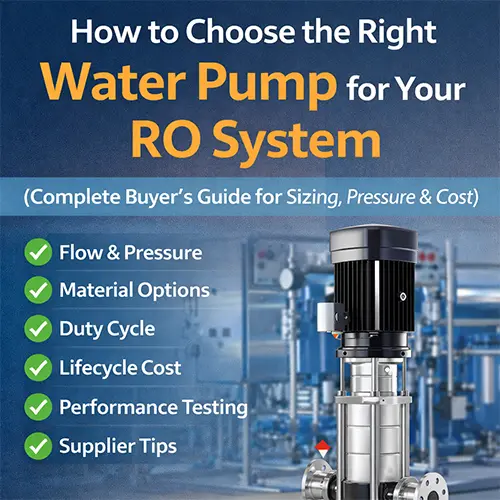
How to Choose the Right Water Pump for Your RO System
Introduction
Choosing the right water pump for your Reverse Osmosis (RO) system is one of the most important decisions in the whole water treatment process. Many buyers assume that if a pump can move water, it is good enough for an RO system. In practice, that is not true. In RO applications, the pump does much more than simply transport water from one point to another. It creates the pressure that allows water to pass through the membrane, and that pressure directly affects purified water output, salt rejection, membrane stability, energy consumption, and maintenance cost.
This is why two RO systems with the same nominal output may still require different pump selections. One system may run on low-TDS municipal water with short piping and stable inlet pressure. Another may run on groundwater with higher dissolved solids, longer pipe runs, more pressure loss, and a longer daily operating cycle. Even if both systems are described as “5 m³/h RO systems,” the correct pump may not be the same.
From a buyer’s perspective, the real goal is not simply to buy a pump. The real goal is to buy a pump that gives stable production, protects the membrane, keeps operating cost under control, and reduces the chance of repeated downtime. That is why pump selection should always be based on actual duty conditions, not only on price, brand, or motor power.
This guide is written for buyers, project engineers, plant managers, distributors, and commercial users who want to make a practical and technically sound decision. It is structured so that you can follow the selection logic step by step.
By the end of this article, you should be able to understand:
- what data you must collect before asking for a quotation,
- how to estimate required pump flow and pressure,
- why water quality changes pump selection,
- why two pumps with the same motor power can perform very differently,
- how to compare quotations professionally,
- and how to check after installation whether the pump was actually selected correctly.
Why Choosing the Wrong RO Pump Becomes Expensive Later
Many pump selection mistakes do not look serious at the beginning. The system may still start, water may still move, and the buyer may think the choice was acceptable. But over time, the wrong pump creates performance instability, higher maintenance frequency, and unnecessary operating cost.
The pump is the force that pushes feed water through the RO membrane. If it cannot maintain stable pressure at the required flow, the whole RO system starts to operate below design condition. In many projects, this does not show up as an immediate breakdown. Instead, it shows up as a series of smaller problems that gradually become expensive.
For example, a pump that is slightly undersized may still run, but it may never deliver stable pressure once filters begin to foul or inlet pressure drops slightly. This means the membrane receives less pressure than expected, product water flow falls, and salt rejection becomes less stable. The operator may first suspect the membrane, then the pretreatment system, and only later discover that the real problem started with poor pump selection.
A pump that is oversized can also create problems. Some buyers assume that choosing a larger pump is always safer. In reality, too much margin can create unnecessary power consumption, unstable throttling, higher internal stress, and more difficult control adjustment. In short, both undersizing and oversizing can become costly.
From a procurement point of view, the visible price of the pump is only one part of the total cost. The hidden cost usually comes from four areas:
- lost production because the system cannot maintain design output,
- increased membrane fouling or unstable rejection,
- more frequent seal, bearing, or motor-related issues,
- and higher electricity use over the life of the system.
That is why professional buyers do not ask only, “What is the cheapest pump?” They ask, “What pump can reliably hold the required duty point in this RO system over time?”
Before You Choose a Pump, Collect These 8 Site Parameters
A pump supplier cannot make a reliable recommendation if the basic operating conditions are unclear. If the input data is incomplete, the quotation is only an estimate, and the risk of mismatch becomes much higher.
Before selecting an RO pump, the buyer should gather the most important site information. This step is often skipped because people want a quick answer. But in reality, spending a few extra minutes on these inputs can prevent expensive mistakes later.
The most important site parameters are:
- Required RO output
This is the amount of purified water you need, usually expressed in LPH, GPH, or m³/h. This is the starting point of the whole selection process. - Daily operating hours
A system that runs 4 hours per day and a system that runs 20 hours per day do not place the same demand on the pump. Duty cycle affects reliability requirements, seal life expectations, and long-term cost. - Feed water source
Municipal water, groundwater, brackish water, and high-TDS water create different pressure and material requirements. - Feed water TDS or general water quality
Total Dissolved Solids (TDS) helps estimate how much operating pressure the RO membrane will need. - Available inlet pressure
If feed pressure is already low or unstable, the system may need a booster stage or a different pump arrangement. - Pipe distance and elevation difference
Longer pipes and vertical lift create extra head loss. Ignoring this can result in an undersized pump. - Power supply
Voltage, phase, and frequency all affect motor selection. A technically good pump is still the wrong pump if the motor does not match the site power. - Future expansion plan
If the customer expects capacity growth within the next 1–2 years, that may influence how much margin should be included.
If a buyer cannot collect all eight items immediately, the minimum practical set for a rough quotation is:
- required purified water output,
- water source,
- daily operating hours,
- and available power supply.
That is enough for an initial technical conversation, but it is still not enough for a final risk-free selection.
The most important point here is simple: pump selection starts with site conditions, not with catalog browsing.
Step 1 – Start With Required Water Output
The first real sizing step is to calculate how much purified water the RO system must produce during actual operating time. This sounds obvious, but many selection mistakes begin here.
A common buyer mistake is to focus on daily water demand without converting it into hourly demand. Pumps are selected for actual operating duty, not for a vague daily total.
Let us look at a simple example.
A factory needs 40 cubic meters of purified water per day.
The RO system will run 8 hours per day.
The calculation is:
Required RO output = Daily water demand ÷ Operating hours
Required RO output = 40 ÷ 8 = 5 m³/h
Now let us explain that in plain language.
This result means the RO system must be able to produce 5 cubic meters of purified water every hour while it is running. It does not mean the system can be selected as if it runs all day. If someone incorrectly divides by 24 hours, they would calculate only 1.67 m³/h, which would seriously undersize the whole system.
So this step is not just math. It is a way of converting the buyer’s business need into a real equipment requirement.
If you are discussing a pump with a supplier, do not say only, “I need 40 tons per day.” Also say, “The system runs 8 hours per day, so I need about 5 m³/h production during operation.” That gives the supplier a much more useful basis for selection.
Step 2 – Convert Product Water Output Into Pump Feed Flow
The pump does not only handle the final purified water volume. In RO systems, part of the feed water becomes product water, and part becomes concentrate or reject water. This means pump flow is usually higher than product water output.
The basic relationship is:
Feed flow = Product flow ÷ Recovery rate
Now let us apply that.
Suppose the required purified water output is 5 m³/h.
Suppose the system recovery rate is 65%.
The calculation becomes:
Feed flow = 5 ÷ 0.65 = 7.69 m³/h
Now let us explain what that means.
This does not mean the customer wants 7.69 m³/h of final purified water. It means the pump must feed approximately 7.69 cubic meters of raw water per hour into the RO process so that, after the membrane separates product and reject water, the system can still deliver 5 m³/h of purified water.
This is a very important distinction. If someone incorrectly selects the pump based only on product water output, the feed pump may be too small from the beginning.
The recovery rate itself must also be treated carefully. Buyers sometimes assume that a higher recovery rate is always better because it seems to reduce waste water. In practice, higher recovery often means the system is asking more from the membrane and feed conditions. If recovery is pushed too high, scaling risk and fouling tendency may increase. That is why the recovery value used in pump sizing should come from the actual membrane/system design, not from guesswork.
As a simple working rule:
- small and simple commercial systems may run at lower recovery,
- standard industrial systems may run at moderate recovery,
- optimized engineered systems may run higher, but only when the full design supports it.
So when you calculate feed flow, the number itself is only the first step. The more important question is whether the chosen recovery rate is realistic for the water quality and membrane arrangement.
Step 3 – Determine Required Pressure Based on Water Quality
Once feed flow is estimated, the next question is pressure. This is where many buyers begin to see why equal-capacity RO systems do not always use the same pump.
In RO applications, the membrane requires pressure to overcome osmotic resistance and produce purified water. The amount of pressure required depends heavily on feed water quality. Lower-TDS municipal water usually needs less pressure than higher-TDS groundwater or brackish water.
As a practical directional guide:
- municipal water RO systems often operate in a lower pressure range,
- low-TDS groundwater usually needs more than municipal water,
- higher-TDS groundwater needs still more,
- and brackish water RO systems typically need significantly higher pressure.
The reason is simple. As dissolved solids increase, the system needs more pressure to push water across the membrane effectively. If the pressure is too low for the water condition, several problems appear:
- product water output falls below target,
- salt rejection may worsen,
- recovery may become unstable,
- and the membrane operates less efficiently.
At the same time, pressure should not be treated as “the more the better.” If pressure is unnecessarily high, the system wastes energy, and components may experience more stress than needed. Good pump selection is not about maximizing pressure. It is about matching pressure to the real membrane and water requirement.
Let us put this into buyer language.
If two customers each say they need a 5 m³/h RO system, that does not mean they need the same pump. One customer may use clean city water and moderate operating hours. Another may use harder groundwater with higher TDS and a longer runtime. The second customer may need a pump with much higher head and a stronger long-term duty profile, even though the nominal system output is the same.
So at this stage, a buyer should ask not only, “How much water do I need?” but also, “What kind of water am I processing?”
Step 4 – Add System Losses, Not Just Membrane Pressure
A very common mistake is to size the pump only according to membrane operating pressure. But the pump must overcome not just the membrane requirement. It must also overcome the pressure losses created by the rest of the system.
These losses usually include:
- pretreatment filter pressure drop,
- cartridge filter resistance,
- pipe friction loss,
- valve losses,
- elevation or vertical lift,
- and a reasonable safety margin.
Let us look at a simple example.
Suppose the RO membrane duty requires 10 bar.
Pretreatment losses add 1 bar.
Pipe and valve losses add 0.8 bar.
A reasonable margin adds 0.5 bar.
The total becomes:
Total required pressure = 10 + 1 + 0.8 + 0.5 = 12.3 bar
Now let us explain that clearly.
The membrane itself may need only 10 bar to operate as designed, but the pump does not “see” only the membrane. The pump sees the whole hydraulic path. By the time water passes through filters, piping, bends, valves, and elevation changes, more pressure has been consumed. So if you choose a pump that can only just deliver 10 bar, the actual membrane may never receive the pressure it needs under real operating conditions.
This is exactly why some systems look correct on paper but perform badly on site.
From a practical procurement perspective, this means that a supplier quotation that says only “10 bar pump” may be misleading if it does not explain whether that value includes total system losses or only nominal membrane pressure.
So when reviewing a pump recommendation, always ask:
- Is this pressure based only on membrane duty?
- Or is it based on total system pressure requirement under real operation?
That question alone can prevent many sizing mistakes.
Why Two Pumps With the Same kW Can Perform Very Differently
One of the most common misunderstandings in pump purchasing is the belief that motor power alone tells you whether a pump is suitable. In RO systems, that approach is risky.
Two pumps can both use a 2.2 kW motor, but one may be suitable for high-flow, low-pressure transfer duty, while the other may be suitable for lower-flow, higher-pressure multistage RO duty. The motor power is the same, but the hydraulic behavior is not.
This happens because pump performance is influenced by more than motor size. Important differences include:
- the number of stages,
- impeller design,
- impeller diameter,
- hydraulic efficiency,
- casing design,
- and operating speed.
A single-stage transfer pump is usually designed to move a larger volume of water at lower head. That may work well for tank transfer or low-pressure circulation. But RO feed duty often requires the opposite balance: the system needs enough pressure to support membrane performance, even if the required flow is lower.
A multistage pump creates pressure by passing water through multiple impellers in sequence. That is why it is often used in commercial and industrial RO systems. It is not “better” in every application, but it is often more appropriate where higher head is needed.
So when a buyer receives two quotations and both mention the same kW, the correct response is not, “They are basically the same.” The correct response is, “What flow and pressure can each pump deliver at the required duty point?”
That is a much more meaningful comparison.
This is also why professional pump selection should always refer to the actual required duty point:
- required flow,
- required pressure,
- water condition,
- and expected operating pattern.
Motor power matters, but only after the hydraulic requirement has been matched correctly.
How to Read a Pump Curve (Simple Buyer Version)
Many buyers receive a pump quotation with a performance curve attached, but they do not know how to use it. This often leads to choosing pumps based only on model name, kW, or price. In reality, the pump curve is one of the most useful tools for verifying whether a pump is suitable for your RO system.
A pump curve shows how much flow and head (pressure) the pump can deliver under different operating points. It also helps identify whether the pump will run efficiently and stably at your required duty point.
What the Buyer Should Look At First
A standard pump curve normally contains:
- Horizontal axis = Flow rate
- Vertical axis = Head or pressure
- Efficiency zones
- Power consumption trend (sometimes shown)
- NPSH requirement (sometimes shown)
For most RO buyers, the first task is simple:
- Find your required flow rate.
- Find your required pressure/head.
- Check where those two values meet on the curve.
- See whether that point falls in a stable and efficient zone.
What Is a Good Duty Point?
A good operating point is usually somewhere near the middle of the curve, not at the extreme left or right side.
If the duty point is too far left:
- Flow may be too low
- Internal recirculation may increase
- Heat and vibration may rise
If the duty point is too far right:
- Pressure may collapse
- Motor load may rise
- Efficiency may drop
- Future fouling margin may disappear
Buyer-Level Practical Advice
If your supplier recommends a pump, ask them:
- Where is my duty point on the curve?
- What happens if filter pressure loss increases later?
- Do I still have pressure margin?
- Is this point near best efficiency zone?
These questions quickly show whether the recommendation is serious or generic.
Step 5 – Choose the Right Pump Type
Different pumps solve different problems. Buyers often compare pumps as if all pumps are interchangeable. They are not.
The correct pump type depends on what role the pump plays inside the RO system.
Booster Pump
A booster pump is usually selected when incoming water pressure is low or unstable.
Typical situations:
- Municipal pressure too weak
- High-rise building supply fluctuation
- Small commercial RO units needing stable inlet pressure
The purpose is not extreme pressure. The purpose is stable feed conditions.
Vertical Multistage Pump
This is one of the most common and practical choices for commercial and industrial RO feed duty.
Why it is popular:
- Can generate higher pressure efficiently
- Stable output for membrane feed
- Compact footprint
- Suitable for longer daily operation
For many B2B projects, this is often the safest starting direction. Buyers comparing engineered options frequently review solutions from liqen power.
End Suction Pump
Often used for:
- Raw water transfer
- Tank-to-tank transfer
- Pretreatment circulation
It can be an excellent pump in the correct role, but it is not always the best main RO pressure pump.
Diaphragm Pump
Usually found in:
- Small household RO systems
- Under-sink units
- Compact point-of-use systems
Not typically used for larger industrial continuous-duty RO feed applications.
How to Choose for 1000 LPH, 2000 LPH, and 5000 LPH RO Systems
Many buyers first ask by capacity size. That is normal. Capacity alone is not enough, but it is a practical starting point.
Below is a directional reference, not a final engineering guarantee.
1000 LPH RO System
Common uses:
- Restaurants
- Clinics
- Small workshops
- Light commercial sites
Typical starting direction:
- Smaller multistage pump
- Sometimes booster + RO feed arrangement
If feed water is clean municipal supply, pump demand may be modest. If groundwater is used, pressure demand may increase.
2000 LPH RO System
Common uses:
- Medium commercial sites
- Laundry operations
- Food preparation facilities
- Light industrial production
Typical starting direction:
- Stronger multistage pump
- More attention to pretreatment loss and runtime
At this size, buyers should begin thinking about lifecycle cost, not only purchase price.
5000 LPH RO System
Common uses:
- Factories
- Bottling support systems
- Production plants
- Larger facilities
Typical starting direction:
- Industrial multistage feed pump
- Stronger motor quality requirement
- Better seal system
- Spare parts planning
At this level, downtime can cost far more than the pump itself.
Important Reminder
A 1000 LPH city-water RO system and a 1000 LPH groundwater RO system may require different pumps. Capacity alone never tells the full story.
Lifecycle Cost: Cheap Pump vs Quality Pump
Lowest purchase price often creates the highest long-term cost. This is one of the most expensive misunderstandings in industrial procurement.
Many buyers compare only invoice price:
- Pump A = cheaper
- Pump B = more expensive
But the real comparison should be:
- energy use over time
- seal life
- maintenance frequency
- spare parts cost
- downtime risk
- replacement cycle
How Cheap Pumps Often Become Expensive
A low-cost pump may save money at purchase, but later create:
- lower hydraulic efficiency, causing higher electricity cost
- shorter seal life, causing leakage and service calls
- weaker bearings, causing vibration and shorter lifespan
- unstable pressure, affecting RO production
- slower spare parts support
How Quality Pumps Often Recover Cost
A better-engineered pump may cost more initially, but can reduce:
- power consumption
- emergency repairs
- production interruptions
- operator complaints
- early replacement cost
Practical Buyer Logic
If the RO system runs occasionally, purchase price may matter more.
If the RO system runs daily or continuously, lifecycle cost usually matters more than initial price.
Simple Rule
The more hours the pump runs, the more important efficiency and reliability become.
Step 6 – Choose the Right Material
Material choice should match water chemistry. Choosing by habit or lowest price often leads to corrosion problems later.
Common Material Logic
SS304 is commonly acceptable for cleaner treated water and moderate conditions.
SS316 is often preferred where chloride exposure or corrosion risk is higher.
Duplex or specialty alloys may be considered for aggressive conditions.
Buyer Perspective
If water quality is uncertain, it is often worth discussing risk rather than assuming the cheapest stainless grade is enough.
Real-World Example
A pump that costs slightly less in SS304 may become expensive if corrosion shortens service life.
Step 7 – Choose Based on Duty Cycle
How long the system runs each day should strongly influence pump choice.
A pump used one hour daily and a pump used twenty hours daily should not be purchased the same way.
Light Intermittent Use
Typical priority:
- lower capital cost
- simple replacement path
Medium Daily Use (8–12 hr/day)
Typical priority:
- balance price and durability
- reasonable efficiency
Heavy Use (16–24 hr/day)
Typical priority:
- seal quality
- bearing reliability
- motor efficiency
- stable continuous performance
Buyer Truth
In continuous-duty systems, a “cheap but replace often” strategy is usually false economy.
How to Compare Supplier Quotations Professionally
Price comparison without technical comparison creates risk.
Two quotations may look similar but be very different in real performance.
Ask Every Supplier These Questions
- What flow and pressure are guaranteed together?
- Is a pump curve included?
- What motor brand or efficiency class is used?
- What seal specification is included?
- Is the pump rated for continuous duty?
- What warranty is included?
- How fast are spare parts available?
- Are there similar RO project references?
Red Flags
Be cautious if a quote only shows:
- model number
- kW
- stainless steel grade
- price
That is not enough to judge suitability.
Smart Buyer Mindset
A useful quotation explains performance. A weak quotation only lists hardware.
Troubleshooting Low Pressure After Installation
Low pressure after startup does not automatically mean pump failure. Many low-pressure issues are caused by system conditions.
Common Causes
Low pressure immediately after startup
Possible reasons:
- wrong pump sizing
- wrong motor rotation
- air trapped in suction line
Pressure gradually drops over time
Possible reasons:
- clogged pretreatment filters
- suction blockage
- wear or internal damage
Noise plus low pressure
Possible reasons:
- cavitation
- air leakage
- poor suction conditions
Normal pressure but low water output
Possible reasons:
- membrane fouling
- wrong recovery setting
- downstream restriction
What Buyers Should Do First
- Check inlet pressure
- Check filter differential pressure
- Check leaks or air suction
- Confirm motor rotation
- Compare actual operating point with design target
After Installation, How to Confirm You Chose Correctly
The commissioning stage is where pump selection is proven right or wrong.
Good Signs
- Stable feed pressure
- Design water output achieved
- Normal motor current
- Low vibration
- No leakage
- Consistent product water quality
Warning Signs
- Pressure hunting
- Frequent trips
- High noise
- Excess current draw
- Output below target
Meaning
These symptoms do not always mean the pump itself is defective. They often indicate mismatch between selection, installation, or system condition.
Example Buyer Scenario
A food factory requires 5 m³/h purified water, operates 14 hours per day, and uses groundwater.
Step 1 – Required Feed Flow
Assume recovery = 65%
Explanation
To consistently produce 5 m³/h purified water, the RO system must receive approximately 7.69 m³/h feed water under operating conditions.
Step 2 – Pressure Target
Assume membrane and system losses require around 14 bar total pressure.
Step 3 – Selection Direction
A practical starting recommendation may be:
- SS316 multistage pump
- Continuous-duty motor
- Spare seal kit stocked
- Optional VFD if demand fluctuates
Why This Makes Sense
Groundwater may increase corrosion and pressure demands, while 14-hour daily operation increases the importance of reliability.
FAQ – How to Choose the Right Water Pump for Your RO System
These are common buyer concerns during sourcing.
What size pump do I need for a 1000 LPH RO system?
There is no universal answer. It depends on water quality, pressure target, recovery rate, and pipe losses. Many systems use smaller multistage solutions, but final duty point matters most.
Can a pump be too large?
Yes. Oversized pumps may waste energy and make pressure control less stable.
Why are two same-kW quotations different?
Because motor size is only one part of the system. Hydraulic design, efficiency, stage count, and seal quality may differ significantly.
Is SS304 enough for groundwater?
Sometimes yes, sometimes no. It depends on chloride level and corrosion risk.
Should I buy the cheapest quote?
Only if performance, support, and lifecycle cost are acceptable.
Is multistage always best?
Not always. But for many RO feed pressure duties, it is often a strong option.
Conclusion
The right RO pump should be selected using real operating conditions, not guesswork. Required output, recovery rate, pressure demand, water quality, runtime, and system losses all matter.
For light-duty systems, a simple booster solution may be enough. For commercial and industrial RO applications, a properly selected multistage pump is often the safer long-term path.
The smartest buyers compare total value, not only purchase price.
For project-ready RO pump solutions, reviewing engineered options from liqen power can help reduce selection risk and improve long-term reliability.
Get A Quote

Get A Quote
0 Comments