
What Is a Submersible Sewage Pump and How Do You Choose the Right One for Real Wastewater Systems?
Introduction
A submersible sewage pump is one of the most common pump types used in wastewater systems, but it is also one of the easiest to misunderstand. Many buyers know that it sits underwater and moves dirty water, yet that basic understanding is not enough to support a correct purchasing decision. In real projects, pump failure rarely happens because the concept of a submersible sewage pump is wrong. Failure happens because the pump was selected as if it were a standard water pump, while the fluid it actually handles behaves very differently from clean water.
Wastewater is not a stable medium. It may contain solids, fibers, grease, sludge, sand, food waste, plastics, wipes, and chemical contaminants. These materials do not simply flow through the pump. They interact with the impeller, the casing, the seal system, and the motor load over time. This is why a pump can appear to work during commissioning and still begin to fail a few weeks or months later. The system did not suddenly change. The true operating conditions were simply not understood from the beginning.
A good article on submersible sewage pumps therefore cannot start with troubleshooting alone. It must first explain how the pump works, where it is used, and why certain wastewater conditions lead to one pump design being reliable while another fails repeatedly. Only after that foundation is clear does it make sense to discuss selection logic, failure patterns, maintenance cost, and how to prevent repeated shutdowns.
This guide is written from the perspective of a buyer, engineer, and operator who needs to make practical decisions. It is not meant to describe the pump in generic terms. It is meant to help you understand what this pump actually does, where it belongs, how to choose it correctly, and how to avoid the hidden mistakes that turn a seemingly simple wastewater pump into a recurring cost.
How Does a Submersible Sewage Pump Work?
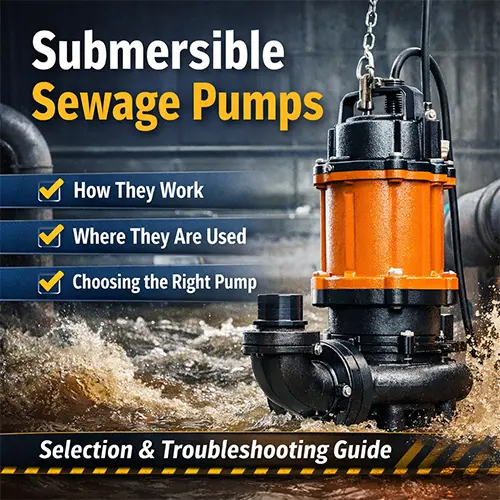
A submersible sewage pump works by operating directly inside the wastewater, using a sealed motor to drive an impeller that pushes sewage, solids, and suspended waste through the discharge line. Its advantage is not only that it removes suction problems, but that it can move contaminated liquid from pits, sumps, and lift stations where a dry-installed pump would be unreliable or impractical.
The most important thing to understand is that a submersible sewage pump does not “suck” water the way many non-specialists imagine. Like other centrifugal pumps, it creates flow by rotating an impeller. The impeller transfers kinetic energy to the fluid, and the pump casing converts part of that motion into pressure so the wastewater can be discharged through the piping system. The difference is that the entire pump, including the motor, operates below the liquid level. Because the pump is submerged, it does not depend on external priming or a stable suction lift condition.
That matters a great deal in sewage applications. In a dry-installed pump arrangement, a fluctuating liquid level or air entry in the suction line can cause priming failure, cavitation, and unstable operation. In a wastewater pit or lift station, those conditions are common. A submersible sewage pump eliminates much of that suction-side uncertainty because the liquid already surrounds the pump. The fluid enters directly, and the pump starts working as soon as the motor turns and the impeller begins moving the sewage.
However, that is only the hydraulic part of the story. What makes a sewage pump different from a normal submersible water pump is its ability to deal with contaminated fluid. Wastewater contains solids that can block narrow passages, fibers that can wrap around rotating parts, and grease that can accumulate gradually. This is why the impeller geometry, passage size, solids handling capability, and sealing design matter so much. In real operation, the pump is not simply moving liquid from point A to point B. It is continuously trying to maintain flow while resisting blockage, overheating, and wear.
Another point that buyers often overlook is cooling. In many submersible sewage pump designs, the surrounding liquid contributes to motor cooling. This is one reason dry running or insufficient submergence is so dangerous. The pump may continue running for a short time, but the thermal margin is reduced, and that creates a chain of risks involving overheating, seal damage, and eventual motor failure. This is why understanding the working principle is not just academic. It directly affects how the pump should be installed, controlled, and protected.
A useful practical definition is this: a submersible sewage pump is a sealed centrifugal pump designed to operate underwater while moving solids-bearing wastewater without relying on suction lift or external priming. That is the principle. Everything else, including selection and troubleshooting, grows from that fact.
If you want to better understand how a standard centrifugal pump behaves in a cleaner, more stable liquid system, it is useful to compare it with an end suction pump guide such as this one: End Suction Pump Guide: How to Choose, Use, and Troubleshoot It in Real Industrial Systems
Working principle comparison for quick scanning
| Item | Submersible Sewage Pump | Dry-Installed Pump |
| Pump position | Fully submerged in fluid | Installed outside the wet well |
| Priming requirement | No | Often yes or suction-dependent |
| Suction stability | High | Can be unstable |
| Best use case | Wastewater pits, lift stations, sewage sumps | Cleaner liquids with stable suction |
| Main advantage | Handles unstable levels and contaminated fluid | Easier access for maintenance |
Where Are Submersible Sewage Pumps Used?
Submersible sewage pumps are used in systems where wastewater must be lifted or transferred from below-grade locations and where the liquid contains solids, fibers, sludge, or debris. The exact application matters because each environment creates a different combination of clogging risk, chemical exposure, and maintenance difficulty.
The most familiar application is the municipal sewage lift station. In these systems, wastewater from homes, buildings, or local collection networks flows into a wet well, and the pump lifts it to a higher part of the sewer network or toward treatment infrastructure. Here the pump must deal with mixed domestic sewage, which often includes wipes, textiles, food particles, plastics, and suspended organic solids. This is one of the reasons why anti-clog design and impeller selection are so important in municipal systems. The pump may have enough hydraulic capacity, but if the solids behavior is not considered, clogging will dominate the maintenance pattern.
Another common application is commercial and residential building drainage. Basements, underground toilets, restaurants, apartment complexes, and hotels often need submersible sewage pumps because wastewater must be moved from a low point to a main sewer line located at a higher elevation. These systems can be deceptively difficult because the flow pattern is often intermittent rather than continuous. A pump may sit idle for long periods, then suddenly receive a high solids load. This stop-start behavior can increase the risk of clogging, overload, and thermal stress if the pump is not properly matched to the actual use pattern.
Industrial wastewater is a third important application. Food plants, textile facilities, chemical factories, paper mills, slaughterhouses, and process plants often generate wastewater that includes a combination of solids, fibers, fats, sludge, and chemicals. These systems are more challenging than domestic sewage because the fluid is less predictable and may introduce corrosion in addition to clogging. In this environment, buyers should never assume that a pump suitable for municipal sewage is automatically suitable for industrial wastewater. The material system, seal arrangement, and impeller design may need to change significantly.
Construction and temporary dewatering applications can also use submersible sewage pumps, especially where site water contains mud, debris, and suspended solids rather than clean groundwater. These are often treated as simple “dirty water” jobs, but if the fluid contains trash, cloth, plastic, or sticky contamination, pump selection can go wrong very quickly. The project may think it needs only a drainage pump, while in reality it needs sewage-style solids handling.
The best way to think about application scenarios is not by industry name alone, but by fluid behavior. If the system involves fluctuating levels, solids-bearing liquid, difficult suction conditions, and limited installation space, a submersible sewage pump becomes a strong candidate. If the liquid is relatively clean and suction conditions are stable, other pump types may be more economical. That is why application analysis must come before product choice.
Application comparison for fast scanning
| Application | Typical Wastewater Characteristics | Main Failure Risk | What the Pump Must Do Well |
| Municipal lift station | Mixed sewage, fibers, wipes | Repeated clogging | Pass solids and resist wrapping |
| Building basement sewage | Intermittent load, unstable level | Short cycling, clogging | Start reliably and clear the sump |
| Industrial wastewater | Solids + chemicals + grease | Corrosion plus blockage | Match material and impeller to fluid |
| Construction sump drainage | Dirty water, trash, debris | Unexpected blockage | Handle solids without losing stability |
| Food or restaurant drainage | Grease + organics | Adhesion buildup | Maintain flow under sticky conditions |
If your comparison involves more abrasive fluids with significant grit or solid wear, it also makes sense to compare against slurry-focused pumping logic rather than assuming every solids-bearing application is “sewage.” A useful reference point is a slurry pump guide such as this one: Slurry Pump Ultimate Guide: How to Select, Operate, and Troubleshoot It in Real Industrial Applications.
How Do You Know Whether a Submersible Sewage Pump Is the Right Choice?
A submersible sewage pump is the right choice when the system needs reliable below-grade pumping of solids-bearing wastewater and when reducing suction-side problems matters more than having a dry, easily accessible pump room. The wrong choice usually happens when the buyer focuses only on convenience or only on initial cost.
The first sign that a submersible sewage pump is appropriate is liquid level instability. When wastewater collects in a sump, pit, or lift station and the liquid level rises and falls, a submerged pump arrangement often offers the most reliable hydraulic behavior. This is especially true if the installation would otherwise require a difficult suction arrangement or repeated priming risk.
The second sign is solids content. If the wastewater contains solids, fibers, or sludge-like material, then a pump designed for clean water is already a risky choice. The point is not whether the pump can move the liquid once. The point is whether it can continue doing so repeatedly without clogging, overheating, or needing constant intervention.
The third sign is system simplicity. In many wastewater projects, especially retrofits or underground installations, the available space makes dry-installed pumps harder to arrange correctly. A submersible sewage pump allows the hydraulic section to sit directly in the fluid and can reduce civil complexity. That said, this installation advantage should not be confused with maintenance advantage. Submersible arrangements are often more compact in layout but less convenient in service access.
The wrong selection usually happens in one of three ways. The first is choosing a submersible sewage pump when the fluid is actually abrasive rather than sewage-like. In such cases, a slurry-oriented solution may be more appropriate. The second is choosing it when the fluid is relatively clean and the main reason is simply familiarity rather than real need. The third is selecting it for sewage duty but using the wrong impeller and materials, which means the pump type is right but the actual configuration is wrong.
A practical buyer rule is this: choose a submersible sewage pump when the system needs submerged operation and solids handling together. If you only need submerged operation but the fluid is clean, a different submersible pump may be enough. If you only need solids handling but have a stable dry installation and a very different fluid profile, another pump family may be more rational.
Quick decision table
| Your Real Condition | Is a Submersible Sewage Pump a Strong Fit? | Why |
| Fluctuating liquid level plus solids | Yes | Stable submerged intake and solids handling |
| Below-grade sewage pit | Yes | Compact and reliable for wet-well duty |
| Clean water with stable suction | Often no | A simpler pump may be more economical |
| Highly abrasive solids | Not always | Wear behavior may require slurry-oriented logic |
| Need easy dry access above all else | Maybe not | Dry-installed solutions may be easier to service |
How Should You Select a Submersible Sewage Pump?
Correct selection starts with the wastewater itself, then moves to solids behavior, impeller type, duty point, installation conditions, and maintenance strategy. Buyers who start with flow and head alone usually end up solving the wrong problem.
The first step is defining the wastewater properly. This sounds obvious, but it is where many bad decisions begin. A specification that says only “sewage” is not enough. You need to know whether the liquid contains wipes, fibers, grease, grit, sludge, food waste, or chemical contaminants. Those details directly influence clogging behavior, wear pattern, and seal risk. Without that information, pump selection is incomplete no matter how accurate the flow and head numbers appear.
The second step is understanding the failure risk you are trying to avoid. In some systems, the dominant problem is fibrous wrapping. In others, it is grease buildup. In others, it is abrasive grit or repeated thermal cycling. This is why pump selection is really failure-prevention selection. A buyer should not ask only which pump meets the duty. The better question is which pump design is least likely to fail in the way this wastewater tends to attack equipment.
The third step is impeller selection. This is one of the most important decisions in sewage pumping and one of the most misunderstood. A channel impeller can deliver relatively strong hydraulic efficiency, but it is more vulnerable in fibrous wastewater. A vortex impeller sacrifices some efficiency in exchange for better anti-clog performance in mixed solids service. A cutter system adds an active mechanism to deal with fibrous matter before it wraps around the impeller. None of these is universally best. The best choice depends on the wastewater profile, especially fiber content and blockage tendency.
The fourth step is duty-point evaluation. Even in sewage service, flow and head still matter. A pump that is too large may short-cycle or operate in an unstable region. A pump that is too small may run too long, overheat, or fail to clear the wet well properly. This is where hydraulic calculation still matters, but it must be done after solids behavior is understood, not instead of it.
The fifth step is installation review. Is the pump fully submerged during operation? Is there risk of dry running? Is the sump geometry creating dead zones where solids accumulate? Is the discharge piping adding unnecessary resistance? Is maintenance access realistic? These are not secondary details. In sewage systems, installation quality directly shapes reliability.
The sixth step is maintenance logic. The pump should be chosen with a realistic idea of how often it may need to be serviced, lifted, cleaned, or inspected. A pump that is technically acceptable but hard to service may become a poor commercial decision, especially in sites with limited labor or expensive downtime.
The table below is useful for quick comparison.
| Wastewater Condition | Main Risk | Preferred Pump Logic | What Not to Prioritize First |
| Fibrous sewage | Wrapping and clogging | Cutter or anti-clog design | Peak efficiency |
| Mixed municipal sewage | Partial blockage | Vortex or anti-clog design | Lowest price |
| Grease-heavy wastewater | Adhesion and buildup | Vortex plus good wet-well flow | Motor size alone |
| Grit-heavy wastewater | Abrasive wear | Wear-aware material selection | Standard sewage assumption |
| Relatively clean drainage | Low solids risk | Channel or simpler design | Overbuilt anti-clog features |
Selection priorities table
| Selection Step | What the Buyer Should Confirm | Why It Matters |
| 1 | Wastewater type | Determines likely failure mode |
| 2 | Solids and fiber content | Determines clogging behavior |
| 3 | Impeller concept | Determines whether the pump can stay clear |
| 4 | Flow and head | Determines hydraulic fit |
| 5 | Wet-well and installation condition | Determines stability in operation |
| 6 | Maintenance access and frequency | Determines real ownership cost |
A strong decision sentence here is: the right submersible sewage pump is the one that matches how the wastewater fails, not just how the system flows.
Why Do Submersible Sewage Pumps Fail Repeatedly?
Most repeated failures are not random and not brand-specific. They usually come from the same root causes: wrong impeller choice, incomplete wastewater analysis, poor installation conditions, or fixing the damaged component without fixing the reason it was damaged.
The most common failure pattern begins with partial clogging. Fibers or debris start collecting on the impeller or in the hydraulic passages. The pump still runs, so the site does not treat it as a serious issue. But flow begins to drop. Because the pump is moving less effectively, the motor load increases relative to useful output. Thermal stress builds, especially if the pump is also cycling often or operating near low submergence.
This increased stress affects the seal and motor over time. Once the seal degrades, moisture ingress becomes possible. At that point, what looked like a clogging problem becomes a motor problem. The final visible failure may be electrical, but the root cause was hydraulic.
Another common failure mechanism is incorrect installation. The pump may not remain sufficiently submerged, the sump geometry may encourage solids settlement, or the control levels may cause excessive starting and stopping. In these cases, the pump is not “bad.” The operating environment is forcing it into unstable behavior.
A third repeated-failure pattern comes from using a sewage pump in wastewater that is more abrasive or more chemically aggressive than assumed. The buyer may treat the application as ordinary sewage service, while the fluid behaves more like slurry or corrosive process waste. The result is rapid wear, seal attack, or unplanned maintenance intervals that seem unreasonable until the fluid is properly analyzed.
This is why changing brands without changing the decision logic rarely fixes the problem. If the same issue happens across multiple pumps, the cause is usually in the application or installation, not in the supplier logo.
A useful field rule is this: repeated pump failure usually means repeated selection failure, repeated installation failure, or repeated diagnosis failure.
Failure comparison table
| Visible Problem | What Many Users Assume | What Usually Caused It First |
| Motor burned | Motor quality issue | Long-term overload after flow loss |
| Seal leakage | Seal defect | Heat, unstable operation, or dry-running stress |
| Frequent trips | Electrical issue | Partial blockage or hydraulic instability |
| Repeated clogging | Poor product quality | Wrong impeller for wastewater |
| Fast wear | Bad material only | Wrong fluid classification or abrasive solids |
How Should You Diagnose, Fix, and Prevent Problems?
Good troubleshooting in sewage systems means following three steps in order: identify the real cause, correct the condition causing it, and then prevent the same condition from returning. Repair without diagnosis creates repeat failure.
The first step is diagnosis. Start with flow behavior, not the motor. Has the pump started taking longer to empty the pit? Has discharge performance weakened? Is the pump tripping more frequently? Has current draw increased? These are early signs that the hydraulic condition has changed. They usually appear before final failure.
The second step is inspection. Check the impeller for fiber wrapping, blockage, grease accumulation, or debris interference. Check the wet well for poor flow movement or settled solids. Check whether the pump is remaining properly submerged. Review whether the control logic is causing excessive starts. Only after this should you move into detailed seal or motor inspection.
The third step is correction. If the problem is fiber wrapping, cleaning alone is not enough if the wastewater will continue producing the same behavior. The correct fix may be changing the impeller concept. If the problem is overheating caused by low submergence, replacing the seal without correcting the level control will not solve it. If the problem is repeated clogging due to sump geometry, pump replacement alone may be ineffective.
The fourth step is prevention. This is where real cost savings happen. Preventive action might include switching to a cutter pump in fibrous wastewater, improving wet-well geometry, correcting level setpoints, reducing unnecessary starts, or changing material choices in chemically aggressive service.
The table below turns this into a practical guide.
| Observed Problem | Likely Root Cause | Correct Fix | Prevention |
| Low flow over time | Partial clogging | Clean and inspect impeller | Match impeller to wastewater |
| Frequent trips | Overload from blockage or unstable duty | Restore flow path and review duty | Improve selection and control logic |
| Seal leakage | Thermal stress, dry running, or vibration | Replace seal after fixing cause | Maintain submergence and stable operation |
| Repeated motor failure | Secondary effect of hydraulic problem | Diagnose upstream cause before replacement | Prevent clogging and overheating |
| Noise or unstable running | Intermittent blockage or hydraulic imbalance | Inspect solids interference and sump behavior | Improve wet-well flow and pump match |
Diagnosis sequence table
| Troubleshooting Step | What to Check First | Why This Order Matters |
| 1 | Flow change | Hydraulic problems often appear first |
| 2 | Current/load trend | Confirms whether resistance is rising |
| 3 | Impeller and passage condition | Shows direct clogging behavior |
| 4 | Wet-well level and cycling | Reveals thermal and control stress |
| 5 | Seal and motor condition | Confirms downstream damage |
A strong practical statement is this: do not repair the failed part first; repair the condition that made that part fail.
How Do You Compare Options Quickly as a Buyer?
Buyers often need a fast way to compare pump choices. The best way is not by horsepower or price first, but by matching pump type to the kind of wastewater problem the site actually has.
Use the table below as a scanning tool.
| Your Real Condition | Best Starting Choice | Why |
| Unstable wet-well level plus solids | Submersible sewage pump | Solves suction instability and solids handling together |
| Heavy fibers and wipes | Cutter-type sewage pump | Reduces wrapping and repeated clogging |
| Mixed municipal sewage with normal solids | Vortex or anti-clog sewage pump | Better clog tolerance |
| Relatively clean drainage water | Simpler submersible or channel design | No need to overbuild |
| Abrasive grit-heavy fluid | Slurry-aware logic or special material review | Standard sewage assumptions may fail |
This kind of scanning table is useful because many customers do not need a long theory before they know whether they are in the right category. They need a quick orientation first, then a deeper explanation second.
Buyer comparison table
| What the Buyer Is Focused On | What They Usually Compare First | What They Should Compare Instead |
| Low price | Quotation amount | Intervention frequency and downtime |
| Strong performance | Motor power | Wastewater match and clog resistance |
| Long life | Brand name | Failure mode match and installation stability |
| Easy maintenance | External appearance | Real service access and lifting frequency |
FAQ — Real Buyer Questions About Submersible Sewage Pumps
These are the questions real buyers and operators ask before purchase and after problems begin. The goal is not just to define the pump, but to reduce wrong decisions.
How do I know if I need a submersible sewage pump?
If your system has fluctuating liquid levels, below-grade collection, and solids-bearing wastewater, a submersible sewage pump is often the correct starting point.
What matters more, pump size or impeller type?
In real sewage applications, impeller type often matters more because it determines whether the pump will clog.
Why does my pump clog even though it is new?
Because clogging is usually a design-match issue, not a pump-age issue. A new pump with the wrong impeller can clog almost immediately in the wrong wastewater.
Why does my pump work at first and then fail later?
Because solids accumulate gradually. The pump may start in clean condition and then move into partial blockage, overload, and overheating over time.
Can I choose only by flow and head?
No. That is only part of the decision. Wastewater composition and blockage risk are equally important.
How do I reduce maintenance frequency?
Reduce clogging and unstable operation through correct impeller choice, better sump behavior, and better control logic.
Why does the motor burn out?
Often because clogging or reduced flow increased thermal stress long before the final electrical failure appeared.
What should I check before buying?
Wastewater type, solids content, fiber content, grease presence, submergence conditions, duty cycle, impeller type, and service access.
Is the cheaper pump a good choice?
Only if it also reduces intervention frequency. In sewage systems, the lowest purchase price often leads to higher total ownership cost.
Expanded FAQ quick-scan table
| Customer Concern | Short Answer |
| Frequent clogging | Usually impeller and wastewater mismatch |
| Repeated motor failure | Usually a secondary effect, not the root cause |
| Low maintenance goal | Prioritize clog resistance and correct selection |
| Budget pressure | Compare lifecycle cost, not purchase cost only |
| Not sure what pump type fits | Start with wastewater behavior, not model name |
Conclusion
A submersible sewage pump should not be selected as a generic wastewater product. It should be selected as a response to a specific fluid behavior and a specific installation condition. The pump must not only move sewage. It must continue moving it after fibers, grease, solids, and fluctuating wet-well conditions begin affecting the system.
That is why the right sequence matters. First understand the working principle. Then understand the application scenario. Then define the wastewater. Then choose the impeller and installation logic. Only after that should price comparison become important.
The strongest pump decision is not the one that looks best in the catalog. It is the one that prevents the most likely failure in your actual wastewater system.
Get A Quote

Get A Quote
0 Comments