
What Defines a Reliable Multistage Pump Manufacturer? Manufacturing Capabilities Behind Long-Term Pump Performance
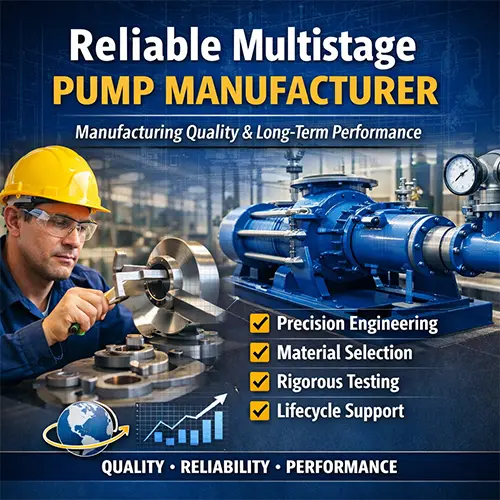
Introduction: Reliability Is Not a Specification — It Is a Manufacturing Outcome
In industrial applications, multistage pumps are selected for their ability to deliver high pressure, stable flow, and continuous operation. However, real-world performance often differs significantly from what is shown on datasheets.
Many pump-related failures do not originate from incorrect hydraulic calculations or insufficient head. Instead, they are frequently linked to manufacturing decisions that are invisible to buyers at the time of procurement.
This reality leads engineers, EPC contractors, and industrial buyers to a critical question:
What truly defines a reliable multistage pump manufacturer?
Reliability cannot be guaranteed by specifications, efficiency figures, or brand claims alone. It is the result of how a manufacturer designs, builds, tests, and supports multistage pumps throughout their operational life.
Definition: What Is a Reliable Multistage Pump Manufacturer?
In industrial applications, a reliable multistage pump manufacturer is defined not by catalog specifications or marketing positioning, but by the manufacturer’s ability to consistently deliver pumps that maintain stable hydraulic performance, mechanical integrity, and predictable lifecycle behavior under real operating conditions.
Reliability, in this context, is a manufacturing outcome, shaped by disciplined design validation, material selection, machining accuracy, assembly control, testing rigor, and continuous integration of field feedback.
1. Understanding Reliability in Multistage Pump Applications
Multistage pumps are typically deployed in applications where failure carries high operational or financial consequences, including:
-
Water supply and pressure boosting systems
-
Industrial and municipal water treatment
-
Boiler feed and energy systems
-
High-pressure process circulation
-
Long-distance fluid transfer
In these environments, reliability is not defined by short-term performance at commissioning, but by consistent operation over many years.
From an operational standpoint, reliability includes:
-
Stable hydraulic output across varying conditions
-
Predictable wear patterns
-
Controlled vibration behavior
-
Low frequency of unplanned shutdowns
A reliable multistage pump is one that continues to perform within acceptable limits long after installation, despite real-world deviations from design conditions.
2. Why Manufacturer Capability Matters More Than Pump Design Alone
The fundamental hydraulic principles of multistage pumps are widely understood across the industry. Most manufacturers can calculate stage count, impeller geometry, and shaft sizing correctly.
However, design knowledge alone does not ensure reliability.
The difference between reliable and unreliable pumps often lies in:
-
Manufacturing consistency
-
Quality control discipline
-
Material execution
-
Assembly accuracy
-
Validation and testing methodology
Two pumps produced from identical drawings can behave very differently in operation if manufactured under different process controls. This is why the manufacturer’s internal capabilities matter as much as the pump model itself.
3. Hydraulic Design Validation Beyond Basic Calculations
Reliable manufacturers treat hydraulic design as a validated system rather than a theoretical exercise.
Key practices include:
-
Use of proven hydraulic platforms with documented field performance
-
Performance mapping across a wide operating range
-
Internal prototype testing before full-scale production
-
Avoidance of overly aggressive efficiency tuning that compromises stability
Multistage pumps rarely operate at a single duty point. Changes in system demand often push pumps away from their best efficiency point. Manufacturers who design only for peak efficiency may deliver pumps that test well but degrade rapidly under real operating conditions.
Reliable manufacturers prioritize hydraulic stability and tolerance to operating variation, even at the cost of marginal efficiency on paper.
4. Material Selection as a Lifecycle Decision
Material selection is a central factor in long-term pump reliability.
Reliable manufacturers consider:
-
Fluid chemistry and corrosion risk
-
Operating temperature and pressure
-
Mechanical fatigue and stress cycles
-
Compatibility between wetted and structural components
Instead of offering a single default material, reliable manufacturers typically provide application-driven options such as:
-
Cast iron or ductile iron
-
Stainless steel variants
-
Duplex or high-alloy materials
-
Surface treatments and protective coatings
Material choice directly influences wear rates, maintenance frequency, and overall service life. It is therefore a lifecycle decision rather than a short-term cost consideration.
5. Manufacturing Precision and Dimensional Control
Multistage pumps rely on precise alignment across multiple stages. Small dimensional deviations can accumulate and lead to:
-
Increased vibration
-
Premature bearing failure
-
Seal leakage
-
Reduced hydraulic efficiency
Reliable manufacturers invest in:
-
High-precision CNC machining
-
Controlled tolerances for impellers and diffusers
-
Shaft straightness and dynamic balancing
-
Multi-stage dimensional inspection
This precision ensures that each stage performs as intended and that cumulative errors do not compromise long-term stability.
6. Assembly Discipline and Process Standardization
Assembly quality is one of the most underestimated contributors to pump reliability.
Reliable manufacturers implement:
-
Standardized assembly procedures
-
Trained and specialized technicians
-
Controlled torque application
-
Verification of axial and radial clearances
Because multistage pumps amplify assembly errors across stages, disciplined assembly processes significantly reduce variability between units and improve repeatability in field performance.
7. Testing and Validation as a Feedback Mechanism
Testing reveals a manufacturer’s true approach to reliability.
Beyond basic pass-or-fail testing, reliable manufacturers evaluate:
-
Performance stability across flow ranges
-
Vibration and noise behavior
-
Seal integrity under pressure
-
Thermal characteristics during operation
Some manufacturers conduct extended run tests or comparative performance analysis against baseline curves. Testing serves not only as quality assurance but as a feedback mechanism for continuous improvement.
8. Quality Management Systems and Traceability
Reliable manufacturers operate under structured quality management systems that go beyond formal certification.
Key elements include:
-
Traceability of critical components
-
Documentation of material batches
-
Inspection records at key manufacturing stages
-
Root-cause analysis for non-conformities
Traceability enables manufacturers to identify systemic issues, prevent recurrence, and continuously improve manufacturing reliability.
9. Field Feedback and Continuous Improvement
Reliability does not end when the pump leaves the factory.
Manufacturers with strong reliability performance actively collect feedback from:
-
End users
-
EPC contractors
-
Service teams
This data informs design updates, material improvements, and manufacturing refinements. Manufacturers who integrate field feedback evolve their products over time, while those who ignore it often repeat the same failures across projects.
10. Lifecycle Support as Part of Reliability
Reliable manufacturers view multistage pumps as long-term operational assets.
Lifecycle-oriented practices include:
-
Availability of spare parts
-
Clear maintenance documentation
-
Technical support during operation
-
Guidance on operating envelopes and system integration
This approach reduces operational risk for end users and supports sustained performance throughout the pump’s service life.
11. Common Misconceptions About Multistage Pump Reliability
Several misconceptions persist in pump procurement:
-
Higher efficiency always equals better reliability
-
Brand reputation alone guarantees performance
-
Standard models fit all applications
In reality, reliability depends on how well a pump is manufactured for its specific duty, not on marketing claims or isolated performance metrics.
12. Evaluating Manufacturers From a Buyer’s Perspective
Buyers evaluating multistage pump manufacturers should look beyond catalogs and ask:
-
How is manufacturing consistency controlled?
-
What testing is performed before shipment?
-
How are materials selected for specific applications?
-
How is field feedback integrated into product improvement?
These questions reveal far more about reliability than datasheet values alone.
Key Takeaways for Engineers and Industrial Buyers
-
Reliability in multistage pumps is not determined by specifications alone, but by manufacturing execution across design, machining, assembly, and testing.
-
Two pumps with similar designs can perform very differently due to differences in manufacturing precision and quality control.
-
Material selection and dimensional accuracy directly influence vibration behavior, wear rates, and long-term stability.
-
Factory testing is essential, but long-term reliability depends on how manufacturers incorporate field feedback.
-
Evaluating a multistage pump manufacturer requires understanding internal manufacturing capabilities, not just product data.
Frequently Asked Questions (FAQ)
The following questions address common concerns raised by engineers, EPC contractors, and industrial buyers when assessing multistage pump manufacturers and long-term operational reliability.
Why is manufacturer reliability more important than pump specifications?
Specifications describe ideal performance conditions, while reliability depends on how consistently a manufacturer executes design validation, manufacturing precision, assembly quality, testing discipline, and lifecycle support.
Do all multistage pump manufacturers follow the same quality standards?
No. While many manufacturers meet minimum standards, only some apply process-driven quality control consistently across design, manufacturing, assembly, and testing.
How does manufacturing precision affect pump lifespan?
Higher precision reduces vibration, uneven wear, and stress accumulation, extending bearing life, seal performance, and overall pump stability.
Is factory testing enough to guarantee long-term reliability?
Factory testing is necessary but not sufficient. Long-term reliability also depends on material behavior, assembly accuracy, operating conditions, and how field feedback is integrated into continuous improvement.
Why is field feedback important for pump manufacturers?
Field data reveals long-term performance trends that cannot be fully replicated during factory testing and helps manufacturers refine designs and manufacturing processes.
Conclusion: Reliability Is Built, Not Claimed
A reliable multistage pump is not defined by its datasheet alone. It is the outcome of disciplined design validation, controlled manufacturing, precise assembly, rigorous testing, and long-term support.
For industrial buyers and engineers, understanding what defines a reliable multistage pump manufacturer enables better procurement decisions and reduces long-term operational risk.
In multistage pump applications, reliability is not a feature.
It is a manufacturing philosophy expressed through every stage of production.
Get A Quote

Get A Quote
0 Comments